Revolutionizing Embodied Intelligence Through Scalable Data Collection
The Critical Role of Data in Embodied AI
In the realm of embodied intelligence, the consensus is clear: data is paramount. While large language models like OpenAI’s GPT have thrived on enormous text datasets, benefiting from the “scaling law” that links performance improvements to increased data and computational power, embodied AI faces a unique challenge. Unlike text, real-world interaction data for robots and humans is scarce and fragmented, making it difficult to reach the transformative performance leaps seen in language models.
Challenges in Gathering Real-World Interaction Data
This scarcity prompts essential questions: How can data be efficiently gathered? At what scale? And how can its quality be ensured? For companies developing embodied intelligence, these questions are not theoretical-they directly influence their ability to innovate and compete.
Lumos’ Innovative Approach to Data Acquisition
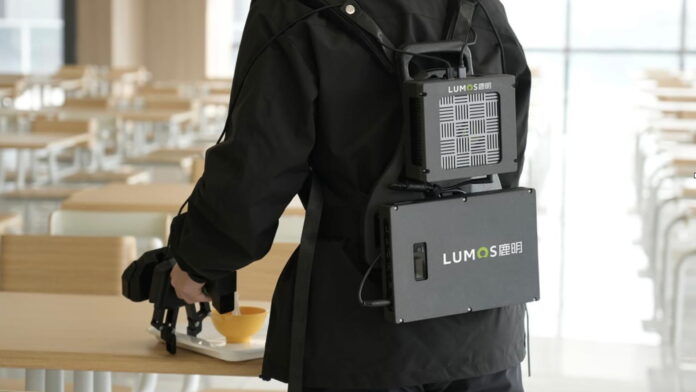
Founded in September 2024, Lumos Robotics has zeroed in on the foundational step of this process: data collection. The startup has introduced the FastUMI Pro, a backpack-style universal manipulation interface designed to capture diverse, high-quality operational data across multiple environments. Lumos plans to deploy 10,000 units in 2026, spanning industrial sites, residential homes, hotels, restaurants, shopping centers, and office spaces, aiming to amass a comprehensive dataset from real-world scenarios.
Understanding the Universal Manipulation Interface (UMI)
UMI, a concept developed collaboratively by researchers at Stanford, Columbia, and the Toyota Research Institute, offers a cost-effective framework for data collection and learning. Unlike traditional teleoperation, which ties data to specific robot hardware, UMI decouples the data acquisition system from the robot itself. This separation enables the collected data to be applicable across various robot designs, enhancing generalizability and reducing hardware dependency.
Efficiency Gains Over Traditional Teleoperation
At a recent press event, Lumos CEO Yu Chao highlighted the efficiency and cost benefits of FastUMI Pro compared to teleoperation. For example, folding clothes via teleoperation takes approximately 50 seconds and costs between RMB 3 to 5 (about USD 0.42 to 0.70). In contrast, FastUMI Pro accomplishes the same task in just 10 seconds at a cost below RMB 0.6 (USD 0.08), dramatically improving throughput while slashing expenses.
Leadership with Deep Industry Experience
Yu Chao brings extensive expertise from his previous role leading embodied robotics at Dreame, where he managed the development and mass production of Xiaomi’s CyberDog, delivering over 1,000 units. Co-CTO Ding Yan, an early advocate of UMI in China, has been instrumental in transitioning the framework from research to industrial application.
Scaling Data Production to Meet Future Demands
In 2025, Lumos established a dedicated data collection center capable of generating 100,000 hours of operational data annually. Yu projects that by 2026, cutting-edge embodied AI models will require at least one million hours of training data to reach their full potential. Lumos aims to meet this demand by expanding beyond centralized facilities to distributed data collection in everyday environments.
“Data for robot training shouldn’t be rare or prohibitively expensive. Humans constantly generate data through their daily physical interactions-it’s abundant but has yet to be systematically captured.”
FastUMI Pro: A Portable Data Collection Powerhouse
Designed as a wearable backpack, FastUMI Pro acts as a mobile, standardized workstation that translates real-world tasks into structured training datasets. Traditional embodied data collection often relies on controlled lab settings, resulting in repetitive and narrow datasets that limit a model’s ability to generalize. Lumos’ miniaturized toolkit aims to democratize data capture, enabling a richer variety of operational data from diverse contexts.
Targeting Diverse Real-World Environments
Lumos plans to gather data across six major sectors-industrial, residential, hospitality, food and beverage, retail, and office spaces-covering 30 distinct task categories. This approach is designed to build a multidimensional, structured dataset that reflects the complexity of real-world operations.
Integrated Data Collection, Training, and Deployment Loop
Central to Lumos’ methodology is a closed-loop system that connects data collection, model training, and deployment. For instance, their dual-arm robot Mos completed a full factory quality inspection cycle-including data gathering, policy training, and inference-in just five hours within a controlled environment. When deployed on-site in Hefei, the same process took seven hours, demonstrating the system’s adaptability to real-world conditions.
Introducing the “Data Supermarket” for Embodied AI
In addition to hardware, Lumos has launched a “data supermarket,” offering standardized dataset packages for purchase via their website. This initiative aims to make high-quality operational data more accessible to developers and researchers, fostering broader innovation in embodied AI.
Prioritizing Data Infrastructure Over Model Design
While many companies focus on refining model architectures, Lumos emphasizes the foundational importance of data pipelines. Co-CTO Ding Yan explains, “Although my background is in model training, we encountered a critical bottleneck: without a robust data pipeline-including production, evaluation, and filtering-building powerful models is impossible. That’s why we prioritized data infrastructure first.”
The Future of Embodied AI Hinges on Data Availability
Whether this data-centric approach will dominate as embodied AI matures remains to be seen. However, it is evident that the ceiling for embodied intelligence is directly tied to the volume and diversity of real-world operational data. If datasets become as standardized and readily available as hardware components, the barrier to training industry-grade models will significantly lower.
Lumos’ Vision: From Labs to the Real World
Lumos is betting that transitioning from centralized laboratories to thousands of backpack-mounted data collectors will dramatically increase the supply of operational data. With more abundant and standardized datasets, embodied AI systems could move beyond controlled demonstrations to perform routine, repeatable tasks reliably in everyday environments.