Scaling Robotics in Solar Panel Installation: From Pilot Tests to Utility-Scale Projects
Nick Hegeman, Chief Commercial Officer at Maximo, highlights that most robotic deployments in solar panel installation have so far been limited to small-scale trials. “Typically, these are lab environments or single-robot field tests, with installations ranging from a few hundred to about a thousand modules,” he explains.
Hegeman emphasizes that the true value of robotics emerges only when the entire project is executed using these systems. “This transition to full-scale deployment marks a pivotal milestone for us and reflects the broader industry’s growing confidence in robotics’ ability to operate effectively at scale,” he adds.
Technological Advancements Demonstrated at Bellefield
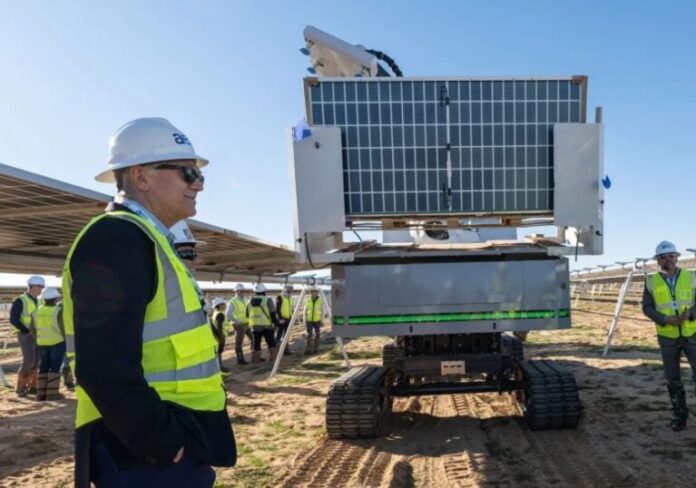
At the Bellefield solar project, Maximo introduced four distinct technological innovations within its robotic units. The current Maximo 3.0 robots have achieved impressive performance metrics, consistently installing over one solar module per minute. Installation teams have reached rates of up to 24 modules per shift hour per person, nearly doubling the productivity compared to conventional manual methods in the region.
Building on this success, Maximo is preparing to launch version 4.0, which promises substantial enhancements in installation speed and efficiency beyond the capabilities of the 3.0 model.
Integrating AI and Advanced Technologies in Solar Robotics
Maximo’s collaboration with technology leaders NVIDIA and Amazon Web Services (AWS) has been instrumental in advancing the AI and data infrastructure supporting their robotic systems. AWS has facilitated the development, deployment, and operational management of Maximo’s AI-driven field solutions. Meanwhile, NVIDIA’s AI infrastructure, Omniverse libraries, and Isaac Sim robotics simulation platform have been critical in refining and validating the robotic fleet used in California.
This synergy of AI, computer vision, robotics, and simulation-based engineering has accelerated development cycles, reduced validation times, and bolstered confidence in the robots’ field performance as deployment scales up.
Marc Spieler, Senior Director of Energy at NVIDIA, notes, “Physical AI is revolutionizing energy infrastructure by enabling faster, more reliable solar panel installations in complex environments through the integration of AI, simulation, and edge computing.”
Leveraging Data for Continuous Improvement and Adaptability
Data collected from large-scale projects like Bellefield-encompassing over 180,000 installation cycles-feeds into AI models that establish a comprehensive baseline. This data-driven approach allows Maximo to adapt quickly to different solar tracker and module designs, significantly shortening development timelines that previously spanned years for simple hardware changes.
Hegeman explains, “The continuous influx of operational data enables our robots to rapidly enhance their proficiency across diverse tasks, facilitating faster adoption and smoother transitions between projects.”
Modular Design Enables Seamless Scaling for Large-Scale Solar Farms
One of Maximo’s key advantages is its modular robotic system, which simplifies scaling from 500MW to 1GW installations by merely increasing the number of robots deployed. For example, the Bellefield project expanded from a single robot to a coordinated team of four units working simultaneously.
Hegeman identifies three primary benefits of robotic integration over traditional methods: consistent productivity across shifts, significantly reduced ramp-up times-from months to weeks-and more uniform output quality.
Importantly, robotics complements rather than replaces human labor. “Handling solar modules weighing between 75 to 100 pounds overhead for extended periods poses safety risks. Our robots mitigate these hazards, enhancing safety, efficiency, and project timelines,” Hegeman adds.
Emerging Trends in Solar Robotics and Workforce Integration
Advancements in user interfaces have made robotic systems more accessible, easing workforce training and adoption. Contrary to earlier assumptions, workers are embracing robotics enthusiastically, accelerating integration on construction sites.
As utility-scale solar projects grow in size and complexity, robotics adoption is becoming essential to meet tight installation schedules amid ongoing labor shortages.
Hegeman advises engineering, procurement, and construction (EPC) firms to initiate robotics integration early. “Each robotic solution introduces unique workflows that impact planning, production cadence, procurement, and logistics. Starting with one provider allows organizations to manage operational changes effectively before scaling up,” he explains.
The Future Outlook: Robotics Driving Solar Industry Growth
With the U.S. solar market poised for rapid expansion-EIA forecasts a record 43.3GW of utility-scale solar PV installations in 2024-robotics will play a critical role in meeting demand and securing tax incentives.
Hegeman concludes, “The gap between laboratory testing and real-world deployment is narrowing. Over the next 6 to 12 months, expect to see a significant increase in large-scale robotic solar installations, driven by the need for speed, safety, and reliability.”