
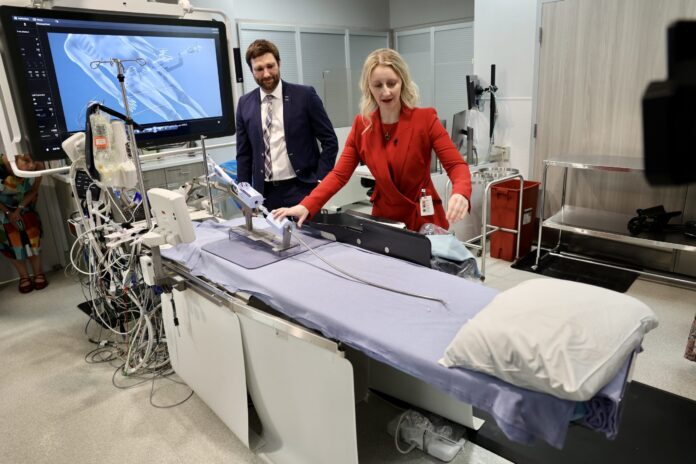
Photo courtesy of Saskatchewan Health Authority
Revolutionizing Epilepsy Treatment: Saskatchewan’s First Robotic Neurosurgery
At Royal University Hospital in Saskatoon, Jacky Willmek, a longtime resident and pharmacy assistant, is undergoing a groundbreaking procedure to pinpoint the origin of her seizures. Equipped with ten slender, flexible electrodes implanted within her skull, she remains connected to monitoring equipment, awaiting a seizure event that will enable precise brain mapping through advanced computer analysis.
Addressing Drug-Resistant Epilepsy with Cutting-Edge Technology
Willmek’s epilepsy has proven resistant to conventional medication, a challenge faced by nearly 4,000 individuals in Saskatchewan living with similar drug-resistant forms of the condition. This innovative, minimally invasive surgery-lasting approximately 90 minutes-utilizes a neurosurgical robot to implant ultra-thin electrodes, comparable in diameter to a blade of grass, into targeted brain regions. This procedure serves as a critical diagnostic step that may pave the way for a subsequent curative surgery.
Patient Experience: The Waiting Game and Support System
More than two weeks post-operation, with wires extending from the left side of her head, Willmek finds herself in a state of anticipation, hoping for a seizure to occur naturally so the electrodes can capture vital data. “It feels like I’m pressuring myself to have a seizure, even though I know it’s beyond my control,” she shared in a recent interview. Despite the challenges, she appreciates the proximity of loved ones, a factor that influenced her decision to remain in Saskatoon rather than transferring her care to Calgary. The local availability of this robotic technology, supported by a $1.2 million funding initiative launched in 2025, ensures timely treatment and the comfort of familiar faces during recovery.
Precision at Its Finest: The Role of Robotics in Neurosurgery
Willmek’s surgical team identified her seizures as originating predominantly from the left temporal lobe, making her an ideal candidate for this pioneering robotic approach. Neurosurgeon Dr. Amit Persad likens the robot’s accuracy to consistently hitting a bull’s-eye when placing electrodes. “Think of the electrodes as projectiles-we need to position them with exact precision. The robot guides us to the perfect angle and depth, ensuring we hit the target every time,” he explained.
Studies indicate that manual electrode placement is at least twice as prone to inaccuracies compared to robotic assistance, which can compromise imaging quality and elevate patient risk. Consequently, robotic guidance has become the standard practice within RUH’s seizure investigation unit. Saskatoon is among the mid-tier Canadian cities adopting this advanced technology, reflecting a growing national trend toward robotic neurosurgery.
Mapping Brain Activity: How Electrodes Guide Treatment
Once implanted, the electrodes-flexible wires only millimeters thick, each equipped with approximately ten contact points-monitor electrical activity within the brain. Dr. Alexandra Carter, director of the Saskatchewan Epilepsy Program, explains, “These electrodes are strategically positioned to capture signals from critical brain regions, enabling us to construct a detailed three-dimensional map of seizure origins.”
This comprehensive mapping is essential for planning further interventions, potentially leading to surgical removal of the seizure focus and improved patient outcomes.