
Subscribe to the Popular Science Daily Newsletter 💡
Stay updated with the latest breakthroughs, discoveries, and practical DIY tips delivered six days a week.
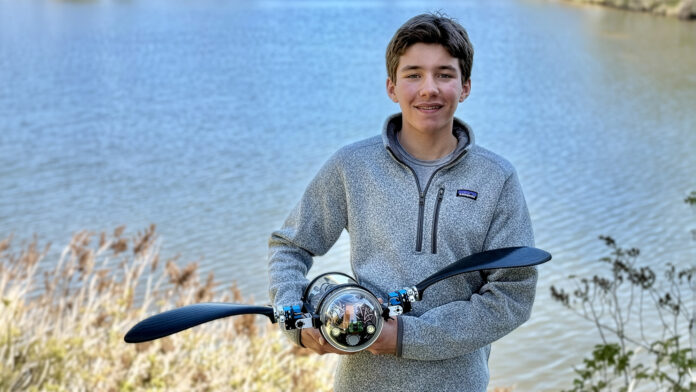
At just fifteen years old, Evan Budz, a high school student from Burlington, Ontario, found inspiration for an innovative project during a camping trip. An avid lover of outdoor activities such as hiking and canoeing, Evan was eager to contribute positively to environmental conservation efforts.
“My parents instilled in me the value of leaving every place I visit in a better state than I found it,” Evan explains. Spotting a snapping turtle gliding effortlessly in nearby waters sparked his imagination and motivated him to develop a robotic turtle designed to safeguard aquatic ecosystems.
Nature’s Influence: The Birth of a Robotic Turtle
“The snapping turtle’s smooth, fluid movements and its gentle interaction with the environment fascinated me,” Evan recalls. “I wanted to replicate its natural swimming mechanics in a robotic form.”
His creation emulates the graceful propulsion of a green sea turtle, integrating artificial intelligence to monitor underwater habitats for ecological threats such as invasive species and coral bleaching-an issue affecting over 75% of the world’s coral reefs as of 2024.
Unlike conventional underwater devices that often generate disruptive noise or high-pressure water jets harmful to marine life, Evan’s robot mimics the turtle’s natural swimming style, enabling it to collect critical environmental data without disturbing fragile ecosystems. “Protecting these habitats without causing harm is my top priority,” he emphasizes.
Designing and Constructing the Robotic Turtle
To bring his vision to life, Evan immersed himself in studying turtle locomotion. He analyzed videos of sea turtles swimming and consulted marine biologists at a local aquarium to understand how turtles use their front flippers for propulsion and rear flippers for steering.
Utilizing his skills in 3D modeling and electronics, he designed the prototype using SolidWorks, a sophisticated CAD and engineering software. He then fabricated the robot’s components with 3D printing technology.
The robotic turtle features four flippers: larger front ones for thrust and smaller rear ones for stability and maneuvering, mirroring real turtle anatomy. Its core is an acrylic tube housing electronic parts, including a Raspberry Pi microcomputer that runs AI algorithms to detect environmental hazards and transmit data. The robot is equipped with GPS for precise navigation along preset grid paths.
Additional sensors include a front-facing camera for visual monitoring, depth sensors, and environmental detectors capable of identifying microplastics and signs of coral bleaching.
Introducing BURT: The Bionic Underwater Robotic Turtle
Nicknamed BURT (Bionic Underwater Robotic Turtle), Evan’s invention maintains realistic body-to-flipper proportions but is scaled down for enhanced maneuverability. Weighing approximately 11 pounds, much of its mass is weighted metal to achieve neutral buoyancy, allowing it to dive and operate at various depths.
“To maintain neutral buoyancy, BURT’s weight must counteract the upward buoyant force,” Evan explains.
Powered by a lithium battery, BURT can swim continuously for up to eight hours, with an integrated solar panel extending its operational time. It cruises at about 0.5 miles per hour, the average speed of sea turtles, but its flipper stroke frequency can be adjusted to increase speed.
Most of BURT’s trials have taken place in Evan’s grandparents’ pool, where he created a simulated coral reef environment using 3D-printed models. The robot is programmed to recognize coral bleaching and invasive species, enabling it to navigate and monitor these conditions as it would in natural habitats.
BURT operates autonomously, following a predetermined search pattern without the need for tethers common in traditional underwater drones. Its front camera continuously scans the environment, feeding data back to the onboard Raspberry Pi. In tests, BURT has identified simulated coral bleaching with an impressive 96% accuracy rate.
Enhancing BURT with Advanced Technologies
Looking ahead, Evan plans to deploy BURT in diverse aquatic environments to explore its depth capabilities. To improve performance in low-visibility conditions, he has equipped the robot with front-facing lights and an ultrasonic transducer that uses high-frequency sound waves to detect obstacles.
In 2024, Evan also developed a holographic imaging system to capture detailed structural data of microscopic particles in water. This data is analyzed by a custom-trained neural network, which mimics human brain processing to accurately classify microplastics-a growing concern as over 8 million tons of plastic enter oceans annually.
Though initially a personal project, BURT has earned significant recognition, winning first place at the 2025 European Union Contest for Young Scientists and the prestigious Canada-Wide Science Fair, which draws finalists from a pool of approximately 25,000 participants.
Evan envisions deploying a fleet of robotic turtles like BURT to monitor and protect aquatic ecosystems worldwide. “I’ve focused on coral bleaching, invasive species, and microplastics so far, but the potential applications are vast,” he says.