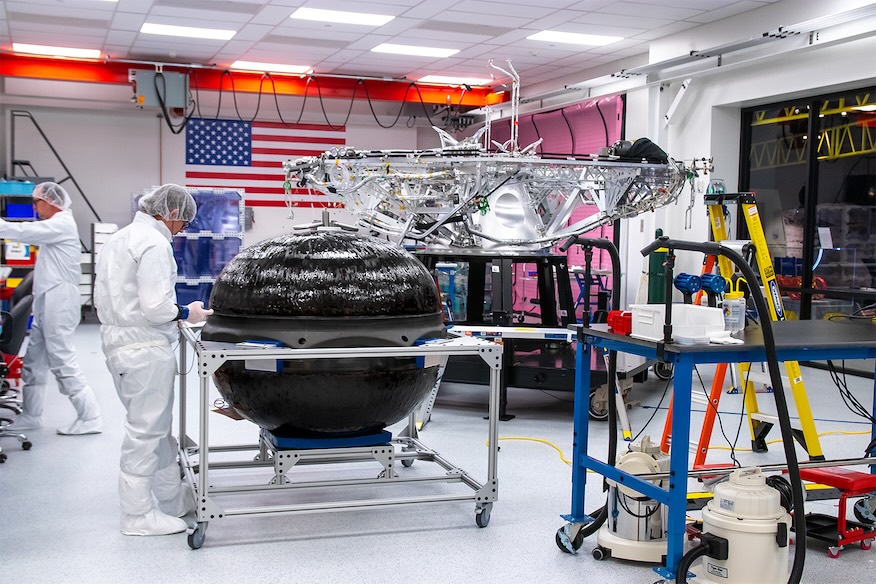
Astrobotic has announced a planned launch for its second lunar mission, targeting a July 2026 departure to the Moon’s surface.
The Pittsburgh-based aerospace company revealed that its Griffin Lander, a medium-class vehicle significantly larger than the Peregrine Lander launched in January 2024, will embark on this upcoming mission.
This endeavor is part of NASA’s Commercial Lunar Payload Services (CLPS) initiative, which facilitates the delivery of scientific instruments and technology demonstrations to the lunar surface. These missions are critical for advancing lunar knowledge and supporting NASA’s Artemis program, which aims to establish sustainable human presence on the Moon.
Progress and Preparations for Launch
Astrobotic has reached several key milestones en route to the Griffin-1 launch, including successful acceptance testing of its avionics flight hardware and conducting a comprehensive closed-loop simulation of the lander’s descent and touchdown sequence.
Following the completion of acceptance testing for its compact BEACON rover (Benchmark for Engineering and Autonomous Capabilities in Operations and Navigation) in July, the company is now utilizing a high-fidelity rover mockup, known as Flatsat, to conduct integrated mission training with its Canadian partner, Mission Control.
The Griffin-1 mission is scheduled to launch aboard a SpaceX Falcon Heavy rocket from Launch Complex 39A at NASA’s Kennedy Space Center in Florida, leveraging the heavy-lift capabilities of this proven launch vehicle.
Delays and Contract Evolution
The Griffin-1 mission timeline has been influenced by delays in Astrobotic’s earlier Peregrine lander project, initially slated for a 2021 launch on United Launch Alliance’s Vulcan rocket. These setbacks were largely due to developmental challenges with Blue Origin’s BE-4 engines, which power the Vulcan vehicle.
Originally, Griffin-1 was intended to carry NASA’s VIPER (Volatiles Investigating Polar Exploration Rover) to the Moon’s south pole. NASA awarded Astrobotic a $199.5 million contract in June 2020 to deliver VIPER by 2023. By May 2021, this contract value increased to $226.5 million, reflecting additional rover requirements that impacted its mass and design.
In April 2022, NASA’s Office of Inspector General reported that the Griffin lander and its four scientific instruments were progressing on schedule, with the mission targeting a November 2023 launch.
However, in July 2022, NASA announced a postponement of the mission to November 2024 to accommodate additional ground testing of the Griffin lander, which increased the mission cost to $320.4 million.
Subsequently, in July 2024, NASA decided to halt further development of the VIPER rover project, citing concerns that continued investment would escalate costs and jeopardize other CLPS missions. Despite this, Astrobotic was permitted to proceed with the Griffin-1 lander and seek alternative payloads, with the launch deferred to no earlier than fall 2025.
New Payload and Current Status
In February 2025, Venturi Astrolab’s FLEX Lunar Innovation Platform (FLIP) rover was selected as the primary payload for Griffin-1. This rover is designed to deliver scientific and commercial payloads on the lunar surface.
John Thornton, Astrobotic’s founder and CEO, emphasized the rigorous selection process for Griffin-1’s payload, highlighting the alignment of Astrolab’s vision with Astrobotic’s goal to make lunar exploration and commercial activities more accessible and impactful.
Currently, FLIP is undergoing thermal vacuum testing to simulate the harsh lunar environment, with core rover systems fully integrated. Astrolab plans to complete payload integration and vehicle-level protoqualification testing in the upcoming months.
Meanwhile, Griffin’s main structure is nearing completion, with critical components such as attitude control thrusters, solar arrays, ramps, and pressurant tanks undergoing final fit checks.