
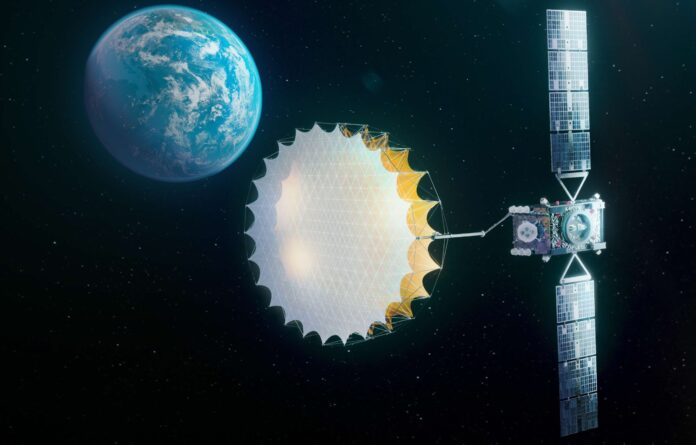
Beyond Gravity Advances Robotic Thruster-Pointing Arms for Swissto12’s GEO Satellites
Based in Tampa, Florida, Beyond Gravity has secured a significant contract to supply advanced robotic arm thruster-pointing mechanisms for Swissto12’s small satellites destined for geostationary orbit (GEO). These innovative systems are designed to enhance satellite maneuverability and operational efficiency in space.
Enhanced Multi-Axis Robotic Arms: The Appmax 3
The newly developed Appmax 3 robotic arms feature extended length and an expanded range of joint articulation compared to their predecessors, according to Wolfgang Pawlinetz, Vice President of Thermal and Mechanisms at Beyond Gravity, during a statement on September 26. Scheduled for delivery between 2026 and 2027, these multi-axis arms enable precise thruster orientation, facilitating flexible deployment and improved satellite control.
“Our Appmax 3 robotic arms provide a highly adaptable platform for positioning thrusters, which significantly optimizes fuel usage and reduces the number of thrusters required onboard,” Pawlinetz explained.
Advantages Over Fixed Thruster Systems
Unlike traditional fixed thrusters, the movable arms of the Appmax 3 system offer superior agility for orbit raising maneuvers and station-keeping tasks. This flexibility also simplifies operations around sensitive satellite components, such as solar arrays, by enabling precise positioning to avoid interference.
“The enhanced maneuverability of these arms facilitates easier deployment and collision avoidance near adjacent solar panel wings,” Pawlinetz added.
Balancing Design Considerations
Earlier iterations of Beyond Gravity’s thruster-pointing arms supported only a single thruster per arm, necessitating multiple arms for redundancy. The Appmax 3, tailored specifically for Swissto12’s HummingSat platform, is the first to accommodate two thrusters on a single arm, thereby reducing hardware complexity and mass.
However, this increased capability comes with a tradeoff: the Appmax 3 occupies more spacecraft surface area at launch compared to the more compact two-axis Appmax 2 system. Pawlinetz noted that integrating the Appmax 3 early in the satellite design phase can effectively mitigate this spatial challenge.
Contract Scope and Satellite Integration
While Pawlinetz withheld specifics regarding other clients or the exact number of Appmax 3 units included in the Swissto12 agreement, he confirmed the contract encompasses five satellites announced by Swissto12 for operators including Intelsat, Viasat, and Astrum Mobile.
The HummingSat platform, weighing approximately one metric ton, represents a new generation of compact GEO satellites that are significantly smaller than conventional multi-ton communication satellites. Its inaugural mission is slated for 2027 aboard Intelsat’s IS-45 satellite.
Beyond Gravity’s Global Reach and Additional Contributions
Headquartered in Switzerland like Swissto12, Beyond Gravity has delivered over 100 electric thruster pointing mechanisms to satellite manufacturers worldwide, underscoring its leadership in this niche market.
In addition to thruster arms, Beyond Gravity is supplying solar array drive mechanisms for Swissto12’s satellites. These components, manufactured in Zurich with sliprings produced in Nyon, are critical for ensuring optimal power generation once the satellites are operational in orbit.