China’s Humanoid Robot Revolution: From Soccer Fields to Everyday Life
Innovating on the Edge of Beijing: Robots That Play Soccer
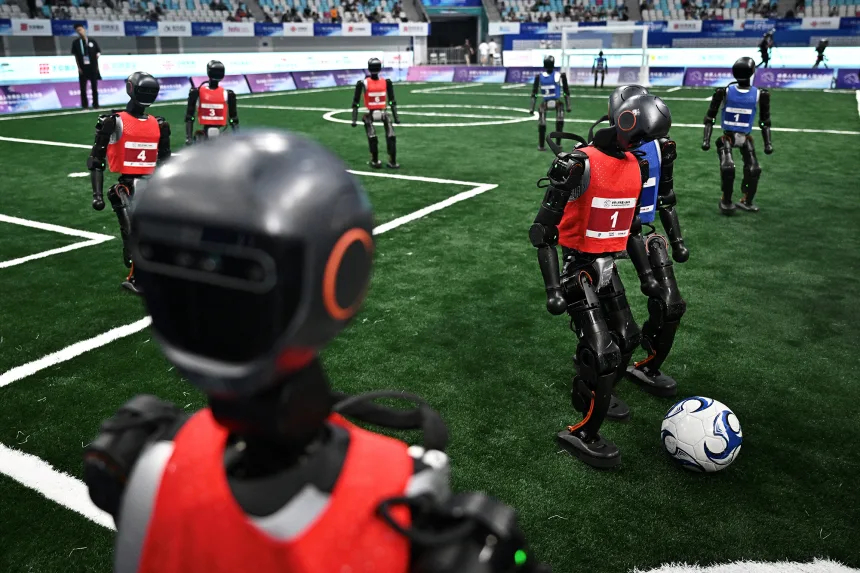
Just beyond Beijing’s bustling city limits, Cheng Hao, a dynamic 37-year-old entrepreneur, oversees a unique training ground: an indoor soccer field designed not for humans, but for humanoid robots. At his start-up, Booster Robotics, engineers harness artificial intelligence to teach these robots how to dribble, pass, shoot, and defend on the pitch, pushing the boundaries of robotic agility and teamwork.
Driving Forces Behind China’s Robotics Surge
Cheng’s venture, launched in 2023, was inspired by breakthroughs like Tesla’s Optimus humanoid and the advanced capabilities of ChatGPT-4. His ambition is clear: to create the world’s most sophisticated soccer-playing robots and dominate this emerging niche before expanding into broader markets. This vision aligns with China’s strategic push since 2015 to transform its manufacturing landscape by prioritizing robotics as a key industry, moving away from its image as the “world’s factory” reliant on cheap labor.
Currently, China boasts over 150 companies specializing in humanoid robotics, a figure that continues to grow as government support and private investment fuel innovation.
Sports as a Catalyst for Robotic Development
For many robotics start-ups, including Booster Robotics, sports serve as an ideal proving ground. The competitive environment allows developers to showcase their robots’ capabilities while refining technologies for practical applications. This trend sparked a surge in robot sporting events across China in 2025, featuring humanoid performances at the Spring Festival Gala, the country’s largest variety show, the first-ever robot half-marathon, and the inaugural World Humanoid Robot Games in Beijing. These events tested robots in soccer, boxing, martial arts, and more, drawing attention to the potential of humanoid machines.
Robotics and China’s Global Tech Ambitions
Humanoid robots have become a focal point in China’s technological rivalry with the United States and other global powers. Beyond the lucrative market prospects, these robots are seen as vital tools to address the challenges posed by China’s aging population and shrinking workforce, aiming to enhance productivity across industries.
Inside Booster Robotics’ Lab: Preparing for RoboCup
During a visit to Booster Robotics’ facility, engineers were meticulously calibrating their robots. One machine was suspended by cables, practicing jumps and landings to perfect balance, while another navigated a scaled-down soccer field, its movements carefully monitored and adjusted. The team was gearing up for RoboCup, an esteemed international competition that evaluates robots’ AI-driven soccer skills.
Soccer: The Ultimate Test for Humanoid Robots
Robot soccer has long been a benchmark for roboticists, dating back to the 1990s when the first RoboCup tournament was held in Nagoya, Japan. The sport demands a complex blend of abilities, including precise motion control, visual processing, spatial awareness, teamwork, and strategic thinking. Peter Stone, a former RoboCup president and computer science professor at the University of Texas at Austin, likens the challenge to monumental feats like the moon landing, emphasizing its role in driving scientific and engineering progress.
From Childhood Passion to Industry Leadership
Cheng’s fascination with soccer and robotics began in his youth, combining his love for the sport with his academic focus on robotic training. Today, he views robot soccer not as an end but as a testing platform. The technologies honed on the field are intended for future deployment in factories, homes, and other real-world environments.
Robot Sports: A Magnet for Investment and Public Interest
Robot sporting events have proven effective in attracting both media attention and financial backing. Booster Robotics’ June exhibition league, for example, was broadcast live by China’s state media and sponsored by diverse brands, from e-sports companies to children’s fitness centers. The event sold over 700 tickets at $15 each, demonstrating strong public enthusiasm. Shortly after winning the 2025 RoboCup championship in Brazil, Booster Robotics secured more than $14 million in Series A+ funding, underscoring the commercial potential of robot sports.
Cheng compares robot soccer to a Las Vegas show-entertaining yet lucrative-providing the resources needed to recruit talent and advance AI algorithms for practical applications.
Government’s Role in Accelerating Robotics Innovation
China’s government has been instrumental in propelling the robotics sector, mirroring its support for electric vehicles and other high-tech industries. Li Shi, Deputy Secretary-General of the Chinese Association of Automation, has overseen domestic robot sports for decades and notes the increasing involvement of municipal governments, especially in tech hubs like Beijing, Shanghai, and Shenzhen. This engagement includes substantial investments and widespread media coverage, which have significantly expanded the influence of robot sports.
In 2021, China unveiled a five-year plan offering financial incentives such as subsidies, tax breaks, and easier access to loans, aiming to foster self-reliance and technological breakthroughs in robotics. This strategic framework paved the way for the launch of the World Humanoid Robot Games in August 2025, co-hosted by Beijing’s government, CCTV, and the World Robot Cooperation Organization.
Showcasing Versatility: From Sports to Industrial Tasks
The World Humanoid Robot Games featured diverse competitions, including 100-meter relays, boxing, and soccer, alongside practical challenges like speed sorting in simulated factories and pharmacies. Over 300 companies from 16 countries participated, with Chinese firms dominating the field. Additionally, a robot half-marathon held in a local district attracted live broadcasts on multiple city screens, accompanied by pre-event showcases designed to draw investment.
Despite the heavy government involvement, industry leaders like Li emphasize the importance of achieving long-term sustainability without relying solely on state support.
Challenges on the Road to Human-Level Performance
Robotic athletes still face significant hurdles. At the World Humanoid Robot Games, incidents such as robots colliding with operators or referees, missed punches in boxing matches, and frequent falls on the soccer field highlighted ongoing technical limitations. However, these setbacks are viewed as valuable learning opportunities that drive iterative improvements in robot design and functionality.
Expanding Applications and Global Trends
In March 2025, China officially recognized “intelligent robots” in its annual government work report, signaling a commitment to accelerating their adoption. Companies like Leju and X-humanoid are already deploying robots in factories for material handling and sorting, while Unitree’s humanoids, known for their dancing and boxing, are also used in industrial inspections.
Worldwide, the focus of the humanoid robot industry is shifting from mere demonstrations of technical prowess to practical deployment. Morgan Stanley’s August 2025 research highlights this trend, noting increased efforts to integrate robots into logistics and other real-world scenarios. For example, Boston Dynamics and Tesla have tested their humanoids in factory environments. Elon Musk has even suggested that Tesla’s Optimus could serve as a “humane” crime deterrent by following individuals to prevent unlawful acts, a concept that has sparked debate over privacy and civil rights.
Bringing Humanoids into Everyday Life
Determined not to lag behind, Booster Robotics unveiled a child-sized humanoid robot in October 2025, designed for broader consumer use. Cheng described these machines as “intelligent agents” equipped with specialized skills, capable of serving as exercise companions, home tutors, or soccer players. Users can customize their functions, expanding their utility beyond entertainment.
As the market matures, Chinese start-ups are carving out unique niches to stand out in a crowded field, all aiming to persuade consumers to embrace humanoid robots.
Making Humanoids Accessible and Practical
At the product launch, a promotional offer priced the new robot at 29,900 yuan (approximately $4,200), significantly more affordable than Booster Robotics’ earlier soccer-focused models. This pricing strategy was met with enthusiastic applause, signaling strong market interest.
Cheng concluded his presentation with a visionary call: to make humanoid robots as straightforward, dependable, and useful as personal computers, envisioning a future where these machines become commonplace in households worldwide.