
(19659001)
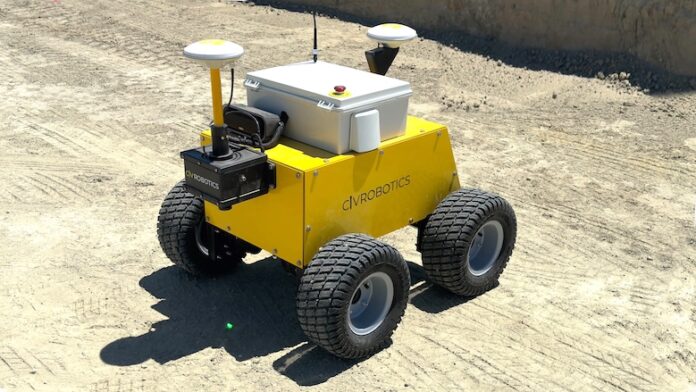
With minimal human supervision, the CivDot+ can autonomously mark layouts in large outdoor sites.
Photo by Civ Robotics.
San Francisco-based startup Civ Robotics, with an eye to expanding its product line beyond the outdoor surveying robot it already has, announced on July 1 that they had secured $7.5 million Series A funding in a round led AlleyCorp, with investments from Bobcat Co., and ff Venture Capital. This brings the company’s funds raised up to date to $12,5 million.
Civ Robotics’ small, wheeled outdoor layout robot called CivDot allows for automated layout with a high level of precision. This reduces the number of workers required to mark out sites. The company claims that the robot can mark layout points with an accuracy of 8 mm using spray paint onboard. A CivDot is rugged enough to work in bad weather and uneven terrain. It can mark up 3,000 points a day.
We have over 100 robots [out in the field] at the moment, mainly used in the renewable energies sector, oil and gasoline, highways, and airports,” said Tom Yeshurun. He is CEO and cofounder of Civ Robotics. Each robot uses an RTK receiver onboard connected to a base station nearby and onboard IMU sensor to precisely orient on project sites.
Yeshurun explains that CivDot robots can be used with existing popular survey software and equipment from Topcon Trimble and Leica. They do not need a BIM or any other complex design files in order to start the layout operation. When our customers use us the robot doesn’t really care what it marks. We are just providing a service.
Yeshurun notes, that although CivDot can generate an as-built with a topographical overlay while performing its layout activities many customers don’t want to do anything with this level of reality capture. They just want the layout completed. “Some absolutely love it [deliverable] while others don’t give a damn.”
Civ Robotics’ layout robots have been used in large installations for wind and solar as well as the oil and gas sector.
Photo courtesy Civ Robotics
One of Civ Robotics largest customers is contractor Bechtel, which has several of the CivDot robots. “On the utility-scale solar projects we work on, being able to save time while maintaining high standards is a godsend,” Kelley Brown, Bechtel’s principal vice president U.S. renewables, said in a statement about Civ Robotic’s latest funding round. “By improving our survey time sixfold, Civ Robotics has helped us keep our projects on schedule. We’ve relied on CivDot for four years so far and will continue to implement the bots across our organization.”
The new funding round is expected to boost Civ Robotics as the company is expanding its product line, Yeshurun says. The company plans to announce a new product related to jobsite autonomy later this summer.
While there are many companies bringing robotic autonomy to jobsite layout and outdoor surveying, Yeshurun says there are still many activities on the site beyond surveying that could be improved with greater automation and more consistent performance.
Yeshurun says contractors often don’t know who the equipment operator will be until the job starts, which can limit them from planning productivity. “ With the autonomy of [technology like] CivDots, [they] already know the level of productivity,” he adds.
Jeff Rubenstone is Deputy Editor for News and Technology at the Engineering News-Record. As news director of ENR he oversees the publication’s news coverage, and also covers emerging technologies and innovations in the construction space. With well over a decade of experience reporting on the industry, Jeff has a broad background in engineering and construction journalism. He is based in New York City.