How Robotics Are Revolutionizing European Warehousing: Decathlon’s Automation Success
Transforming Warehouses with Advanced Robotics
Decathlon, the world’s leading sporting goods retailer, has integrated robotic automation into seven of its European distribution centers, yielding impressive operational improvements. Partnering with Exotec, a French innovator in warehouse robotics, Decathlon has enhanced productivity across facilities in France, the UK, Portugal, Italy, and Germany.
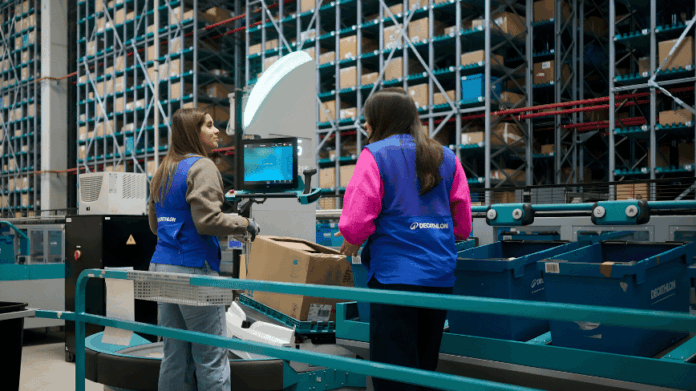
For instance, the Setúbal warehouse in Portugal now processes an astounding 114,000 orders daily-doubling its previous capacity of 57,000 before automation. Similarly, a French distribution center nearly doubled its store replenishment capability, increasing from 37 to 73 locations. In Northampton, England, warehouse workers have drastically reduced their daily walking distance from over 10 kilometers to less than one, while workplace incidents related to order picking have been cut in half, improving safety significantly.
Innovative Robotics: Beyond Humanoids
Unlike the humanoid robots often spotlighted in media, Exotec’s solution centers on its Skypod system-compact, wheeled robots about the size of a large robotic vacuum cleaner. These machines carry storage bins and can ascend specialized shelving units up to 14 meters high, efficiently retrieving and delivering hundreds of thousands of items daily. Typical Decathlon warehouses deploy between 150 and 200 Skypods, supported by automated depalletizers, carton openers, RFID scanning tunnels, and palletizers, all orchestrated by Exotec’s proprietary warehouse management software, Deepsky.
Maximizing Space Efficiency Through Vertical Storage
Romain Moulin, CEO and cofounder of Exotec, emphasizes that the key benefit lies not just in speed but in spatial density. Traditional warehouses limit shelving height to about two meters to accommodate human pickers, necessitating expansive floor areas-averaging around 18,000 square meters-to meet growing order volumes. Skypods, however, leverage vertical space by climbing racks up to 14 meters, enabling the same inventory volume to fit within approximately 6,000 square meters. This reduction in footprint allows retailers to either downsize to more cost-effective facilities or repurpose space for other operational needs.
For a global retailer like Decathlon, with over 1,800 stores and a workforce exceeding 100,000, this modular and scalable warehouse design offers a replicable model across diverse markets. Moulin notes that Exotec can deploy a fully automated warehouse in as little as four months, accelerating expansion and modernization efforts.
Impact on Workforce and Labor Dynamics
Automation inevitably raises concerns about the fate of warehouse employees. Exotec’s data provides insight: at one facility, the number of pickers decreased from 50 to 12 after Skypod implementation, with remaining staff reassigned to roles such as returns processing and equipment maintenance. Moulin frames this shift as an enhancement of working conditions rather than job loss-workers avoid exhausting daily treks of over 10 kilometers, injury rates have dropped, and increased throughput demands more personnel in other critical areas.
However, this transition also reflects a broader labor shortage crisis affecting warehouse logistics across Europe, the US, and Japan. Recruiting human pickers has become increasingly challenging, fueling demand for automation. The global warehouse robotics market, projected to reach $8.75 billion by 2026, is expanding at an annual rate exceeding 18%, driven largely by these workforce constraints.
Why Specialized Robots Trump Humanoids in Warehousing
While companies like BMW and Amazon experiment with humanoid robots for industrial tasks, Exotec’s CEO dismisses this approach for warehouse picking. He argues that humanoids tasked with pushing carts over long distances merely replicate the physical strain automation aims to eliminate. Instead, Exotec focuses on purpose-built robots optimized for specific functions, enhanced by AI for efficient routing, scheduling, and inventory control.
This pragmatic, specialized strategy exemplifies a distinctly European philosophy toward industrial robotics-prioritizing functionality and scalability over spectacle. Founded in 2015, Exotec achieved unicorn status in 2022 after raising $335 million at a $2 billion valuation, backed by investors including Goldman Sachs. The company now generates approximately €300 million annually, with its Skypod system deployed at over 200 sites worldwide, serving clients such as Uniqlo, Carrefour, Gap, and Geodis.
Decathlon’s Skyfleet Program: A Model for Future Retail Logistics?
Decathlon’s Skyfleet initiative represents Exotec’s most extensive multi-site automation rollout to date. Its success could set a precedent for how European retailers manage supply chains amid rising e-commerce demands and labor shortages. As the system scales, maintaining these productivity gains will be critical. For the 38 former pickers reassigned to new roles at one site, the benefits of automation are already tangible-improved safety, reduced physical strain, and engagement in higher-value tasks.