
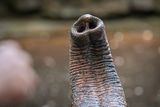
Elephants are often admired for their impressive trunks, but an overlooked feature contributing to their remarkable dexterity is their whiskers. These specialized hairs enable elephants to delicately grasp objects like peanuts without crushing them, showcasing a surprising level of tactile precision.
Previously, scientists assumed elephant whiskers functioned similarly to those of rodents-solid and independently movable. However, groundbreaking research from the Haptic Intelligence Department at the Max Planck Institute for Intelligent Systems (MPI-IS) reveals that elephant whiskers possess a far more intricate structure. This discovery is inspiring innovations in tactile robotics, where engineers seek to replicate the whiskers’ unique sensing capabilities.
Distinctive Structure of Elephant Whiskers
A recent study published in Science highlights that an elephant’s trunk is adorned with approximately 1,000 whiskers, which, once lost, rarely regenerate. These whiskers exhibit a remarkable material composition that compensates for the elephant’s thick skin, enhancing their sense of touch.
Unlike the uniformly stiff whiskers of mice and rats, elephant whiskers feature a gradient in stiffness: rigid at the base and gradually becoming soft and flexible toward the tip. This functional gradient allows elephants to navigate their environment without damaging their whiskers and to precisely detect contact points among the dense array of hairs. This adaptation is somewhat akin to the whiskers of cats, which also display a stiffness transition but differ in scale and function.
Implications for Robotics and Sensory Technology
Inspired by these findings, researchers at MPI-IS are exploring how the unique properties of elephant whiskers can be translated into advanced robotic sensors. By employing micro-CT scans and electron microscopy, the team examined a 5-centimeter elephant whisker and digitally shrank it to the nanoscale, revealing its blade-like shape with a hollow base and flattened cross-section. The internal structure resembles natural materials such as horse hooves or sheep horns, combining strength with lightness.
Further tests using a diamond indenter-comparable in size to a single cell-demonstrated that the whisker’s base is as hard as plastic, while the tip remains soft and pliable. This porosity reduces weight and prevents breakage during feeding, a crucial feature given the elephant’s need to handle delicate items like leaves or fruit without damage.
From Biological Insight to Engineering Innovation
To better understand the tactile advantages of this stiffness gradient, the researchers created a large-scale 3D-printed model dubbed the “whisker wand.” When tapping this model against various surfaces, the team could distinctly feel the difference between the soft tip and the rigid base, allowing them to pinpoint contact locations without visual cues.
Simulations confirmed that this gradient provides a natural “map” along the whisker’s length, enabling elephants to gauge the proximity and position of objects with remarkable accuracy. This phenomenon, known as embodied intelligence, integrates physical structure and sensory function seamlessly.
Looking ahead, the MPI-IS team aims to incorporate these biological principles into the design of next-generation tactile sensors for robots, potentially enhancing their ability to interact safely and effectively with delicate objects in complex environments.
Additional Insights on Elephant Behavior
Beyond their whiskers, elephants exhibit sophisticated behaviors such as using non-verbal gestures to communicate with humans and optimizing their travel routes to conserve energy during long migrations. These traits underscore the complexity of elephant intelligence and sensory adaptation.