Major Shift in Semiconductor Manufacturing: Tesla’s Ambitious Chip Fabrication Plan
Summary of Key Insights
- Tesla’s Bold Move into Chip Production: Elon Musk envisions a colossal semiconductor fabrication facility, dubbed a “Terafab,” capable of producing over 100,000 wafer starts monthly. This initiative aims to fuel Tesla’s expanding AI, autonomous driving, and robotics projects while reducing reliance on Nvidia and other suppliers.
- Intel’s Renewed Prospects: Rumors of collaboration with Tesla have invigorated Intel’s stock and could rejuvenate its foundry ambitions, positioning it as a stronger contender in the AI chip manufacturing arena.
- Vertical Integration Reimagined: Tesla’s in-house AI5 and AI6 chips reflect a return to the integrated design-and-manufacturing model reminiscent of Intel’s historic approach.
- Global Industry Impact: The establishment of Tesla’s Terafab could disrupt existing semiconductor hierarchies, shift supply chains toward the U.S., and potentially leave Europe trailing in advanced chip fabrication.
Revolutionizing Chip Production: From Gigafactories to Terafabs
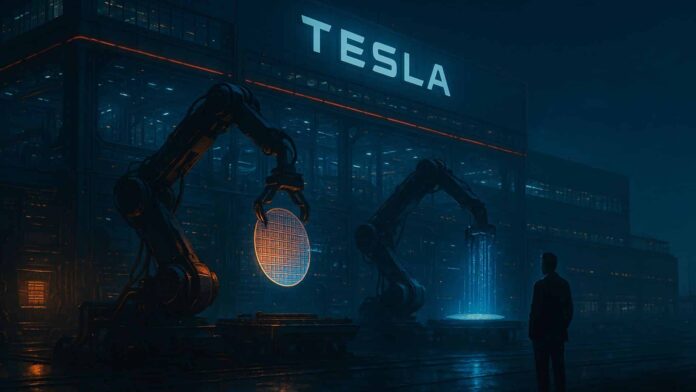
Tesla’s existing Gigafactories have set new benchmarks in battery manufacturing scale, but Musk’s vision extends far beyond. He proposes constructing a semiconductor fabrication plant of unprecedented scale-one that dwarfs current industry giants. This “Terafab” would produce AI chips at volumes exceeding 100,000 wafer starts per month, rivaling or surpassing the largest fabs operated by TSMC and Intel.
The rationale is clear: Tesla’s AI ecosystem, encompassing autonomous vehicles, humanoid robots, and the Dojo supercomputer, demands an extraordinary volume of custom chips. Musk has openly stated that even if suppliers like TSMC and Samsung maximize their output, Tesla’s ambitions will outpace their capacity.
Recent developments, such as Nvidia’s announcement of advanced AI chip wafers manufactured domestically in the U.S., signal a broader shift in semiconductor supply chain control. Tesla’s Terafab could accelerate this trend, emphasizing domestic production and vertical integration.
AI5 and AI6: Tesla’s Next-Generation Custom Chips
At the heart of Tesla’s chip strategy lies the AI5 processor, designed to power Full Self-Driving capabilities and future robotics applications. Initial limited production is slated for 2026, with mass manufacturing expected by 2027.
Looking further ahead, Tesla plans to introduce the AI6 chip, which promises to double the AI5’s performance while utilizing the same fabrication facilities. This next-gen chip is targeted for production around mid-2028.
Musk claims these chips will be significantly more energy-efficient and cost-effective than competitors’ offerings-consuming roughly one-third the power of Nvidia’s flagship Blackwell chip and costing only 10% as much to produce. If realized, this could redefine industry standards for chip efficiency and affordability.
Implications for the Semiconductor Industry
The global semiconductor market is currently dominated by a handful of foundries, including TSMC and Intel, which manufacture the majority of advanced processors. Most leading chip designers, such as Apple, AMD, and Nvidia, outsource production to these foundries.
Tesla’s move to combine chip design and manufacturing under one roof challenges this status quo. Vertical integration at this scale has been rare since Intel’s heyday decades ago, as operating fabs is capital-intensive and complex.
By controlling both design and fabrication, Tesla could reduce dependency on external suppliers, potentially disrupting the market dynamics and threatening the dominance of established foundries.
Intel’s Potential Role in Tesla’s Semiconductor Ambitions
Elon Musk’s mention of possible collaboration with Intel sparked a 4% surge in Intel’s stock, reflecting investor optimism. Intel, which has struggled to attract foundry clients despite heavy investments in U.S.-based fabs, could benefit significantly from a partnership with Tesla.
The U.S. government’s recent 10% investment in Intel aims to bolster domestic chip manufacturing and reduce reliance on Asian supply chains. A Tesla-Intel alliance would validate this strategy, though the exact nature of their cooperation remains uncertain-ranging from joint manufacturing development to temporary fab space leasing.
Global Semiconductor Landscape: A Potential Earthquake
Tesla’s Terafab could trigger profound shifts beyond the U.S. Semiconductor supply chains, already strained by recent U.S. export restrictions on AI chips, are undergoing realignment. Chinese firms are accelerating domestic innovation to reduce dependency on foreign suppliers.
Should Tesla succeed, TSMC and Samsung might lose significant business from one of the most innovative AI chip designers. This vertical integration model could inspire other tech giants-such as Apple or OpenAI-to pursue similar strategies, gradually eroding the dominance of contract foundries.
Consequences for Startups and the Broader Tech Ecosystem
While Tesla’s fab could increase global chip supply and drive down costs in the long term, the immediate effect might be tighter manufacturing capacity. Tesla may prioritize its own chip needs, limiting access for smaller AI startups already facing GPU shortages for training models.
Moreover, Tesla’s fab will require top-tier engineers and technicians, potentially drawing talent away from other semiconductor companies and intensifying the industry’s existing labor shortages.
Europe’s Semiconductor Ambitions in the Shadow of Tesla’s Terafab
Europe’s semiconductor initiatives, including the EU Chips Act, aim to boost regional chip production but have yet to yield large-scale advanced fabs. Most European efforts focus on mid-range and specialty chips rather than cutting-edge AI processors.
If Tesla’s Terafab materializes, it could further marginalize Europe’s position in the global chip race, leaving the most advanced manufacturing concentrated in the U.S. and Asia. This scenario poses challenges for European automakers like Mercedes, Volkswagen, and BMW, who may become reliant on American-made AI chips.
Challenges and Prospects: Can Tesla Deliver?
Constructing and operating a semiconductor fab is an extraordinarily complex and costly endeavor. Maintaining ultra-clean environments and managing billion-dollar equipment surpass the challenges of automotive or rocket manufacturing.
Nonetheless, Musk’s track record of meeting ambitious deadlines and his commitment to vertical integration-evident in SpaceX’s success-suggest Tesla could overcome these hurdles. If Tesla launches its Terafab by 2027, it would not only supply its AI ecosystem but also emerge as a formidable player in chip manufacturing.
Regardless of the outcome, Tesla’s entry signals a tectonic shift in the semiconductor industry, compelling established players to prepare for a transformed competitive landscape.