FieldAI Secures $405 Million to Revolutionize Robotics with Advanced Physical AI
Overview of the Funding Milestone
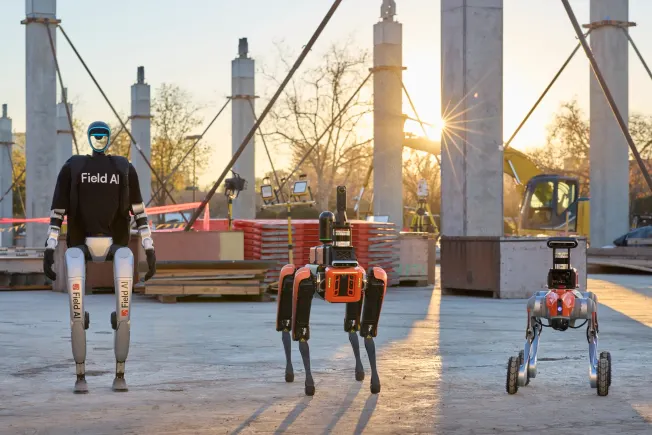
Irvine-based startup FieldAI, specializing in physical artificial intelligence (AI) for robotic systems, recently announced a significant capital raise totaling $405 million through two funding rounds as of August 20. This influx of investment has propelled the company’s valuation to an impressive $2 billion. FieldAI’s innovative technology enables robots to operate safely and reliably in unpredictable, dynamic environments-without relying on pre-existing maps, GPS, or fixed routes-making it a game-changer for industries requiring adaptable automation.
Deployments and Market Adoption
FieldAI’s “single software-brain” platform has been implemented across hundreds of industrial sites in the United States and Europe, including numerous construction locations. The company’s recent funding round was oversubscribed, reflecting strong market demand and rapid adoption of its versatile robotics intelligence solutions. This surge in interest underscores the growing appetite among builders and industrial operators for proven, scalable robotic technologies that can seamlessly integrate into complex job sites.
Industry Insights and Strategic Partnerships
Kaushal Diwan, Corporate Director for Strategic Investments and Partnerships at WND Ventures-the venture capital division of DPR Construction-highlighted that FieldAI’s funding success signals a broader trend of increasing investment in construction robotics. While WND Ventures is not a direct investor in FieldAI, DPR Construction has collaborated with the startup on proof-of-concept trials at its project sites. Diwan emphasized that AI is accelerating the transition of robots from single-task machines to dynamic, multi-functional operators, a shift that demands substantial investor commitment.
Innovative Technology: Field Foundation Models
At the core of FieldAI’s platform are its proprietary Field Foundation Models (FFMs), which prioritize physical intelligence and real-world constraints. Unlike traditional language or vision models adapted for robotics, these FFMs are designed from the ground up to handle uncertainty, risk, and physical limitations inherent in real environments. CEO and founder Ali Agha explained that instead of retrofitting large language and visual models-often plagued by inaccuracies and “hallucinations”-FieldAI’s architecture is inherently risk-aware, ensuring safer and more reliable robotic behavior.
Real-Time Data Integration and Industry Impact
FieldAI’s technology excels at capturing real-time data on construction sites, enabling the generation of precise building information models (BIMs). The construction sector has long debated the role of robots, especially humanoid types, in augmenting human labor. Investor interest reflects this momentum: according to a recent report by Nymbl Ventures, a Chicago-based VC firm, approximately 55% of the $3.55 billion invested in construction technology during Q1 2025 was allocated to next-generation robotics and AI-driven solutions.
Challenges in Robotics Adoption
Despite positive industry sentiment, actual deployment of robotics in construction has experienced some setbacks. Research from BuiltWorlds, a Chicago-based analytics platform, indicates a decline in active robotics use among contractors-from 65% in 2024 to 46% in 2025-even as favorable evaluations of robotic equipment surged from 74% to 95%. This suggests that while enthusiasm for robotics is high, practical integration and sustained usage remain challenging.
Notable Investors and Future Plans
FieldAI’s investor roster includes prominent names such as Bezos Expeditions (the private investment arm of Amazon founder Jeff Bezos), Intel Capital, NVIDIA’s venture arm NVentures, Gates Frontier (founded by Microsoft co-founder Bill Gates), and Samsung. With the fresh capital, FieldAI aims to accelerate its global expansion, enhance product development focused on robotic locomotion and manipulation, and strategically grow its workforce-targeting a doubling of its team size by the end of the year.