Get the Popular Science Daily Newsletter
Breakthroughs and DIY tips are sent every weekday.
On June 22, 2010, the American tennis player John Isner started a grueling Wimbledon game against Frenchman Nicolas Mahut. This match would become the longest ever.
The longest marathon in sport’s historyThe marathon battle lasted three days and 11 hours. Isner won the fifth set 70-68, but some in the crowd wondered half-jokingly if the two men would be stuck on the court for eternity.
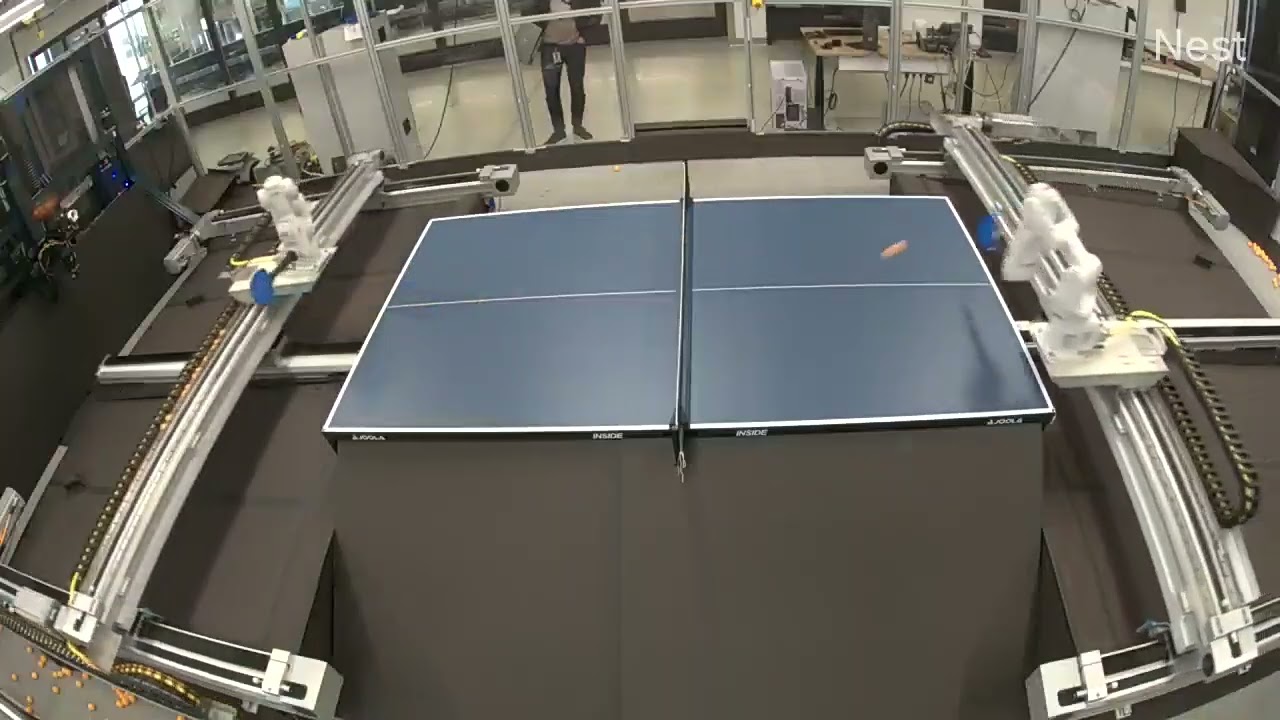
At Google DeepMind, a similar skirmish with rackets that seems to go on forever is taking place just an hour south of the All England Club. DeepMind, a company known for its AI models that outperform the best human players in Goand chess, now has two robotic arms engaged.
Table tennis game that never endsThis ongoing research project began in 2022 with the goal that both robots would learn from each other by competing. Each robotic arm uses AI models in order to improve and change strategies, just as Isner adapted his game over time to beat Mahut.
Unlike the Wimbledon example, the robots cannot reach a final score to end their slugfest. They continue to compete forever, improving with every swing. While the robotic arms are
They are easily beatenby advanced human players, but they have been shown to be superior against beginners. Researchers say that robots are roughly 50/50 against intermediate players. This puts them at a level “solidly amateur human performance.”
Meet our AI-powered table tennis robot.This is the first agent that has achieved amateur human-level performance in this sport. Here’s how the system works.
pic.twitter.com/AxwbRQwYiB— Google DeepMind (@GoogleDeepMind)
August 8, 2024 (19659009) All of this was noted by two researchers this week.
TheIEEE Spectrum blog is being done to create an advanced, general purpose AI model that can serve as the “brains’ of humanoid robotics that will interact with humans in real-world factories and homes. Researchers at DeepMind, and elsewhere, are hopeful that if scaled-up, this learning method could spark a ”
ChatGPT moment” for robotics–fast-tracking the field from stumbling, awkward hunks of metal to truly useful assistants.We are optimistic that research in this area will lead to more adaptable machines capable of learning the diverse skills required to operate safely and effectively in our unstructured environment,” DeepMind Senior Staff Engineer Pannag Sanketi, and Arizona State University professor Heni Ben-Amor write in IEEE Spectrum
Related to: [Robots can now understand us with the help of the web]
How DeepMind trained the table tennis robot
Initially, the inspiration for the racket swinging robots was a desire to find a better and more scalable way to train robots to complete multiple types of tasks. While Boston Dynamics’ Atlas has been able perform acrobatic feats that are awe-inspiring for more than a decade, most of these feats were scripted by engineers and the result meticulous coding and tuning. This approach is great for a demo or a limited use case, but fails when designing a robot to work with people in dynamic environments such as warehouses. In these settings, it is not enough for a robotic system to know how to load boxes onto crates. It must also be able to adapt to the people and an environment that constantly introduces new and unpredictable variables. Table tennis is a great way to test this unpredictability. Since the 1980s, robotics researchers have used table tennis as a benchmark because it combines speed with responsiveness and strategy. To be successful in the sport, players must master a variety of skills. They need to have fine motor control, and good perceptual skills, in order to track and intercept the ball, even when it is coming at them with different speeds and spins. They also need to make strategic decisions on how to best outplay their opponent, and when to take calculated risk. The DeepMind researchers describe this game as “a constrained, yet highly-dynamic, environment.”
DeepMind started the project by using reinforcement learning, where an AI is rewarded when it makes the right decision, to teach a robot arm the basics of sport. The two arms were initially trained to simply engage in cooperative rallies. After some fine-tuning, engineers developed two robot agents capable of autonomously maintaining long rallies.
Learning from humans to achieve infinite play
The researchers then adjusted the parameters and instructed their arms to try to earn points. They wrote that the process quickly overwhelmed the robots, who were still inexperienced. The arms would learn new tactics and take in information during a match, but then forget what they had learned before. The result was a constant stream of short rallies that often ended with one robot slamming a non-returnable winner.
It is interesting to note that the robots improved when they had to play against human opponents. Initially, humans of all skill levels were better able to keep the ball in play. This was crucial for improving the robots performance, since it exposed them to more shots and styles of play to learn from. Over time, the robots’ performance improved. They were able to play more complex points, combining defense, offense and greater unpredictability. The robots played a total of 4,000 points.
The AI robots won 45 percent of 29 games against humansincluding 55 percent of times they beat intermediate-level players.The now-experienced AI robots have faced off again since then. Researchers claim that they are always improving. A new type of AI coaching has contributed to some of the progress. DeepMind uses Google Gemini’s model of vision-language to watch videos and give feedback on how the robots can win more points. Videos of “Coach Gemini,” in action, show the robotic arm responding to AI-generated commands such as “hit the ball as right as possible,” and “hit a ball that is shallow close to the net.”
Longer rallies may one day lead to helpful robotics
DeepMind and others hope that agents competing with each other will improve general-purpose AI in a manner that is more similar to how humans learn to navigate their environment. Even though AI is capable of outperforming humans in basic coding and chess, the most advanced AI-enabled robotics still struggle to walk as steadily as a toddler. Robots have a difficult time performing tasks that are easy for humans, such as tying shoes or typing letters on a keyboard. This dilemma is known in the robotics world as
Moravec’s paradox () remains one of the biggest obstacles to creating a Jetsons-style “Rosie”, a robot that can actually be useful around the home.However, there are early signs that these roadblocks may be beginning to diminish. DeepMind finally achieved in
Teaching a robot how to tie a bootwas a feat once thought to take years. (Whether it tied the shoe is another story. Boston Dynamics is celebrating its 10th anniversary this year
A video was released showing the new, lighter Atlas robot adapting in real-time in response to mistakes made while loading materials into a mock manufacturing plant.They may seem like small steps, and they are, but researchers hope that multi-purpose, generalized AI systems, such as the one the robots are using to train table tennis, will help make these advancements more frequent. The DeepMind robots, meanwhile, will continue to swat away, unaware of the never-ending fifth set odyssey.
More deals and reviews
The PopSci team spent thousands of hours testing hundreds of products to find the best gadgets and gear you can buy.