
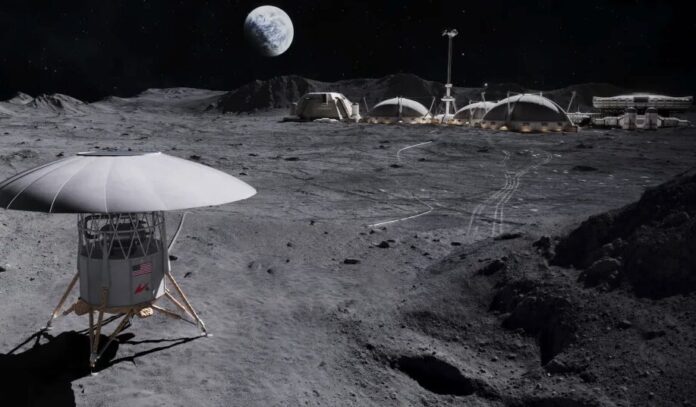
NASA’s Accelerated Lunar Exploration: 30 Robotic Missions and a Nuclear-Powered Base by 2030
Rapid Expansion of Lunar Science Through Robotic Missions
NASA is set to revolutionize lunar exploration by deploying up to 30 robotic landers starting in 2027, significantly accelerating the Commercial Lunar Payload Services (CLPS) program. This surge aims to establish a sustainable Moon Base that will serve as a springboard for future missions to both the Moon and Mars. The initiative invites contributions from industry leaders, academic institutions, and international collaborators, offering diverse payload opportunities such as rovers, hopping vehicles, and drones. Early missions will include notable payloads like the VIPER rover and the LuSEE-Night experiment, with NASA issuing a Request for Information (RFI) on March 24 to solicit additional payload proposals for flights planned in 2027 and 2028.
Innovative Nuclear Power Solutions for Lunar Habitats
In partnership with the U.S. Department of Energy, NASA is developing a compact nuclear fission reactor system known as Fission Surface Power (FSP), targeting deployment on the lunar surface by 2030. The baseline design aims to deliver a continuous 40 kW of electrical power-sufficient to power approximately 30 average American homes for over a decade. However, recent NASA directives and a 2025 RFI are encouraging industry to propose reactors capable of generating 100 kW or more, to support larger lunar bases, scientific instruments, rovers, and in-situ resource utilization (ISRU) activities such as oxygen and propellant production.
Technical Specifications and Operational Features
The FSP system utilizes High-Assay Low-Enriched Uranium (HALEU) fuel within a heat-pipe reactor core. Electricity generation is achieved through Stirling engines-building on the success of previous Kilopower and KRUSTY demonstrations-or via a closed Brayton cycle. Designed to be compact and lightweight, with an earlier mass target of around 6,000 kilograms, the reactor is engineered for autonomous operation exceeding ten years without the need for refueling.
Deployment Strategy and Safety Measures
To ensure crew safety, the reactor will be launched in an inert state and only activated once on the lunar surface. It can be remotely deployed at a safe distance-approximately one kilometer from crew habitats-using robotic rovers, minimizing radiation exposure to astronauts. Additionally, lunar regolith can serve as natural shielding if necessary. The system is designed for minimal maintenance, requiring no ongoing human intervention during its operational lifespan.
Lunar Terrain Vehicle Services: Enhancing Mobility for Moon Missions
NASA is refining its approach to the Lunar Terrain Vehicle Services (LTVS) contracts to support the establishment of a permanent Moon Base. This strategy involves procuring multiple crewed and uncrewed rovers, with initial operational capabilities expected by 2028. Uncrewed LTVs will feature basic autonomous functions and teleoperation capabilities, designed to operate for at least one year and cover distances of 800 kilometers or more. Incentives will be offered for vehicles demonstrating surface enhancement technologies. Crewed LTVs will provide astronauts with essential mobility, boasting a minimum operational lifespan of one year and the ability to traverse at least 900 kilometers, including an additional 100 kilometers dedicated to crewed exploration.
Collaborative Lunar Development: Commercial and International Partnerships
NASA’s Moon Base vision hinges on unprecedented collaboration with commercial enterprises and international partners, creating one of the most diverse and expansive lunar programs in history. Key elements include:
- Expanding the CLPS program to incorporate larger, more capable landers and rovers, with new task orders being issued promptly.
- Deploying multiple classes of Lunar Terrain Vehicles, starting with simpler models in Phase 1 and evolving to advanced vehicles capable of exploration, surface preparation, and logistics support in subsequent phases.
- Securing dozens of commercial launches annually through the Launch Services Program to maintain a steady cadence of Moon Base missions.
- Increasing demand for crewed and heavy cargo transport beyond Artemis V, utilizing redundant lunar access pathways and leveraging the Human Landing System and Human Landing Development programs.
- Generating significant commercial opportunities through the Moon Base development campaign, offering multiple entry points for both new and established providers.
- Providing numerous payload opportunities to test cutting-edge technologies, including surface and orbital communication relays, positioning, navigation and timing (PNT) systems, observation platforms, in-situ resource manufacturing, habitation modules, and a wide array of scientific instruments.
- Welcoming contributions from all Artemis Accords signatories to participate in technology demonstrations, scientific payloads, and foundational infrastructure development throughout every phase of the Moon Base build-up.
Looking Ahead: A New Era of Lunar Exploration
With these ambitious plans, NASA is laying the groundwork for a sustainable human presence on the Moon, leveraging advanced robotics, nuclear power, and international cooperation. This multi-faceted approach not only accelerates lunar science but also paves the way for future crewed missions to Mars and beyond, marking a transformative chapter in space exploration.