The robot vacuums are developing many new features. Self-scrubbing docks, which emptied dirty water directly into a tank on the dock to keep mop pads dry and clean, were a new innovation a year ago. The robots then developed wheels and legs to allow them to hop over difficult room transitions.
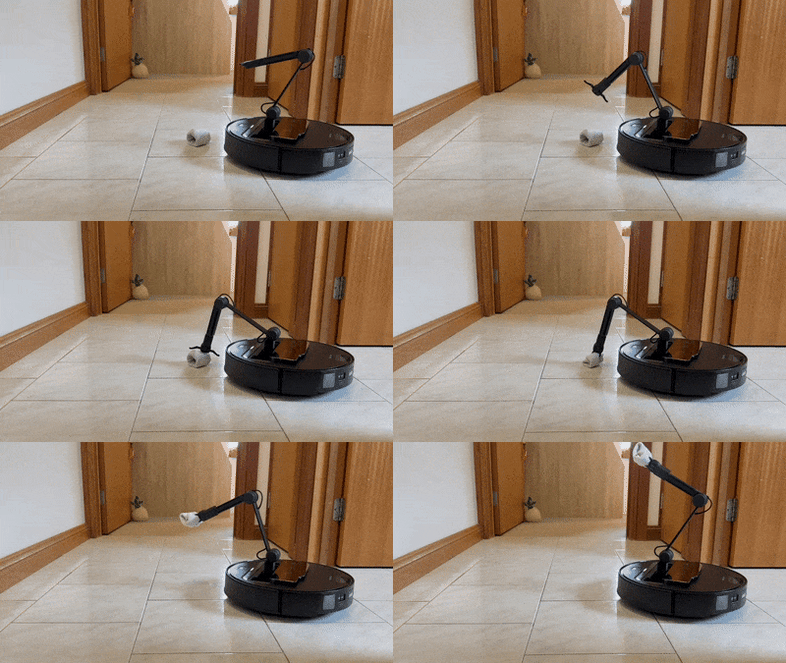
Roborock has the first robot on the market with this next big trick: a robot that can physically pick up and move objects.
states that the Z70 can sort and spot socks, sandals and towels. It turns out that there are some other limitations.
This idea sounds like pure science fiction. Imagine a robot that vacuums and mops your house while you are away. It cleans up all the nooks, crannies, and small items that you may have left on the floor. When you get home, they’ll be neatly arranged where they belong — or in the robot’s little lost-and found basket.
Roborock’s Saros Z70, a $4000 robot from Roborock, is an intriguing glimpse into the future. But it’s not quite there yet. The company claims that the robot is only able to pick up very few items, such as socks, cloths and tissues. As I discovered, the robot will only do this in very specific situations.
This bot comes with a futuristic-looking dock and a cardboard bin with QR codes that it can use to deposit objects. After setting it all up and letting the robot map my house, which it did quickly with its cameras and sensors, I immediately performed a simple test that I thought would be a sure-fire success for the robotic arm. I decluttered the children’s bedroom and placed one sock on the floor. Then, I asked the robot to vacuum.
The robot began cleaning in a grid, and it was able to see the sock as it veered from its pattern. It finished the job, and returned to dock. The sock was still lying on the floor.
After checking the app, the robot seems to have detected the sock. It was my fault, the sock was not socky. I chose a sock that was easily identifiable for the second test. It was white, well-worn and had a green toe. The very definition of a shoe. The robot completely avoided it. Second strike.
I decided to change tact and replace the sock by a kitchen towel. The robot dragged it around the room, running over it. Three strikes.
The floor was now very clean, and I wanted to see what the grabber looked like. I chose the manual mode which allowed me to take direct control. The arm is exactly what you would expect: a black five-axis robotic pincher mounted on a pole with neat wiring. It’s impressive how it fits into the robot. But I dread to think what might happen if debris got stuck in its hidey-hole before it returned home.
loading
i pointed out the sock and asked the robot collect it. It said that there were no items visible to be lifted. I turned the arm on manual and used it to grab the sock with a surprising tight grip. Then, I drove the robot into its bin to deposit the sock. It was a fun novelty, but it took more work to pick up the sock.
It was a bit of a challenge to get the robot pick up things automatically. It turns out that any socks, clothes or tissues must be rolled into a ball in order for the robot grab them. The opening of any slippers must face the middle of the room in order for the robot arm to grab them. It will not grab anything that is near a wall or weighs more than 300 grams. It also won’t try to grab anything on the carpet.
Keeping all this in mind, I revised my test to place a single balled sock in the middle of a tiled hallway. The robot picked it up, with an unsettling mechanical squeal and placed it in the basket, before returning to clean. It was a good demonstration, even if it was highly artificial. It also passed tests using other objects placed on tiles, all of which were either slippers or balls rolled up. You can program it to place different objects in different locations, such as socks in the bin or slippers in front the bed.
loading
This is all part of a very deliberate test. The robot has never picked up an object and sorted it out while performing its cleaning duties. It’s highly unlikely that an object in the way of the robot would activate the arm. It’s not that the feature is hopeless. Roborock claims it will improve its grip in future software updates, making it possible to pick up objects in more situations. You’d have to gamble that it will be useful.
If you were willing to pay a premium price for a robotic vacuum, you would likely be happy with the Z70’s other features.
It’s a compact unit that can fit under gaps as small as eight centimeters. Its mop and side brushes come out on little extension rods to reach corners. It’s great at vacuuming hair without getting its rollers stuck, and it integrates with smart homes. The dock can be used to remove and store the mop pads of the robot when they are not in use, and then clean and dry them using hot water at 80degC. It has a lifting frame that can move wet mop pad over short carpet or jump over thresholds up to four centimetres. It does a good job vacuuming and mopping.
But you can get it all in a robot for less than $3000. This includes Roborock’s Saros 10R and Dreame X50 Ultra. A mechanical arm that is currently not more than a novelty is asking for $1000 extra.
Receive news and reviews about technology, gadgets, and gaming every Friday in our Technology Newsletter. Sign up for our newsletter here.
Most Viewed in Technology.
Downloading