
Northrop Grumman’s Mission Robotic Vehicle Set to Revolutionize Satellite Longevity
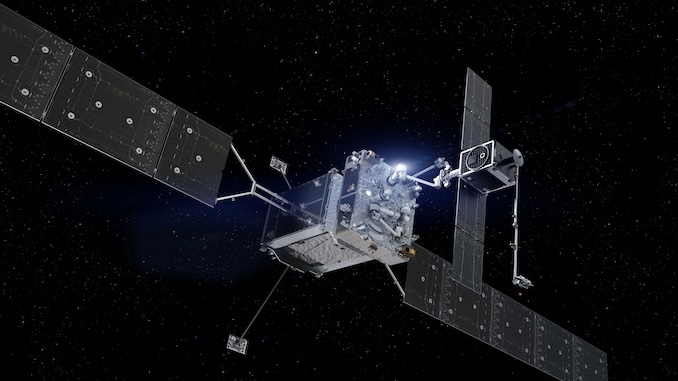
On Tuesday, a SpaceX Falcon 9 rocket will launch from Cape Canaveral, carrying Northrop Grumman’s innovative Mission Robotic Vehicle (MRV) alongside three Mission Extension Pods (MEPs). This pioneering mission aims to significantly extend the operational lifespan of multiple satellites orbiting in geosynchronous Earth orbit (GEO).
Advanced Robotic Servicing Technology
The MRV is outfitted with the Robotic Servicing of Geosynchronous Satellites (RSGS) payload, featuring two highly dexterous robotic arms equipped with a variety of specialized tools. Developed by the U.S. Naval Research Laboratory with funding from the Defense Advanced Research Projects Agency (DARPA), this technology enables the MRV to perform complex tasks such as inspection, repair, relocation, and upgrades on client satellites.
Mission Profile and Satellite Servicing
After deployment, the MRV and its MEPs will embark on a year-long journey to GEO, where the MRV will begin attaching the MEPs to client satellites. These clients include prominent operators such as Australia’s Optus and Luxembourg’s SES. The MEPs are essentially “jetpacks” that supply fresh maneuvering fuel, potentially adding up to eight years of operational life to each satellite.
Launch Details and Falcon 9 Booster Retirement
The launch window opens at 5:15 p.m. EDT (2115 UTC) from Space Launch Complex 40, with the Falcon 9 rocket set to fly due east. Notably, this mission marks the 32nd and final flight of the Falcon 9 first stage booster B1069. SpaceX has retired this booster due to the extra performance demands required to deliver payloads to geosynchronous transfer orbit (GTO).
Booster B1069 has an impressive flight history, having supported 27 Starlink satellite batches and key missions such as NASA’s CRS-24 resupply mission, Eutelsat’s Hotbird 13F, OneWeb’s Mission 15, and SES’ SES-18 & 19 satellites.
Two Decades of Innovation in Space Robotics
The foundation of the RSGS technology dates back over 20 years to early research at the Naval Research Laboratory exploring autonomous rendezvous and docking between uncrewed spacecraft. Initial concepts evolved through programs like RescueSat, which investigated satellite recovery from incorrect orbits, and the Spacecraft for the Universal Modification of Orbits (SUMO) initiative.
Designing a Universal Satellite Servicing Robot
Glen Henshaw, Ph.D., NRL’s lead space roboticist for RSGS, explains the breakthrough: “We realized every satellite is launched attached to a rocket via a robust structural interface. By targeting this ‘launch vehicle interface plane,’ our robotic arms can securely grapple nearly any satellite without risking damage to sensitive instruments.”
From Concept to Flight-Ready Hardware
By 2005, the SUMO program transitioned into the Front End Robotics Enabling Near-term Demonstration (FREND), which focused on developing space-qualified robotic arms. Alliance Spacesystems, Inc. (ASI)-the same company behind the robotic arms on NASA’s Mars Curiosity Rover-was selected to build these arms, with environmental testing commencing in 2008.
Establishing a Viable Commercial Model
To validate the business case for robotic servicing, multiple studies were conducted, including a 2012 joint NASA-DARPA Manned GEO Servicing study. DARPA subsequently advanced the technology through the Phoenix program, focusing on maturing hardware and research for spaceflight applications.
Expanding Satellite Capabilities in Orbit
The RSGS payload was designed to enable ultra-close inspections, orbital repositioning akin to a “tow truck,” mechanical repairs, and upgrades to satellites not originally built for servicing. In 2019, DARPA selected SpaceLogistics, a Northrop Grumman subsidiary, to integrate the RSGS with the MRV platform. After initial testing, the program will be handed over to the U.S. Space Force to support its Servicing, Mobility, and Logistics initiatives.
Enhancing Satellite Sustainability for the Future
Northrop Grumman’s MRV and MEPs represent a transformative step in satellite maintenance and sustainability, addressing the growing need to extend the functionality of costly space assets. With over 4,500 satellites currently in orbit worldwide and increasing congestion in GEO, such servicing missions are critical to reducing space debris and maximizing the return on investment for satellite operators.