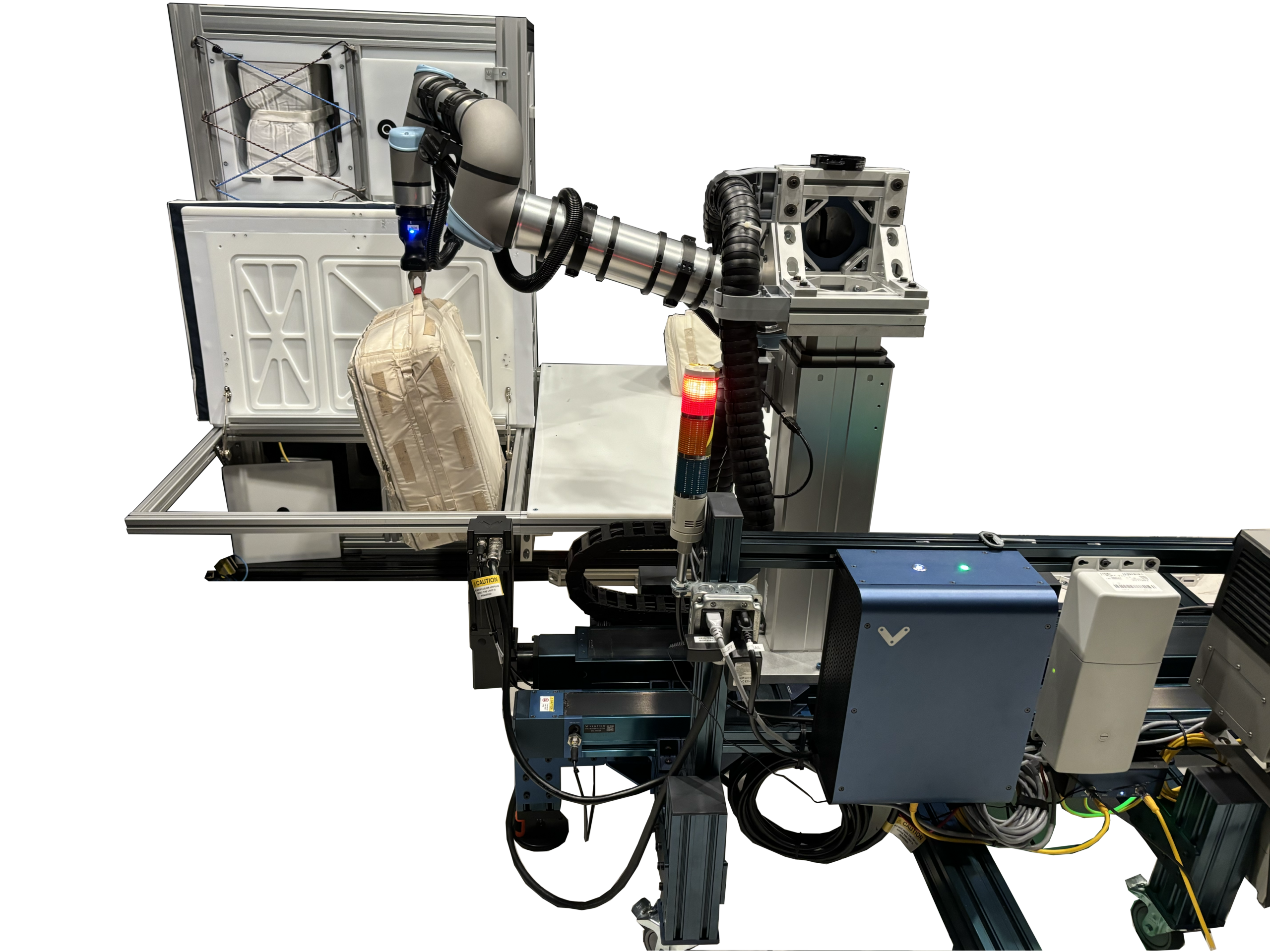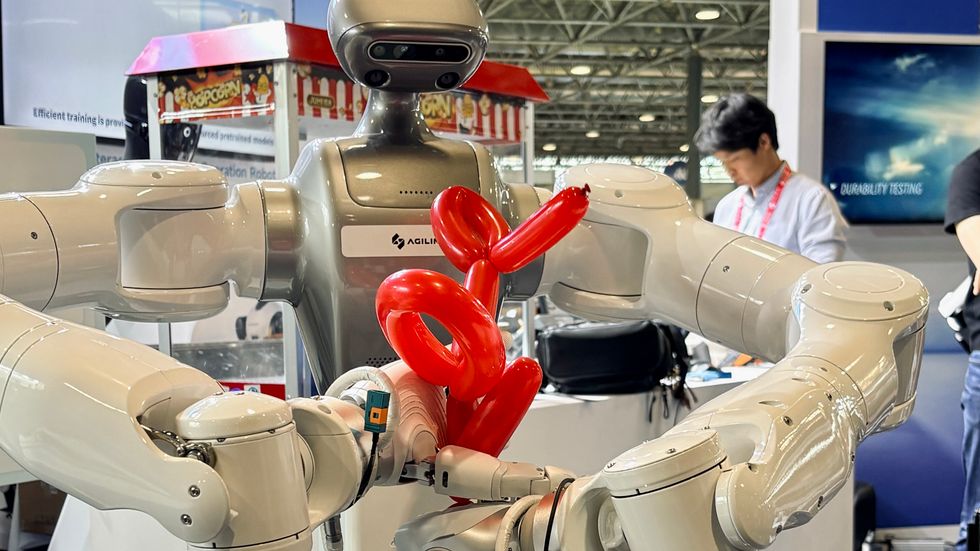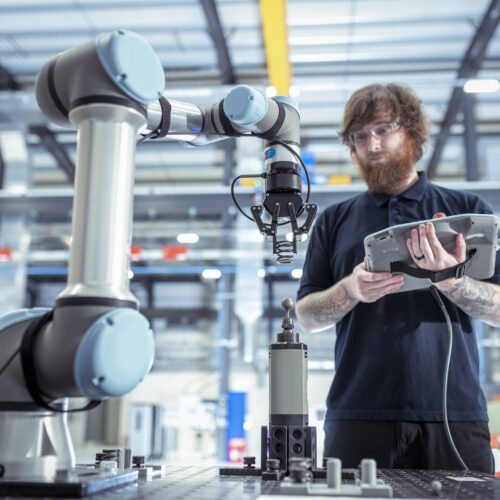
Innovative software enables robots with diverse hardware to share learned skills seamlessly.
Upgrading to a new smartphone is typically effortless: your apps, contacts, and settings transfer automatically. However, in robotics, replacing an older robotic arm with a newer model often requires rebuilding the entire setup from the ground up.
Addressing this challenge, researchers at the Swiss École Polytechnique Fédérale de Lausanne (EPFL) introduced a novel framework called Kinematic Intelligence. This system aims to make robot replacement as straightforward as switching phones, allowing robots with different physical designs to share learned tasks effortlessly. Their findings were recently published in Science Robotics.
Teaching Robots Through Demonstration
Roboticists have long pursued the goal of teaching robots new skills by demonstration rather than programming. This involves guiding a robot’s arm-either remotely or physically-to perform tasks such as cleaning surfaces, stacking items, or assembling components. Yet, these learned behaviors typically remain locked to the specific robot used during training.
“Robots come in many shapes and sizes, and emerging designs introduce unique challenges,” explained Sthithpragya Gupta, lead author and roboticist at EPFL. Variations in arm length, joint orientation, or complexity can cause a skill learned on one robot to fail catastrophically on another, leading to erratic or halted movements.
Durgesh Haribhau Salunkhe, co-author and EPFL roboticist, added, “Each new robot design brings distinct capabilities and limitations. The key is adapting learned actions to these differences while preserving the original intent.” Currently, transferring skills between different robots often demands complete retraining.
Understanding Robotic Movement Constraints
Robots must continuously calculate joint angles to guide their end-effectors-robotic equivalents of hands-along precise paths. A critical challenge arises when a robot approaches a singularity, a configuration where its joints align in a way that temporarily restricts movement freedom. “At singularities, control can become unstable or lost,” Gupta noted.
To illustrate, this is akin to a person locking their elbows fully while pushing a heavy object, momentarily losing the ability to move their arms sideways.
Because different robots have unique joint structures, their singularities occur in different configurations. If a robot blindly follows a path that crosses a singularity, its control algorithms can fail, potentially causing dangerous, uncontrolled motions like joints spinning at extreme speeds. The EPFL team’s Kinematic Intelligence equips robots with an intrinsic mathematical understanding of their physical limits, enabling safe execution of demonstrated tasks across diverse robot types.
Remarkably, this system achieves robust performance without relying on artificial intelligence.
From Reactive Fixes to Proactive Design
Traditionally, engineers have managed singularities by applying inverse kinematic models-complex equations that translate desired end-effector positions into joint angles-combined with safety filters to prevent hazardous configurations.
More recent AI-driven methods reduce manual effort but require extensive training on every robot model and carry risks due to their probabilistic, opaque nature. “AI can sometimes produce unpredictable or unsafe behaviors,” Gupta cautioned. Seeking reliability over uncertainty, the team embedded mechanical constraints directly into the robot’s control policies from the outset.
Focusing on three-joint robotic arms-common foundational elements in many industrial robots-the researchers performed algebraic analyses of parameters like link lengths and joint offsets. This allowed them to precisely map singularities and joint limits, dividing the robot’s movement capabilities into distinct safe regions called aspects.
By examining these aspects’ topology, the team classified three-joint robots into six categories, each with a known structure of physical constraints. This classification provides a comprehensive blueprint of each robot’s “danger zones.”
Using this knowledge, Kinematic Intelligence guides robots to navigate around singularities through a method termed the “track cycle.” Robots dynamically adjust their movements to slide safely along singularity boundaries until they can resume their intended paths without risk.
After validating their mathematical framework, the researchers tested it on various robotic arms with differing degrees of freedom and joint limits.
Collaborative Robotics in Action
The experimental setup featured three robots: a compact 6-DoF Duatic DynaArm with tight joint constraints, a 7-DoF KUKA LWR IIWA 7 with moderate limits, and a 7-DoF Neura Robotics Maira M with more flexible boundaries. These robots formed a simulated assembly line, collaboratively performing a sequence of tasks.
Initially, a human demonstrated a three-step task: pushing an object off a conveyor belt, picking and placing it on a workbench, then picking it up again to throw it into a basket. Each robot was assigned one of these actions-the DynaArm pushed, the KUKA handled pick-and-place, and the Neura performed the throwing.
Despite the pushing and throwing requiring movements near workspace edges and the pick-and-place demanding intricate internal calculations, all robots successfully learned the task from a single demonstration. “Then we swapped their roles and positions without any retraining,” Gupta said.
Thanks to Kinematic Intelligence, the robots adapted instantly, completing the task sequence regardless of which robot performed which action. This flexibility marks a significant step toward versatile, plug-and-play robotic systems. However, Gupta acknowledged that further refinements are needed before industrial adoption.
Towards Flexible and Safe Robotic Systems
While Kinematic Intelligence ensures mechanically safe motions by respecting joint limits and singularities, it currently lacks advanced perception and contextual reasoning necessary for unpredictable, real-world environments. For instance, the system cannot yet differentiate between handling a full container requiring gentle movement versus an empty one that can be moved quickly.
Moreover, integrating high-level cognitive safety checks is essential to align robot actions with human intentions and common sense-such as avoiding grabbing dangerous objects when performing unrelated tasks.
Another challenge is equipping robots with sophisticated environmental sensing to safely operate alongside humans in dynamic settings like factory floors. Although the framework has been validated on existing industrial robots, its application in sensitive domains such as healthcare awaits improvements in robotic hardware.
“We anticipate that within five years, mechanically safer robots will emerge, enabling deployment of frameworks like ours in medical contexts,” Salunkhe said. “Our approach is readily adaptable to these new designs, and we look forward to their arrival.”