
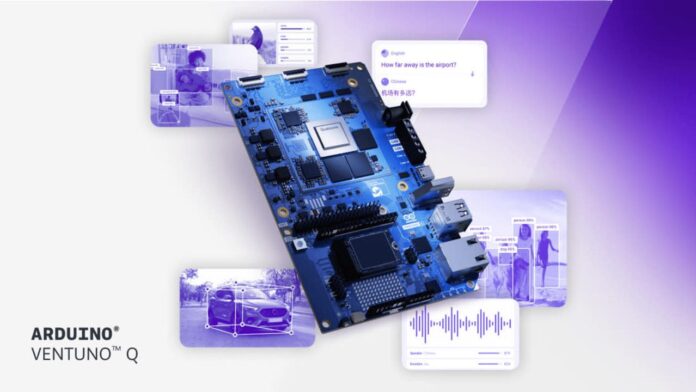
- VENTUNO Q enables fully autonomous AI agents to operate offline without cloud dependency
- Powered by the Dragonwing processor, it delivers up to 40 TOPS of AI performance
- Ideal for robotics applications such as vision-guided manipulators and autonomous navigation in complex settings
Qualcomm, in collaboration with Arduino, has introduced the Arduino VENTUNO Q, a cutting-edge single-board computer tailored for robotics, generative AI, and edge computing tasks that require complete offline functionality.
This innovative board integrates the Qualcomm Dragonwing IQ8 Series processor alongside an STM32H5 microcontroller dedicated to real-time deterministic control. This combination empowers devices to sense, analyze, and respond autonomously without external server reliance.
With a neural processing unit capable of delivering up to 40 trillion operations per second (TOPS), the VENTUNO Q supports simultaneous AI inference and complex data processing locally. Complemented by 16GB of RAM and 64GB of expandable storage, it efficiently manages intensive multitasking demands.
Designed for Advanced Edge AI and Robotics
Fabio Violante, Vice President and General Manager at Arduino, emphasizes that this platform enables machines to not only interpret their surroundings but also interact with them dynamically, eliminating the need for cloud connectivity.
The architecture seamlessly merges AI acceleration with real-time microcontroller logic, consolidating perception, decision-making, and actuation within a single compact board.
VENTUNO Q supports fully autonomous AI agents capable of powering offline voice assistants, gesture-controlled smart mirrors, and interactive kiosks deployed in transportation hubs, healthcare facilities, and tourist information centers.
Robotics applications are extensive, including vision-guided pick-and-place robotic arms and service robots that can autonomously follow individuals through changing environments.
Moreover, the board facilitates autonomous navigation in intricate settings by combining Visual Simultaneous Localization and Mapping (Visual SLAM) with optimized path planning algorithms.
Edge AI vision systems are also supported, enabling proactive security surveillance, traffic flow monitoring, and automated quality control inspections using locally hosted visual language models.
All these capabilities operate entirely on-device, removing the necessity to send sensitive data to external cloud servers, thereby enhancing privacy and reducing latency.
Robust Software and Hardware Ecosystem
VENTUNO Q runs mainstream Linux distributions such as Ubuntu and Debian on its primary processor, while the STM32H5 microcontroller operates Arduino Core on Zephyr OS for real-time tasks.
The Arduino App Lab environment supports development with Python scripts, Arduino sketches, and pre-trained AI models including gesture recognition and object tracking. Additionally, it accommodates local large language models (LLMs) powered by Qualcomm AI Hub, and developers can train custom models via Edge Impulse Studio.
Hardware compatibility is extensive, featuring industrial-grade input/output interfaces, multiple MIPI CSI camera connectors, audio and display outputs, and a high-speed 2.5Gb Ethernet port.
“VENTUNO Q represents a pivotal shift, bringing AI from the cloud directly into physical devices,” said Fabio Violante. “This platform empowers creators to build intelligent machines capable of perceiving, deciding, and acting autonomously on a single board.”
He added, “Our mission is to democratize advanced robotics and edge AI, making these technologies accessible to developers, educators, and innovators worldwide. VENTUNO Q is a significant milestone in realizing real-world intelligence for all.”
Compatibility and Availability
The VENTUNO Q board supports Arduino UNO shields, Modulino nodes, Qwiic sensors, and Raspberry Pi HAT expansions, ensuring broad integration possibilities within existing ecosystems.
Scheduled for release in the second quarter of 2026, it will be available through the Arduino Store and authorized distributors including DigiKey, Farnell, Mouser Electronics, and RS Components. While its impact on established platforms like Raspberry Pi remains to be seen, the VENTUNO Q offers a compelling option for developers focused on edge AI and robotics.