WASHINGTON – A startup has raised a first round of funding for the commercialization of a technology which could create large structures orbitally.
Rendezvous Robotics, a startup based in Golden, Colorado, announced on Sept. 10 that it raised $3 million as part of a pre-seed funding round led by Aurelia Foundry & 8090 Industries with participation from other funds & angel investors.
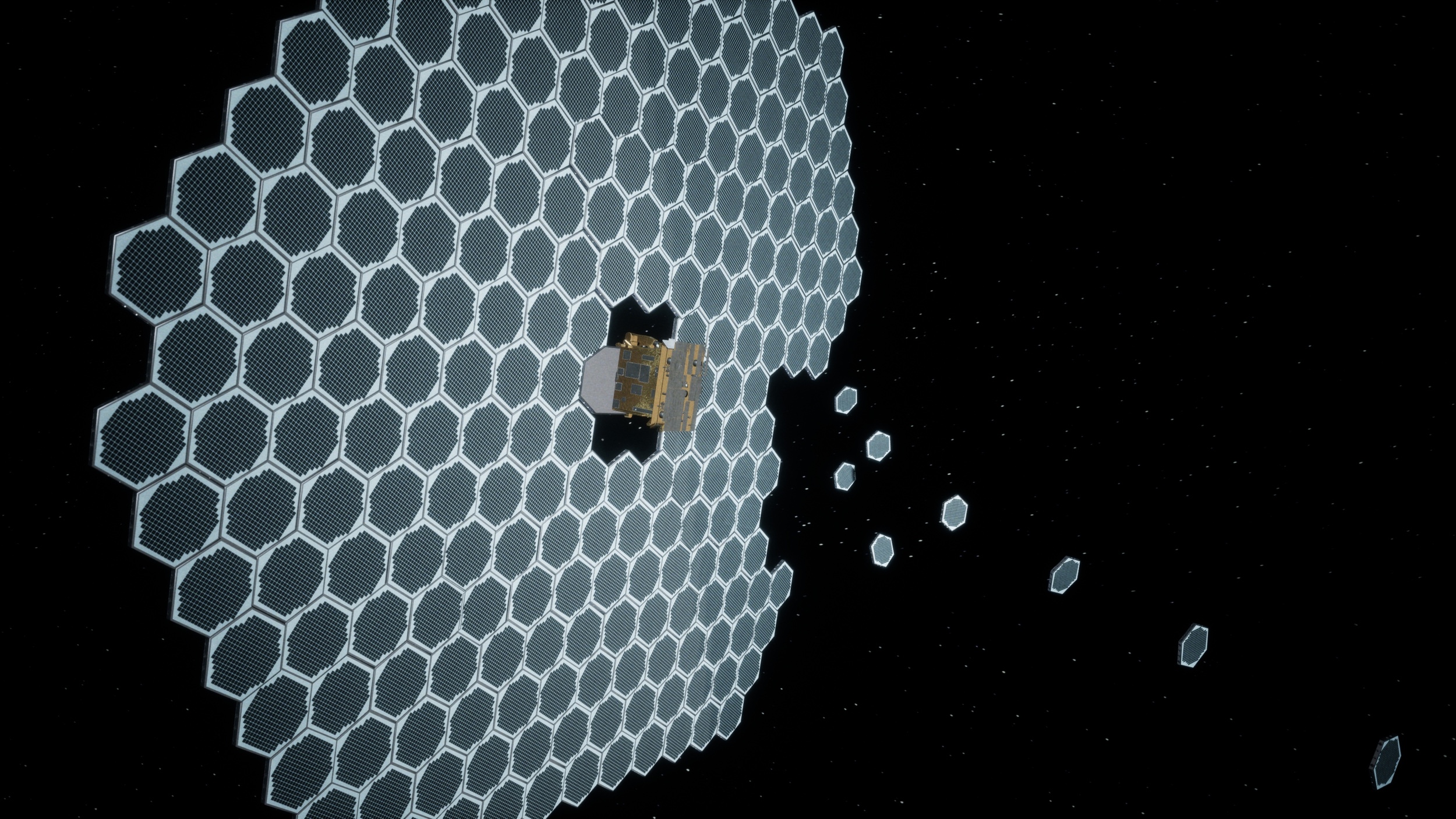
The Golden, Colorado-based company plans to commercialize a MIT Media Lab technology called Tessellated Electromagnetic Structures for Exploration of Reconfigurable Adaptive Environments or TESSERAE. The technology uses tiles that can self assemble and reconfigure to create large structures.
It’s time to scale up our orbital ambitions. In a press release, Ariel Ekblaw (MIT inventor and co-founder of Rendezvous Robotics) said that we are launching a “new paradigm for in-space building”.
TESSERAE, developed at MIT, and supported later by Ekblaw’s Aurelia Institute has undergone several rounds of testing. This includes parabolic aircraft flight that provides brief periods of microgravity, and a New Shepard Suborbital Flight. It has been tested twice at the International Space Station.
In an interview, Joe Landon, cofounder and president at Rendezvous Robotics said, “We’re now on the fifth generation” of TESSERAE. This latest version will be sent to the ISS for more testing in early 2026. It will see how a set 32 tiles, each measuring the size of a plate, can self assemble into a structure enclosed within the station. The technology will then be tested in space.
Ekblaw envisaged using TESSERAE for the assembly of large space habitats. The company, who has the exclusive rights to the technology and is exploring applications in the near future, is also exploring. Landon stated that there are missions and applications today that require a large scale in space. These missions and applications are missions where performance is driven by physical size, such as large antenna apertures and solar arrays used for high-power communication and remote sensing missions. “That’s the most urgent and first application we see.”
According to the company, TESSERAE can be used to assemble sturdy structure more efficiently than traditional deployable technology. He said that the larger a mechanical deployable is, the more expensive it becomes and the longer it takes to build it. “If you build with our TESSERAE tile, it scales linearly as size increases.”
Rendezvous Robotics envisions sizing up the size TESSERAE to the diameter rocket payload fairings. This would maximize the volume of the fairings for launching tiles in various applications.
The company has found interest in the technology from both potential commercial and national security customers. “We need to prove that we can actually do this in a free-space environment and we can make it resilient,” said Phil Frank, a veteran technology executive and entrepreneur who is chief executive and co-founder of Rendezvous Robotics.
“We need to demonstrate it first. But we think the demand is really strong for this once it’s demonstrated,” added Landon, who has worked at companies ranging from Boeing and Lockheed Martin to startup Planetary Resources before co-founding Rendezvous Robotics.
The pre-seed funding will help the company carry out those demonstrations. “This has given us enough bandwidth to be able to actually bring a team on and scale that team,” Frank said. The company has about half a dozen engineers now, including some who previously worked at Blue Origin and SpaceX, and plans to grow to 15 to 20 by the end of the year.
“That $3 million pre-seed funding is a bridge to allow us to build a team and get to the seed round,” he said. The company didn’t disclose details about the timing or size of that seed round.
Frank added that while Ekblaw is a co-founder of the company, she will remain focused on her organization, the Aurelia Institute. “We’re going to continue to work with Aurelia as kind of our think tank,” he said. “They’re going to continue to look at things like habitats and human applications in space, and if there’s anything interesting that comes out of that, we have the rights to that as well.”
Jeff Foust writes about space policy, commercial space, and related topics for SpaceNews. He earned a Ph.D. in planetary sciences from the Massachusetts Institute of Technology and a bachelor’s degree with honors in geophysics and planetary science…
More by Jeff Foust (19659023)
Post navigation