Robot lawn mowers are the natural progression in robotic home care. There are many options available, but Ecovacs Goat is a robot from a company with specialized knowledge of home robots. It’s not cheap, but still cheaper than hiring a person to do it.
Before we begin, there’s a disclaimer to make. Ecovacs robot lawn mowers don’t provide the perfect solution for lawn maintenance. As with any smart mop or vacuum, the user must meet it halfway and create an environment where it can be hands-off.
For smart vacuums, this means picking up cords or cordoning off the areas where they are likely to get stuck. This is less of a problem as they have improved over the years. It needs help to become a hands off tool.
Although the Goat A3000 intelligent mower from Ecovacs shares this drawback, I wouldn’t consider it a “con.”
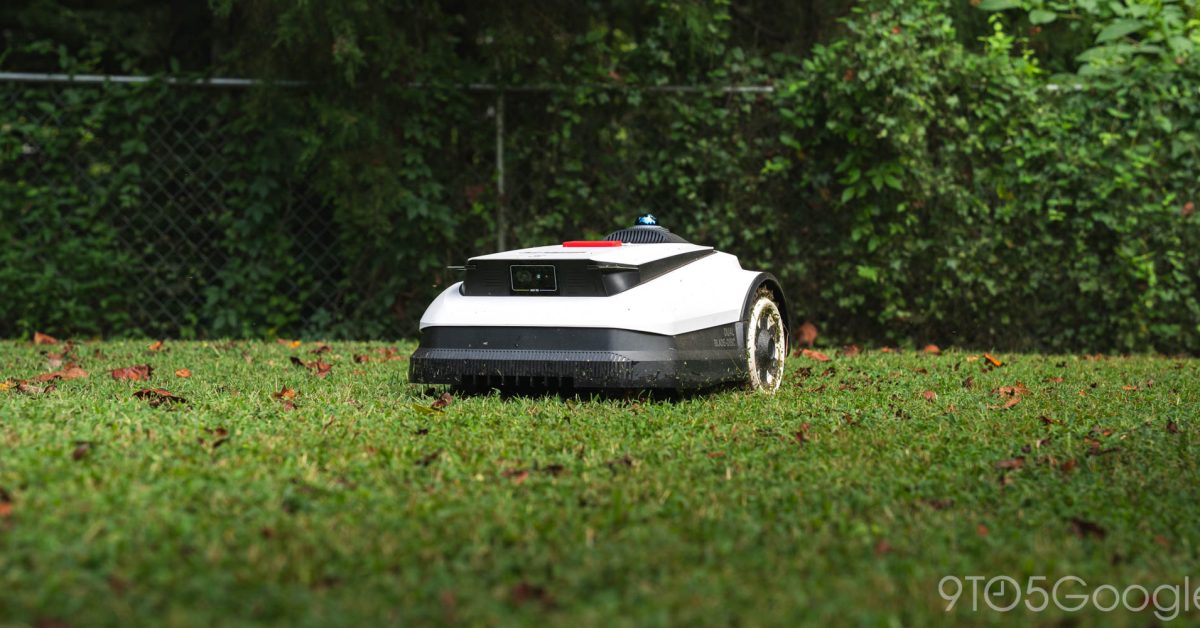
The Goat A3000 looks like a small tank
. Smart lawn mowers are a relatively new industry, and some of the designs have been extreme. Ecovacs has a solution that is less aggressive and looks more innocent, with the actual cutting mechanisms hidden below.
The top of the smart mower has a dual-LiDAR array that scans at a full 360 degrees. That system allows it to create a detailed 3D map of the surrounding areas. The front of the mower carries a camera and another LiDAR sensor that brings depth data so shadows and other objects don’t disrupt map information.
An LED display along the top allows for quick status information and basic settings via physical buttons. It’s useful for when the robot gets stuck, needs a restart, or if you just need to send it home for the day.
The front two wheels aren’t visible, but they’re essentially rugged casters that allow the mower to traverse different terrains. The back two wheels bring the power, steering the mower like a little tank across the lawn. The wheels have a rather deep and sharp tread, but they have their limits – more on that later.
The hidden portion of the robot houses two rotating blade wheels, complete with three razor blades each. They’re attached with some threadlocked Phillips screws, of which Ecovacs includes several replacements. They’re very easy to replace, and it’s something that needs to get done at least once a season, in my experience.
The entire mower is IPX6 water-resistant. It can be washed with a shower-style nozzle to get dirt and debris off the top, sides, and bottom. During the wet season, it’s necessary not only for resistance to wet grass, but for the inevitable washing it’ll need when blades get stuck underneath.
The rating seems to hold true. I’ve washed the Goat A3000 mower with varying strengths of water pressure, and it’s still running like day one.
A docking station lets the mower charge, and it’s a simple setup. A long cord is included, so there’s plenty of wiggle room for choosing a home. Once it’s placed, the robot will place itself in the docking station to charge when not in use. It uses two surface-contacts to send power. Since the mower is water-resistant, it can placed almost anywhere. I have a shed with a covered parking area, so it lives there where it stays dry.
Mapping
Mapping is the first thing that any user of Ecovacs mowers will do. There are two modes of operation: automatic mapping and manually. I chose manual mode because I have a steep hill that is higher than the 27-degree rating. In manual mode, all you have to do is drive the mower to create a border using the manual controller in the app.
Automatic is a good option for homeowners with fewer delicate areas. The sensors can detect the boundaries of grass and pavement separately, and the map is created based on these boundaries.
Where users need to be careful is when lawn items like paving stones are small enough for the robot to run over, but not big enough for it to recognize as an edge. In my first map, I included the entire backyard with just a boundary run inside my fence. Well, the shed and paved areas around it have raised concrete. It’s just low enough for the mower to try and traverse it, but too large for it to avoid the blades.
At first, I made sure larger boundary stones were placed by those raised areas, to ensure the mower wouldn’t dare try. Then, I realized I could just remap the area and exclude the driveway and shed. With that, the mower doesn’t even try to get up onto the pavement, and I have to replace blades much less often!
That’s where my warning comes into play. The lawn needs to be maintained in a way that makes it easy for the robot to get to where it needs to go. Yes, it has settings that control at which height objects need to be before they’re avoided, but it only does so most of the time; and if the object detection height is set too low, large patches of grass will never get cut.
Fortunately, the Ecovacs app is easy to use. You can set boundaries for pathways, rock gardens, and more with no-mow zones and no-entry zones. However, you can’t set a boundary that includes the docking station. In my case, that meant I couldn’t define a paved area. That’s why I remapped, avoiding the area at all costs.
If the docking station isn’t in a mapped section, the Goat A3000 mower will remember the path it took to the area, which is great if there is a very specific path the mower needs to take between lawn sections.
Performance and app
The foundation for performance is a good traversal capability and LiDAR Arrays. The Goat A3000 will get you where you need to go, as long as you don’t set up the system to fail.
Like Ecovacs other products, the app is well designed. It has mowing-specific and robot settings for a variety of different options. You can either set the mowing height per area or a general setting for automatic cutting if you are scheduling or having your robot cut a section of lawn.
The cut direction is also adjustable, allowing for diagonal cuts or straight paths. There’s a toggle to have the robot change the path by 90 degrees each week, which is great for the health of the grass.
My grass isn’t perfect, and it’s a mix of types I haven’t determined yet. Still, the Goat A3000 does a really good job of getting it down to a consistent height and covering a good amount of space. Of course, it can edge tight corners and fencelines, so be prepared to do some weed-eating.
It also can’t mow down tall, thick grass without getting stuck and redirecting all over the place. There is an “enhanced” mode that lets it carefully bring the height down on thick grass, but it’s slow and takes extra time. The key to using a robot mower is to run it twice or more a week during the summer, and once a week in the offseason. If you wait until it gets high, the Goat is going to struggle.
It can also struggle in wet grass, much like a manual lawn mower. There are times when I was limited to running it once a week, and I needed to shorten the grass with a push mower first, before letting the Goat run on a consistent basis again.
I also found that it sometimes got stuck in loose dirt. The wheels would spin without getting any traction, and the mower would need to be picked up and moved. After remapping and removing the weak spots from my lawn, problems dropped significantly.
No Matter for your smart house
Other new smart products from this company have Matter capability, but the Goat A3000 lawnmower does not. The connection to Google Home will be basic, but it’s not without its usefulness.
You can start and stop it, but it starts in automatic mode. It’s not something I personally prefer. You can dock it through the Google Home App. This is a simple way to dock your device before you leave or while you are away. This means that commands sent via Google Gemini and Assistant will also work.
Battery life
The battery life of the Goat A3000 was very impressive. It has a rotating disc powered by a motor that runs on 32V and can be used in either a delicate or quick mode. I always choose the slower mode because it offers better performance and coverage.
My 6,000-square-foot yard is completed in just over 3.5 hours. It takes only 45 minutes for it to go from 15% to about 80% when it is charging. The rest of the yard can be cleared from there. Total, it’s around 4.25 hours. The front yard is bigger so the Goat A3000 has more time to do it. It gets the job done in one day without any issues.
The Ecovacs Goat A3000 is rated for 3/4 acre with around 5,400 square feet every two hours. That likely accounts for the faster mowing mode, though the real-life numbers aren’t disappointing. If you have more than 0.5 acres, though, you might need to parcel out sections per week with the robot running almost daily.
Final thoughts
I believe that the Ecovacs Goat A3000, at $3,000 costs less than hiring a crew of lawn mowers in a year. It doesn’t do all the details, but it does most of it. You’ll save a few hours per week and some energy.
Ecovacs’ smart mower has a long battery life, a fast charging system, and features that make it stand out from other options. It can run on a schedule without any issues, provided you set it up correctly. It’s not cheap, but it saves you valuable time during the week. It also makes your neighbors slow down, whether you want it to or not. Ask me how I know. Follow Andrew:
Bluesky Tweet/Xand Threads
FTC: we use income-generating auto affiliate links. More.