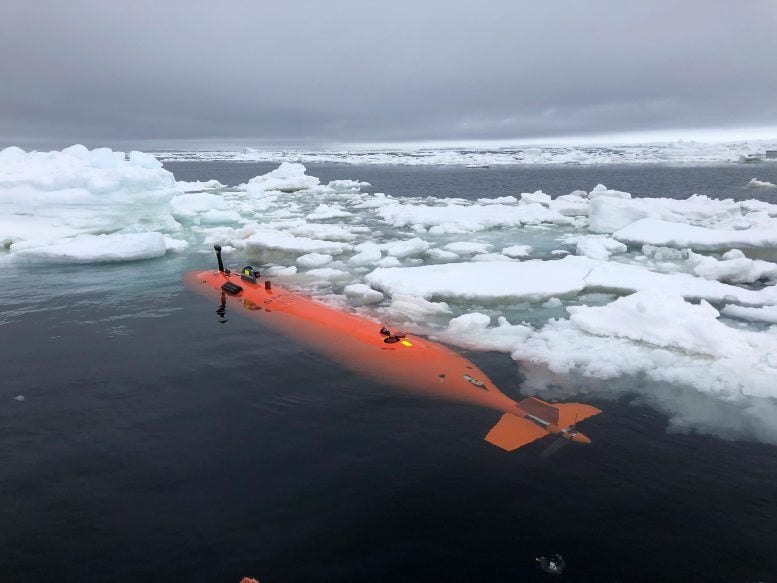
After the loss of a groundbreaking robotic submarine beneath Antarctic ice, a new, more advanced vehicle is being developed to continue unlocking the mysteries of glacier dynamics and ice melt.
The upcoming autonomous underwater vehicle, Ran II, is poised to resume exploration beneath Antarctica’s ice shelves, venturing into one of the most inaccessible and scientifically vital regions on Earth.
Ran, operated by the University of Gothenburg, disappeared during a perilous mission in January 2024. Thanks to substantial funding from the Voice of the Ocean Foundation (VOTO) and insurance support, the next-generation Ran II is under construction and expected to be operational by late 2026 or early 2027. This new craft will feature enhanced durability and navigation capabilities tailored for the extreme polar environment.
Unveiling the Subglacial Frontier
Over six years, Ran provided unprecedented access to the submerged bases of Antarctic glaciers, areas unreachable by humans or surface vessels. Its expeditions included the Thwaites Glacier, a critical ice mass closely monitored due to its potential to significantly raise global sea levels.
“Ran enabled us to be the first to directly observe the underside of the Thwaites Glacier, which partly extends into the ocean. While satellites detect surface melting and ice movement, Ran’s close-range imaging and data collection revealed the precise processes driving basal melting,” explains oceanography professor Anna Wåhlin.
One of Ran’s most ambitious journeys was beneath the Dotson Ice Shelf in West Antarctica, where it traversed over 1,000 kilometers (approximately 620 miles) in near-total darkness over 27 days. The vehicle penetrated as far as 17 kilometers (about 10.6 miles) into the ice cavity, mapping the glacier’s underside from depths around 50 meters (164 feet) using advanced sonar technology.
Revealing a Complex Sub-Ice Landscape
Contrary to earlier beliefs that the glacier base was relatively smooth, Ran’s sonar scans uncovered a rugged terrain featuring ridges, valleys, and dune-like formations. Scientists hypothesize that these structures result from ocean currents shaped by Earth’s rotation, creating a dynamic environment beneath the ice.
Moreover, melting patterns were found to be highly variable, intensifying in zones where warm, saline water rises and along vertical fissures in the ice. This nuanced understanding challenges previous models that assumed more uniform melting.
“While satellite imagery and ice core samples have long informed us about glacier changes, Ran’s direct exploration provided high-resolution maps of the ice’s underside-akin to revealing the moon’s hidden far side,” Wåhlin remarks.
Implications for Global Sea Level Rise
Antarctica’s floating ice shelves act as critical buttresses, slowing the flow of inland ice into the ocean. Their thinning or collapse can accelerate glacier movement, contributing to rising sea levels worldwide.
Ran’s detailed mapping is instrumental in refining predictive models of ice melt and glacier retreat. Prior models often simplified sub-ice conditions, but the new data highlights a far more intricate and dynamic system heavily influenced by oceanic currents.
“Ran’s comprehensive maps mark a significant leap forward in our comprehension of Antarctic ice shelves. While we suspected complexity, the vehicle revealed an unprecedentedly detailed picture,” says glaciologist Karen Alley, co-author of the research.
Current scientific consensus now suggests that some regions may be melting faster than previously estimated, especially where ocean conditions intensify basal melting.
Challenges of Under-Ice Exploration
Deploying autonomous vehicles beneath Antarctic ice is fraught with risk. Ran often operated beyond 24 hours without communication, navigating narrow, dark cavities hundreds of meters below the surface.
“Few places on Earth remain unexplored. Watching Ran disappear into the unknown depths for extended periods was both thrilling and nerve-wracking,” Wåhlin reflects.
Despite over 40 successful missions, the inherent dangers were always present. During a 2024 expedition, Ran completed one dive before vanishing without a trace.
“The unique data collected by Ran is invaluable to global research efforts. While the loss is unfortunate, it’s preferable to the vehicle remaining unused. Its legacy will drive future exploration,” Wåhlin stated following the disappearance.
Advancing Polar Research with Ran II
Ran II aims to surpass its predecessor by incorporating enhanced navigation and autonomous decision-making systems, enabling it to better handle emergencies and complex environments. The mission is to not only replace Ran but to extend exploration into previously unreachable sub-ice regions.
Beyond Antarctic missions, Ran II will also support marine research closer to home, including studies in the Baltic Sea, through an expanding partnership between the University of Gothenburg and VOTO. This collaboration will provide scientists with cutting-edge marine technology and detailed environmental data.
Simultaneously, rapid advancements in artificial intelligence are revolutionizing the analysis of vast datasets generated by these missions. When combined with next-generation autonomous underwater vehicles, AI promises to accelerate discoveries about the interactions between oceans and ice.
Embarking on a New Chapter in Ice Shelf Exploration
Launched in 2018, Ran was among only three such vehicles worldwide and the sole one based in Sweden, positioning the country at the forefront of polar oceanographic research.
With Ran II’s arrival, researchers are preparing to delve deeper into one of Earth’s most enigmatic environments. Understanding the processes beneath Antarctica’s ice shelves is crucial for predicting future climate impacts.
Equipped with advanced technology and improved capabilities, scientists hope to answer pressing questions about the rate of ice melt and its implications for global sea level rise in the coming decades.