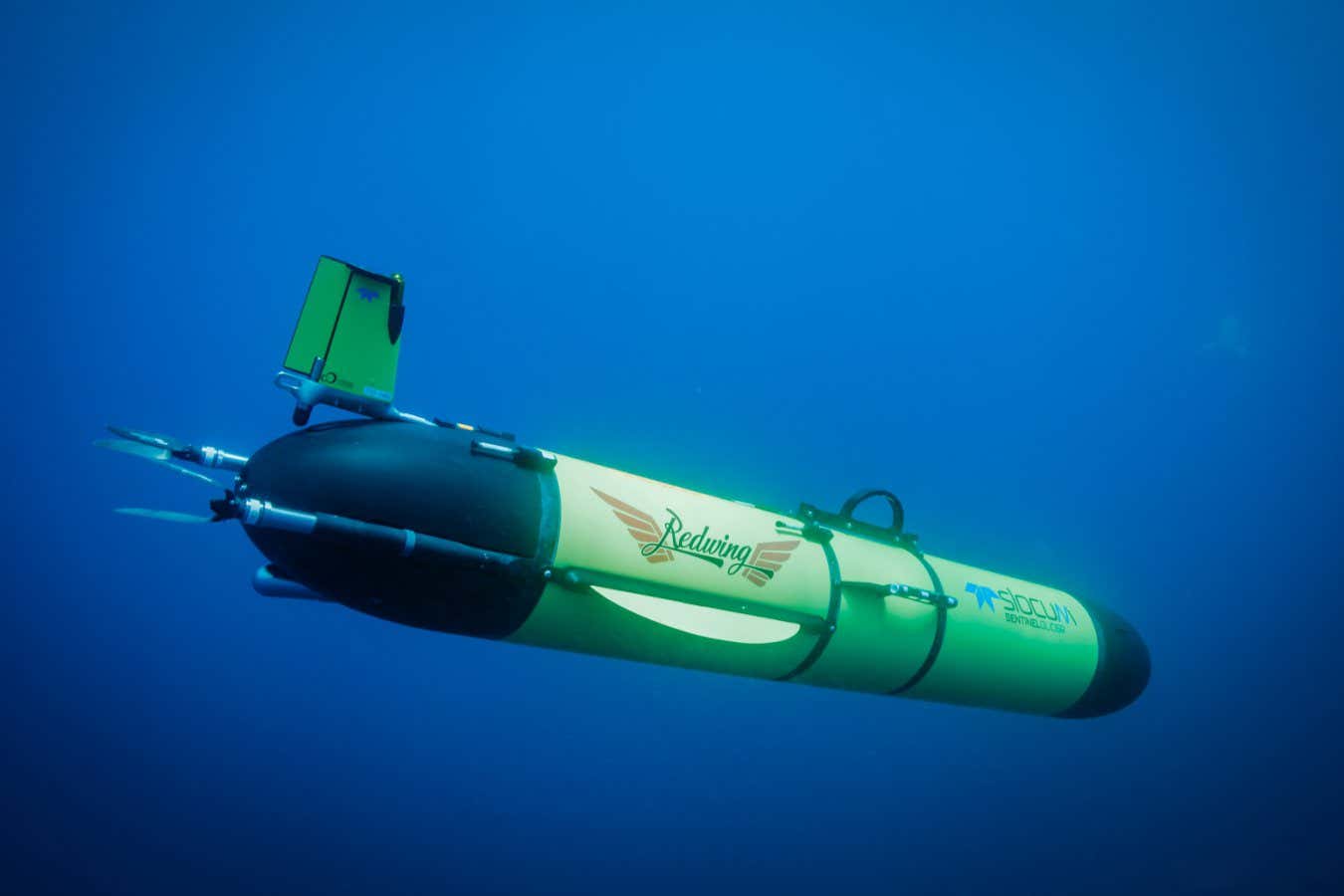
Redwing underwater glider during a trial deployment.
Teledyne Marine.
Introducing Redwing: The Autonomous Underwater Glider Embarking on a Global Voyage
In an unprecedented endeavor, a compact autonomous underwater vehicle named Redwing is set to traverse the world’s oceans. Developed collaboratively by Teledyne Marine in New Jersey and Rutgers University in New Brunswick, Redwing will commence its ambitious circumnavigation from Martha’s Vineyard, Massachusetts, on October 11 as part of the Sentinel Mission.
Innovative Propulsion: Harnessing Buoyancy for Efficient Ocean Exploration
Unlike traditional submarines that rely on propellers or gas-filled chambers, Redwing employs a buoyancy-driven propulsion system. This mechanism uses a piston to adjust the vehicle’s density relative to seawater, enabling it to glide through the ocean in a distinctive sawtooth pattern. As the piston extends, Redwing becomes denser and gently sinks; once it reaches depths near 1,000 meters, the piston retracts, increasing buoyancy and allowing the glider to ascend. This energy-efficient method eliminates the need for auxiliary propellers, facilitating prolonged missions with minimal power consumption.
Mission Profile: Navigating with Ocean Currents at a Steady Pace
Redwing is designed to move harmoniously with prevailing ocean currents, maintaining an average speed of approximately 0.75 knots (just under one mile per hour). Spearheaded by Shea Quinn of Teledyne Marine, the Sentinel Mission aims to complete the glider’s full circumnavigation within a five-year timeframe.
Compact Yet Capable: Design and Endurance Features
Measuring 2.57 meters in length-smaller than a typical surfboard-and weighing 171 kilograms, Redwing packs advanced battery technology within its streamlined fuselage to support extended deployments. Previous underwater gliders have demonstrated endurance spanning several months, and Redwing is engineered to surpass these benchmarks.
Charting a Historic Course: Following in the Wake of Magellan
The glider’s route mirrors the legendary circumnavigation of Ferdinand Magellan (1519-1522), covering roughly 73,000 kilometers. Key waypoints include Gran Canaria near northwest Africa, Cape Town in South Africa, Western Australia, New Zealand, the Falkland Islands in the South Atlantic, and potentially Brazil before concluding its journey back at Cape Cod.
Scientific Impact: Advancing Oceanographic Research and Climate Understanding
Underwater gliders like Redwing have revolutionized oceanographic data collection by enabling long-duration, cost-effective missions without the need for large support vessels. Redwing will gather critical measurements of ocean temperature, salinity, and current patterns in remote and underexplored regions, contributing valuable insights into global climate dynamics.
Operational Challenges and Resilience in the Open Ocean
Brian Maguire of Teledyne Marine notes that the glider will be remotely monitored and guided by engineers and students from Rutgers University and Teledyne Webb Research, with course adjustments made twice daily via satellite communication. Battery replacement is anticipated midway through the mission to sustain its prolonged operation.
While weather conditions such as storms and heavy seas pose limited threats due to the glider’s robust design, other hazards include dense shipping lanes, fishing gear entanglement, marine biofouling, and encounters with marine wildlife like sharks. Karen Heywood from the University of East Anglia highlights the glider’s ability to operate safely in extreme environments, including hurricane zones and near calving glaciers, where manned vessels face significant risks.
Alexander Phillips of the UK’s National Oceanography Centre emphasizes that biofouling-accumulation of algae and marine organisms on the glider’s surface-can impair functionality, while collisions with ships or fishing equipment have historically resulted in losses of similar vehicles. Despite these challenges, underwater gliders remain indispensable tools for ocean exploration.
Redwing’s Legacy: Pioneering the Longest Open Ocean Sampling Mission
This mission is poised to set a new record for the longest continuous open ocean sampling expedition ever attempted by an autonomous underwater vehicle. Previous glider missions have successfully crossed the Atlantic and Pacific Oceans and ventured beneath the Ross Ice Shelf, demonstrating the technology’s versatility and resilience.