Surging Momentum in Embodied Intelligence: Market Growth and Global Expansion
The field of embodied intelligence has witnessed a remarkable surge in interest and commercial activity since early 2025. For instance, Agibot recently celebrated the production of its 10,000th robot, having doubled its output from 5,000 units in just over three months. Similarly, Unitree Robotics projects revenues of approximately RMB 1.707 billion (around USD 250 million) for 2025, with anticipated shipments surpassing 5,500 units, signaling rapid market adoption.
This growth is largely driven by Chinese robotics manufacturers expanding their footprint internationally, leveraging competitive pricing and advanced performance. Wang Xingxing, founder of Unitree Robotics, revealed at the 2025 World Robot Conference that over half of the company’s revenue in recent years has originated from overseas markets.
Ambitious Visions and Global Outreach: MagicLab’s Strategic Moves
Among the leaders in embodied intelligence, MagicLab has set an aggressive revenue goal of USD 14 billion by 2036. To bolster its global presence, the company hosted the Global Embodied AI Innovation Summit (GEIS) in Silicon Valley’s San Jose on April 28, a hub for tech giants like Adobe, TikTok, and IBM.
At GEIS, MagicLab unveiled a suite of cutting-edge products integrating foundational AI models with robotic hardware:
- Magic-Mix: A comprehensive world model comprising two core engines-Magic-WAM, which enables robots to interpret and learn from real-world environments, and Magic-Creator, which generates extensive synthetic datasets offline. This system supports continuous improvement through iterative cycles of data generation, model training, real-world validation, and further data synthesis.
- MagicHand H01: A highly dexterous robotic hand featuring 20 degrees of freedom (DoF), closely approaching the human hand’s 24-27 DoF. Equipped with 44 high-resolution 3D tactile sensors, it is designed for precision tasks in industrial automation, service industries, and healthcare.
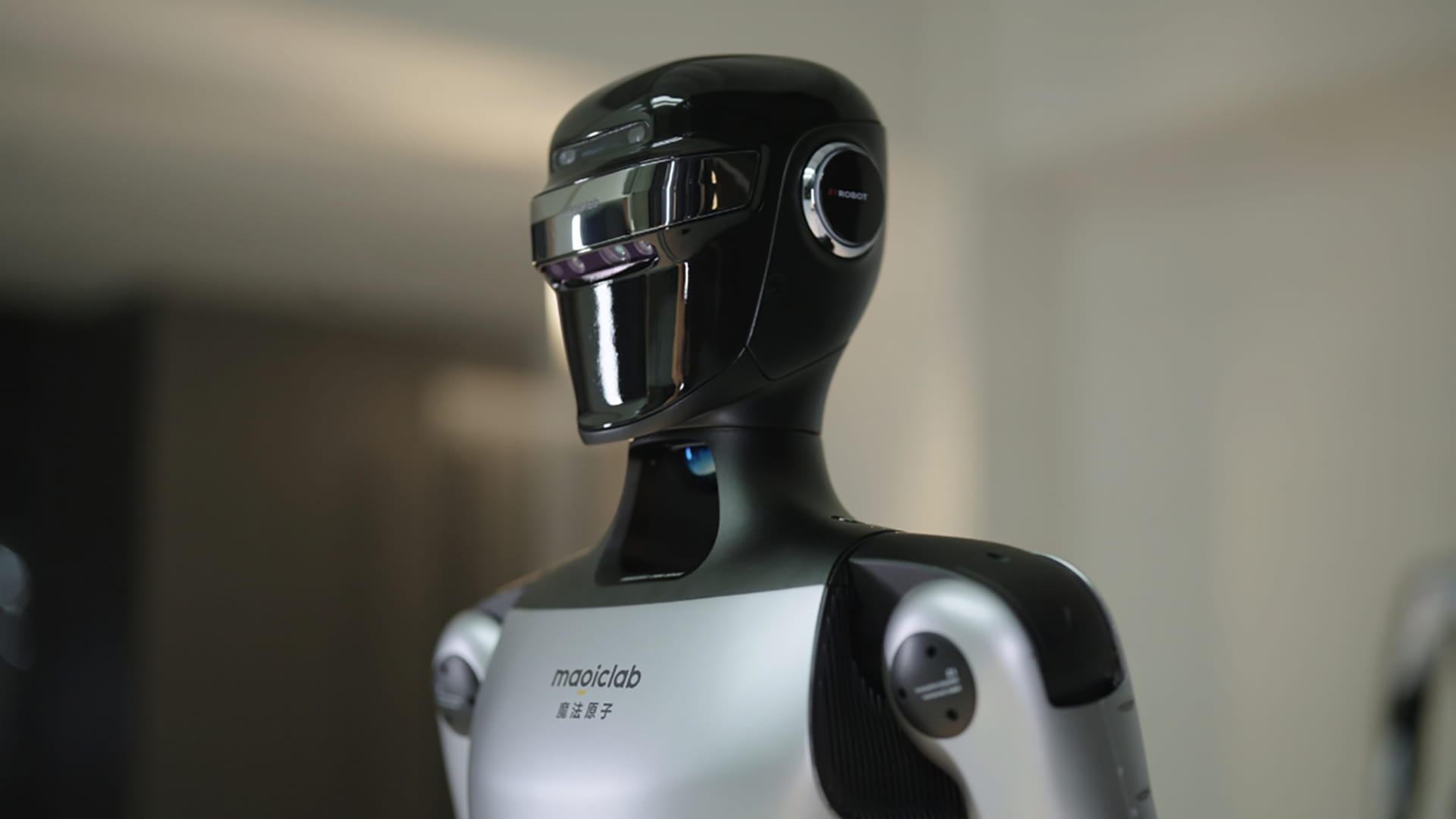
- MagicBot X1: A humanoid robot standing 180 cm tall and weighing 70 kg, with 31 active DoF and peak joint torque of 450 Nm. Its hot-swap architecture allows for continuous 24/7 operation. Available in both commercial and research variants, the latter supports foundational secondary development and customizable form factors for academic and industrial partners.
Diverse Approaches to Robot Intelligence: Insights from Silicon Valley Innovators
The summit also featured prominent embodied intelligence startups such as OpenMind, PrismaX, and Chestnut Robotics, each presenting unique methodologies in robot cognition, physical embodiment, and data utilization.
Balancing Synthetic and Real-World Data in Training
One of the persistent challenges in embodied intelligence is the scarcity of high-quality training data. Collecting real-world robotic data remains costly, time-consuming, and limited in scope. Synthetic data generated by machines offers a promising alternative but often lacks critical real-world nuances like friction, latency, and tactile feedback, leading to the well-known sim-to-real gap.
Currently, a hybrid approach combining synthetic and real-world data is favored. MagicLab’s president, Gu Shitao, shared that the company collects approximately 16,000 real data points daily, which are then amplified by a factor of 10,000 through synthetic data generation. She highlighted the automotive sector, especially new energy vehicle manufacturers, as a rich data source due to their rapid product cycles and significant human labor involvement (60-70%).
Experts agree that the optimal data mix depends on the specific training goals and application contexts. Qi Haozhi from Amazon Frontier AI & Robotics (FAR) noted that synthetic data is effective for teaching basic reactive skills but insufficient for complex, long-horizon tasks like preparing breakfast, which require real-world data due to the high cost of simulating rich environments.
Luo Zhengyi of Nvidia GEAR Lab described their training regimen as approximately 50% simulation data, 15% motion capture, 25% internet video data for human movement understanding, and 10% high-quality real-world data. Additionally, some companies leverage social media content to inform robot embodiment design.
Evaluating Vision-Language-Action (VLA) Architectures in Robotics
Vision-Language-Action (VLA) models have gained traction for their ability to generalize across tasks in embodied intelligence. However, VLA architectures have inherent limitations. For example, humans can spin a basketball on a finger relying primarily on tactile and proprioceptive feedback rather than vision, highlighting gaps in VLA’s sensory integration.
Qi Haozhi explained that the dominance of VLA stems from the maturity of vision sensors compared to the nascent state of tactile sensors. To compensate for this sensory imbalance, VLA leverages vision and language inputs to maintain robot functionality. As sensor technologies advance, it is expected that embodied intelligence algorithms will evolve beyond current VLA frameworks.
Design Debates in Dexterous Robotic Hands
The design of robotic hands sparks debate over how closely they should mimic human anatomy. Three primary design philosophies have emerged:
- Linkage-based designs: These are less anthropomorphic but offer cost-effectiveness and simpler control mechanisms.
- Tendon-driven systems: Closely replicate human hand mechanics, enabling fine manipulation but at higher costs and control complexity.
- Direct drive: Integrates actuators directly into joints, balancing performance and complexity, though challenges remain in force transmission and heat dissipation.
Recently, hybrid architectures combining tendon-driven elements with AI-enhanced control and autonomous learning have gained attention. Evan Tao, founder of Chestnut Robotics and former Tesla Optimus dexterous hand team member, advocates for this balanced approach, aiming to optimize both flexibility and engineering robustness.
Pathways to Scalable Robot Deployment
Real-world data remains crucial for enabling robots to comprehend diverse environments and execute complex tasks effectively. Li Zizheng, CEO of XGSynBot, emphasized a hybrid data strategy that incorporates a modest amount of high-quality real-world data to balance cost and model generalization.
From a systems perspective, Li advocates for transitioning robots from specialized single-task units to versatile multitasking platforms. For example, XGSynBot’s robotic arm features a modular design with six interchangeable modules, allowing rapid adaptation to various industrial processes and expanding deployment possibilities.
Jan Liphardt, founder of OpenMind and bioengineering professor at Stanford University, stresses the importance of early real-world deployment. Laboratory conditions cannot replicate challenges such as intense lighting, uneven terrain, corroded hardware, or concurrent system loads, which often cause failures post-deployment.
Therefore, Liphardt recommends introducing robots into real environments-homes, schools, airports, and public spaces-at early development stages to gather interaction data and iteratively enhance performance.