Summary: Samsung has enhanced its SmartThings platform with innovative family care functionalities that leverage connected devices and wearables to remotely oversee elderly family members. These include fall detection via robot vacuum cameras, cognitive health monitoring through behavioral analysis, environmental safety notifications, and activity tracking. The update also introduces Galaxy AI-driven routine automation, millimeter-wave ambient sensing with on-device processing, and expanded Matter camera compatibility across SmartThings’ extensive 500-million-user network.
Samsung’s latest SmartThings update introduces a comprehensive suite of family care tools designed to support remote monitoring of seniors. By utilizing data from an interconnected ecosystem of appliances-such as refrigerators, air conditioners, robot vacuums-and wearable devices, the platform now offers fall detection, cognitive health screening, and environmental safety alerts. This evolution transforms SmartThings from a convenience-focused smart home system into a proactive health and safety monitoring solution.
Innovative Family Care Features Explained
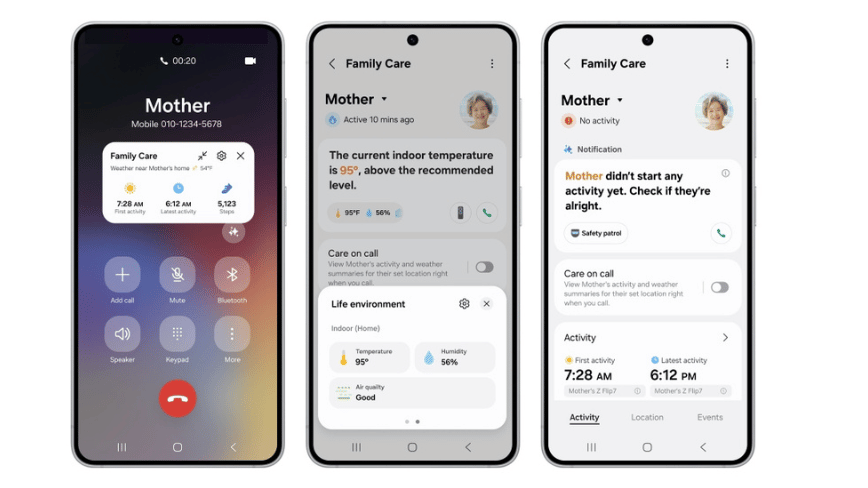
One of the standout features, Care on Call, provides caregivers with a quick snapshot of a monitored family member’s day before initiating a call. It displays key information such as the first and most recent activities, step count, and local weather conditions, all sourced from SmartThings-connected devices and Galaxy wearables. This immediate context helps caregivers assess well-being before engaging in conversation.
Reassurance Patrol leverages the 2026 Bespoke AI Steam Ultra robot vacuum as a mobile monitoring unit. If no movement is detected within a preset timeframe, the vacuum sends an alert. Equipped with a camera capable of identifying a person lying on the floor, it also supports two-way audio communication, enabling remote check-ins. This dual-purpose device seamlessly combines cleaning with safety surveillance.
Care Insight monitors environmental factors such as temperature and humidity through connected appliances like air conditioners, purifiers, and humidifiers. It alerts caregivers if conditions deviate from safe thresholds. Additionally, it tracks usage patterns of household devices and activity levels, flagging significant deviations-such as a sudden decrease in refrigerator door openings or reduced mobility-that may signal emerging health issues.
The most advanced capability is the cognitive decline detection feature. By analyzing behavioral data collected from mobile and wearable devices-including speech patterns, typing speed, gait, sleep quality, and movement-SmartThings can identify early indicators of cognitive impairment. Alerts are sent to designated caregivers when notable changes occur. This approach harnesses longitudinal behavioral insights traditionally gathered in clinical settings, now accessible in everyday environments.
Advanced Ambient Sensing Technology
At the core of these care features lies Samsung’s ambient sensing technology, which combines millimeter-wave radar with audio sensors embedded in devices like TVs and refrigerators. This system can differentiate between various activities-such as exercising, sleeping, working, or simply moving around-without relying heavily on cameras.
Importantly, all sensor data is processed locally on the SmartThings hub rather than being uploaded to the cloud, addressing privacy concerns associated with in-home radar sensors. This local data handling enables detailed monitoring of household activity patterns while minimizing external data transmission. However, care alerts do involve sharing select information with authorized family members.
Enhancements to SmartThings’ spatial interface, Map View, incorporate generative AI to improve room mapping. Users can capture photos of their spaces to generate precise floor plans. The system integrates furniture placement with ambient sensing data to better understand context-such as whether someone is in bed, seated at a table, or on the floor.
Leveraging Scale and Interoperability
Samsung’s extensive SmartThings ecosystem, boasting over 500 million users, provides a unique advantage. Many households already possess the necessary hardware-ranging from refrigerators and washing machines to TVs, robot vacuums, and Galaxy Watches-to generate comprehensive behavioral and environmental data, enabling detailed monitoring of daily life.
SmartThings also emphasizes cross-device compatibility. It is the first major smart home platform to fully support Matter-compatible cameras, collaborating with partners like Aqara, Eve, and Xthings. The new SmartThings hub integrates multiple protocols, including Thread, Zigbee 3.0, Wi-Fi 6E, Bluetooth 5.3, and Matter, while doubling as a 15-watt Qi2 wireless charger for Galaxy phones. This open ecosystem approach allows family care features to extend beyond Samsung devices to any Matter-enabled hardware.
Integration with Galaxy AI further enriches the platform. SmartThings now automatically learns user routines from sensor data on Galaxy phones, and a Routine Creation Assistant powered by large language models enables users to create automations via natural language commands. These automations can trigger care-related alerts-for example, notifying caregivers if a family member hasn’t turned on a light by their usual time.
Ethical Considerations and Challenges
While remote monitoring of elderly relatives addresses a critical need-especially for adult children living apart from aging parents-it also raises significant ethical questions. The system creates a surveillance environment within the home, managed by family members who may unintentionally overstep boundaries between care and intrusion.
Samsung emphasizes that participation is opt-in and requires consent from the monitored individual. However, consent in these contexts can be complex. Seniors experiencing cognitive decline might feel pressured to accept monitoring without fully understanding the extent of data collection and analysis involved.
The cognitive decline detection feature, in particular, warrants scrutiny. Clinical cognitive assessments require controlled environments and expert interpretation. Samsung’s passive monitoring of behavioral signals-such as gait changes, typing speed, and speech-relies on correlations identified in research but lacks publicly disclosed data on accuracy, false positives, or clinical validation. Misinterpretations could lead to undue anxiety or false reassurance.
These concerns are not unique to Samsung; major tech companies like Apple, Google, and Amazon are also integrating health monitoring into their ecosystems, facing similar ethical dilemmas. Samsung’s strength lies in its broad appliance ecosystem, offering more comprehensive in-home data than phone- or speaker-centric platforms. The impact of this advantage depends on thoughtful feature design and transparent communication with users and families.
Availability and Future Outlook
The elder care functionalities are slated to launch alongside the Galaxy S26 release in late 2026. Meanwhile, SmartThings Pro-targeted at HVAC professionals-and energy management enhancements are currently available. Samsung has yet to reveal pricing details for the family care features or whether they will require subscriptions beyond existing SmartThings plans.