
Groundbreaking Robotic Surgery at St Vincent’s Hospital Saves Melbourne Man’s Voice and Life
A Life-Changing Diagnosis
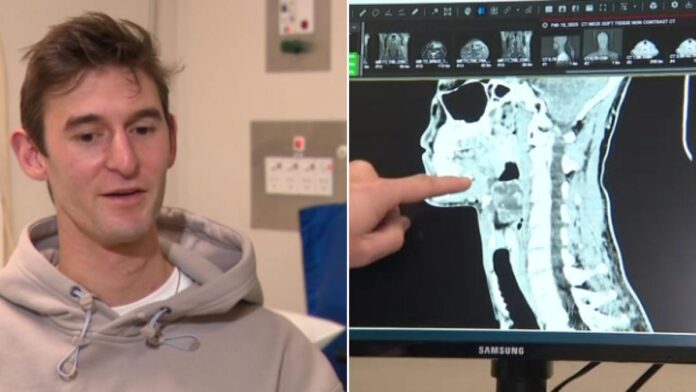
In a pioneering medical achievement, St Vincent’s Hospital successfully performed a robotic surgery on 27-year-old Jordan Robotis from Melbourne, preserving both his voice and life. Jordan, who works in before-and-after-school care, first noticed changes in his voice around the Christmas period. Concerned, especially after his cousins spotted a lump on his throat, he sought medical advice.
From Uncertainty to Clarity
Initial examinations, including ultrasounds, CT scans, and biopsies, left doctors uncertain about the nature of the lump. Eventually, Jordan was referred to St Vincent’s Hospital, where specialists provided a definitive diagnosis. The tumor was situated in a highly intricate region of the neck-nestled between the voice box and the side wall of the mouth-an area densely packed with vital nerves and arteries.
Facing a Daunting Prognosis
Jordan recalls the shock of hearing the initial prognosis. Another hospital had warned him he might lose his ability to speak or eat, predicting he would require tube feeding indefinitely. “They told me I would lose my voice completely and never be able to speak or eat again,” he shared. Despite this grim outlook, Jordan was referred to Professor Ben Dixon, Director of the ENT, Head and Neck Service at St Vincent’s, who offered a more hopeful path forward.
Innovative Surgical Approach Using Robotics
Professor Dixon explained that the surgery demanded complete tumor excision with clear margins to prevent recurrence. However, the challenge was to preserve essential functions such as breathing, swallowing, and speech. Traditional surgical methods risked significant impairment and the need for a tracheostomy.
Utilizing the da Vinci robotic system, the surgical team approached the tumor from inside the mouth, allowing for unparalleled precision. “We were able to delineate the tumor boundaries internally and make meticulous incisions around the throat lining and voice box to maximize functional preservation,” Professor Dixon said. This minimally invasive technique reduced the risk of complications and improved recovery prospects.
Microsurgical Reconstruction with Robotic Assistance
Following tumor removal, plastic surgeon Dr. Edwin Morrison employed the Simani microsurgical robot to reconstruct the affected area using tissue harvested from Jordan’s leg. This advanced robotic system enables surgeons to operate at a microscopic scale, repairing blood vessels as small as 1 to 1.5 millimeters in diameter-an extraordinary feat that would be challenging without robotic precision.
Dr. Morrison emphasized, “Our objective is to restore blood flow and functionality, ultimately improving the patient’s quality of life. Robotics provide us with superhuman capabilities to achieve this.”
Recovery and Reflection
The operation took place on May 5th, marking a significant milestone in Jordan’s journey. The initial recovery phase was intense, with considerable pain and difficulty. “Those first few weeks were the hardest of my life,” Jordan admitted. However, as time passed, healing progressed, and he began regaining strength.
Jordan recently returned to St Vincent’s to express his gratitude to the medical team. “I was amazed at how swiftly and effectively everything was handled. I’m just grateful to be here,” he said.
The Future of Robotic Surgery in Public Healthcare
Professor Dixon highlighted Jordan’s case as a prime example of how robotic-assisted surgery is revolutionizing patient outcomes, especially in complex cases involving critical anatomical structures. “This technology allows us to offer patients a high quality of life post-treatment,” he noted. Importantly, efforts are underway to make such advanced procedures accessible to a broader public patient base.
Addressing common concerns about robotic surgery, Professor Dixon clarified, “The robot is a tool fully controlled by the surgeon-it is not autonomous. The expertise and decision-making remain firmly in the hands of the medical professional.”
Conclusion
Jordan Robotis’s story underscores the transformative potential of robotic technology in modern medicine. With over 1 million robotic surgeries performed worldwide annually as of 2024, this approach is becoming a cornerstone in treating complex conditions while preserving vital functions. As robotic systems continue to evolve, patients like Jordan can look forward to safer surgeries, faster recoveries, and better quality of life.