As the summer approaches, US homeowners will once again be faced with a familiar problem: overgrown grass. This year, what used to be a seasonal nuisance is evolving into a more competitive situation: a turf battle led by Chinese robotic mower makers.
North America is their endgame, the biggest and most difficult market to enter.
Gao Lufeng is the founder and chairman of Segway-Ninebot. He told 36Kr about an inflection point for the US market. The company is expanding its retail presence. It has already secured a deal with Lowe’s and discussions are ongoing with other major retailers.
Agilex Robotics, Luba’s consumer brand (by Mammotion), announced a recent partnership with the United Soccer League in order to increase brand awareness. A person familiar with Agilex said that the company has stocked over 300,000 robotic lawn mowers between January and May.
Dreame, on the other hand, continues to focus its efforts in Europe. The three models are aimed at lawns of a medium size.
Frost & Sullivan estimates that the global outdoor power equipment market (OPE) is now worth USD 30 billion. Robotic lawn mowers only make up USD 2.6 billion and have annual unit sales between 1.2 and 1.3 million. This is less than 5% of the market. By 2030, the number could rise to five to ten millions units.
North America is the largest lawn care market in the world. It offers significant growth potential.
The US has not yet adopted robotic mowers widely, despite accounting for nearly 60% global lawn mower sales. The penetration rate is still below 3%. The main barrier to penetration is a lack of consumer awareness.
Companies that want to establish themselves on the market have a limited window. The first to secure retail outlets, localize technology and build a presence for their brand will have an edge.
Unlocking a market
The US marketplace presents unique challenges because of distinct consumer behavior.
In Europe users have been conditioned by years of using robotic mowers with boundary-based technology. These older models, although expensive and difficult to install, helped users become accustomed to smarter lawn care solutions.
This experience created a receptive market for boundary-free robot mowers that eliminate the need for wire installation by hand and offer greater flexibility. In the US, however, things are different. According to the National Gardening Association (NGA), about 42% middle-class households prefer to mow their own lawns. The wealthy homeowners hire professional gardening services. These services are usually staffed by Mexican workers and charge USD 50-100 for each visit. This adds up to about USD 1,000-2,500 a year with 25 visits.
According to Zhang Jia, a hardware startup investor who follows overseas hardware startups, “US consumers are more concerned about efficiency and value rather than smart features.” “The core question is, can it cut the grass well?”
Former executive of a robotic lawn mower company echoed that view:
Companies worry that if investing heavily in educating US customers, latecomers will just swoop and capitalize on newly built awareness.
The typical yard size ranges from 1,000 to 5,000 square meters. Many yards are semi-open with an average tree cover of 15 percent and gradients above 20 degrees. Some slopes even reach 30°. In peak season, grass types such as tall fescue or ryegrass can grow up to 1.5 centimeters a day. This calls for strong blades, and frequent mowing.
Variations in local conditions further complicate the situation. In Florida, sandy soil can cause wheel slippage. Cactus plants in Texas can puncture tires. There are thousands of lawn conditions.
While basic push mowers are sold for less than USD 100, robotic mowers can cost over USD 1,000. Their popularity is due to the fact that they are easy to use and inexpensive to maintain.
Robotic mowers need to improve significantly in order to gain traction in America. Motors require more torque on steep slopes. This drains batteries and stresses gearboxes. Dense grass can dull blades, reducing their efficiency and causing tears instead of clean cuts.
Zhang said, “A robotic lawnmower is essentially a compact intelligent vehicle.” “Its standards of design should be more in line with those of the automobile industry than small appliances or toys. Weaknesses in any key component could affect the entire user experience.
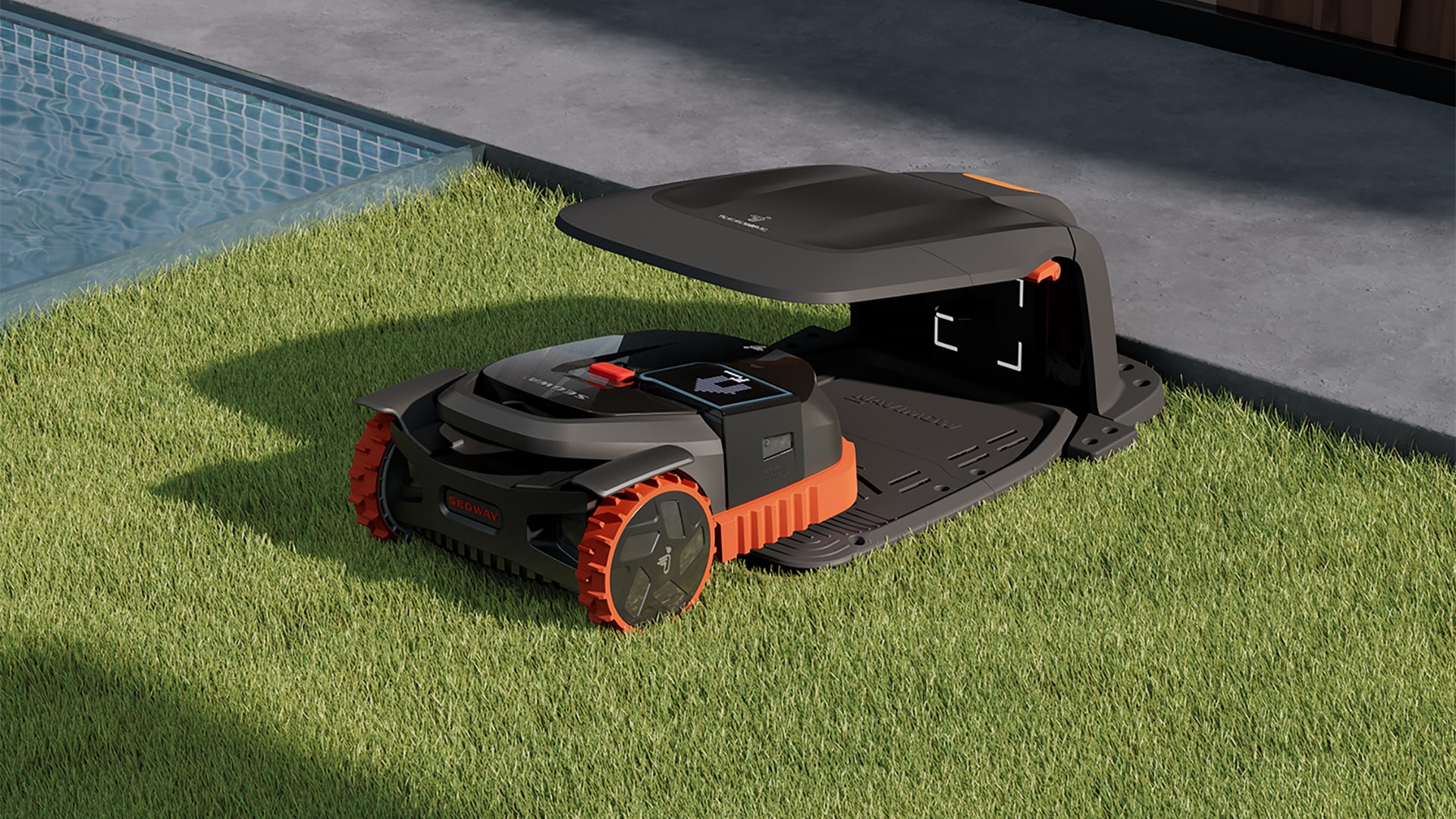
US customers have little tolerance for flaws. One industry insider stated that consumers expect a near-flawless product and service experience, which forces manufacturers into investing heavily in customer support. Major players are taking action. Willand, a subsidiary of Segway-Ninebot, launched the Segway Navimow X3 at a Paris launch in April. The X3 is over half a meter wide, can climb slopes of up to 26.6%, and can cover up to 10,000 square metres.
The X3 uses real-time Kinematic (RTK), a positioning system that combines visual sensors with real-time kinematics, to provide a wide coverage area and reduce signal latency. Its updated obstacle avoidance algorithm detects objects down to one centimeter.
Agilex has introduced its Luba 2 AWD Series for lawns of up to 2.5 acres. These models can handle gradients up to 38.6° and perform well in uneven terrain, tall grass and gravel.
Many companies are exploring high-end technology like LiDAR (light detecting and ranging). Agilex launched the Luba Mini AWD LiDAR recently, which it claims to be the industry’s very first solid-state LiDAR lawn mower. It has partnered up with RoboSense to produce 1.2 million units. This is a substantial investment.
“Unlike automotive, robotics does not benefit as much from the scale effects,” said a core component provider. “The robotic mower supply chains are maturing, but it will take time for cost reductions to occur.”
The key to survival is speed
Segway Ninebot reported RMB 861 (USD 120.5) million in robotic mower revenue by 2024. It sold 33,100 units for RMB 180 (USD 25.2) million in the first quarter, indicating that total 2024 shipments will exceed 140,000 units. It reported that it had over 240,000 users worldwide as of May 2025.
Agilex expects to sell more than 300,000 Luba mowers in 2025. It now serves over 400,000 households.
Dreame announced in February that its robotic mowers had sold more than 100,000 units.
The success of this category depends on the quality of customer service, the user experience and distribution strategy. Leading brands are vying for retail space.
US retail is fragmented. It includes garden tool specialty stores, big-box retail, and online platforms like Amazon and direct-to consumer (D2C). Each channel caters to different consumers. Specialty dealers such as SiteOne and John Deere, which offer high-end models above USD 2,500 with tailored installation and support after the sale, account for 35 percent.
Home Depot and Lowe’s account for 40% of the market. These stores sell mid-range mowers for USD 800-1,500, and attract DIY buyers by offering seasonal discounts up to 25%.
The remaining 25% is made up of online sales, which are growing. Amazon has created a dedicated robotic mowers category, while D2C platforms are helping brands increase traffic and brand awareness.
A manufacturer stated that online and offline sales in the US should be equally split. Kickstarter’s revenue is still dominated by e-commerce with only a minimal offline presence.
High-ticket items such as robotic mowers require customer trust and long-term service. US retailers will not take on unknown brands without a fight, and if so, they’ll be charged high listing fees. “Cross-channel marketing is crucial right now,” said the person. Segway-Ninebot, Dreame and
are the leaders in this area. Both companies have partners in North America, Europe and some distributors are requesting product tests proactively. Xu Peng is Segway-Ninebot’s vice president and board secretariat. She told 36Kr that the company is leveraging existing Segway brand awareness. It works with US influencers, lawn care creators and other professionals to produce demonstration videos and hands-on tests.
Lowe’s and the partnership will start with online sales, then expand to physical stores.
It takes time to break into the US market. “Once users are educated, the long-term potential here is bigger than Europe,” Xu stated.
Segway’s Navimow was the top seller on Amazon in Germany in April.
Agilex introduced price tiers for its Luba line to reflect different lawn types. In the first quarter 2025, two Luba mowers ranked number one in the robotic mower categories of Amazon in Germany France and the US. Within a month after launch, the Luba 2 AWD 10,000H generated more than USD 4 million per month in US sales.
Dreame’s robotic mower business is still primarily focused on Europe, leveraging its vacuum cleaner distribution networks. It uses online campaigns in the US to drive traffic to its retail partners. Industry insiders said that Dream’s strength lies in the execution of supply chains. “They are quick to ship and adjust, which gives them an advantage in retail rollout.” Companies that secure strong retail channels early have the best chance to build regional dominance.
This spells trouble to startups. Innovation in product design will not suffice. They must scale up their distribution quickly. The window of opportunity to act is rapidly closing as the peak mowing period approaches. Speed may be the deciding element in this race.
KrASIA Connection includes translated and adapted material that was originally published 36Kr. This
Huang Nan wrote the article for 36Kr.