
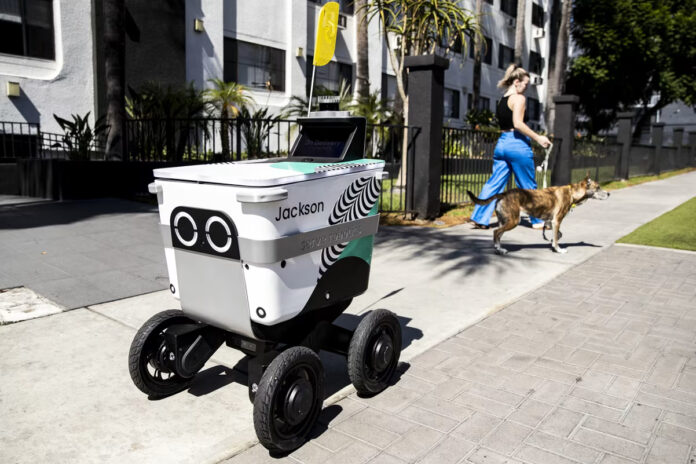
Meet Courtney: The Autonomous Food Delivery Robot Navigating Atlanta’s Streets
In the bustling neighborhoods of Atlanta, a new kind of delivery agent has quietly rolled onto the scene. Named Courtney, this autonomous robot is part of Serve Robotics’ fleet, designed to transport Uber Eats orders within a mile radius from restaurants to customers. Unlike humans, Courtney lacks eyes but is equipped with an array of sensors, and two blinking lights on its boxy frame mimic wide, expressive eyes, giving it a friendly, approachable appearance.
Challenges on the Urban Terrain
Despite its innovative design, Courtney and its robotic counterparts-such as Deandre and Orion-face significant hurdles navigating the city’s uneven sidewalks and busy streets. Their cautious, sometimes erratic movements resemble those of novice drivers, occasionally accelerating unexpectedly. Although outfitted with rugged four-wheel designs, these robots often get stuck in sidewalk cracks or pause frequently, making their presence more noticeable for their stillness than their speed.
From Novelty to Neighborhood Fixture
When these delivery robots first appeared in Atlanta in late June, they sparked curiosity and excitement. Residents eagerly snapped photos and shared videos on social media, heralding a glimpse of the future. However, after three months, the initial fascination has faded. Now, locals treat them as just another obstacle to navigate around, much like the ubiquitous electric scooters and bikes that clutter sidewalks. At popular spots like Shake Shack, customers weave past these robots to place orders on nearby iPads, signaling their integration into daily life.
Robots Are Here-But Are They Ready?
Ali Kashani, CEO of Serve Robotics, emphasizes that autonomous delivery robots are no longer a distant concept-they are already operating in select cities. Yet, despite their growing presence, these machines have yet to prove their reliability or usefulness fully. Experts like Joanna Bryson, an AI ethics professor, caution that while these robots may seem friendly, they function as data-collecting devices for corporations, raising valid privacy concerns.
Public Reception and Ethical Considerations
Edward Ongweso Jr., a technology researcher and critic of rapid tech deployment, highlights the importance of public consent in introducing such innovations. He notes that many communities have little say in the arrival of these robots, which are often rolled out in ways that inconvenience residents. Ongweso argues that if people were given choices about the types of robots integrated into their environments-whether at home, work, or public spaces-the reception might be more positive.
Expanding Robot Delivery Across Cities
Atlanta is not alone in embracing robotic delivery. Companies like Avride and Coco Robotics have launched similar services in metropolitan areas including Chicago, Dallas, and Jersey City, as well as smaller university towns. Meanwhile, ride-hailing giants Uber and Lyft are testing autonomous vehicles, with some cities seeing a surge in demand for driverless rides. For instance, in Atlanta, many riders now prefer waiting for a Waymo self-driving car over a human driver.
The Business Behind the Bots
Ongweso points out that these robots are primarily commercial products designed to generate profit for investors. Humanizing them with names and playful LED eyes may encourage public acceptance, but ultimately, they represent a business model rather than a genuine social companion. This commercialization raises questions about the true impact of these machines on communities and labor markets.
Personal Experience: The Elusive Robot Delivery
Despite ordering Uber Eats multiple times from restaurants within walking distance, the author rarely encountered a robot courier in action. Human cyclists consistently delivered meals within 15 minutes, while the robots remained mostly stationary, often congregating in designated hubs. This scarcity makes it difficult to assess the effectiveness of robotic delivery services in real-world conditions.
Potential Benefits and Limitations
Kashani explains that Serve Robotics introduced these bots to reduce traffic congestion in car-dependent cities like Atlanta. Their deliveries typically cover short distances in about 18 minutes and are engineered to withstand extreme weather, including heat and snow. The company envisions these robots contributing to safer streets, lower pollution levels, and expanded delivery capabilities for local businesses. Additionally, robotic delivery could reduce costs for consumers by eliminating tipping.
Concerns Over Deployment and Equity
However, the initial deployment has focused on Atlanta’s most walkable and affluent neighborhoods, raising questions about whether these areas truly need such technology. Critics argue that prioritizing wealthier districts may exacerbate existing inequalities, leaving underserved communities behind.
Broader Reflections on AI and Automation
While delivery robots like Courtney represent a tangible example of AI integration into daily life, concerns about the broader implications of artificial intelligence persist. Technologies such as ChatGPT have sparked debates about misinformation, mental health, and societal impact. Moreover, automation threatens to displace human workers, as companies increasingly rely on robots to perform tasks once done by people.
Expert Insights on Safety and Regulation
Dylan Losey, an assistant professor specializing in human-robot interaction, supports the use of robots for repetitive tasks like food delivery but expresses caution about their interaction with humans. He highlights the lack of standardized safety regulations and independent verification for the hardware and software controlling these machines. This regulatory gap places the onus on users to trust that these robots operate safely and ethically.
Final Observations: Coexisting with Delivery Robots
In a recent attempt to engage with the robots, the author observed a group of bots outside a Shake Shack, some displaying promotional messages and delivery status flags. Despite waiting patiently, none of the robots moved to fulfill the order. While these machines are more of a mild nuisance than a threat, incidents elsewhere-such as a viral video showing a delivery robot obstructing a man in a wheelchair-highlight ongoing accessibility and safety challenges.
Looking Ahead: The Future of Robotic Delivery
The growing presence of delivery robots signals an inevitable shift toward increased automation in urban environments. As AI becomes deeply embedded in communication, creativity, and daily routines, society must grapple with the consequences of this transformation. While these robots may offer convenience and environmental benefits, their integration raises critical questions about privacy, equity, and the human experience in an increasingly automated world.