How Weaver Ants’ Teamwork Could Revolutionize Robotics
For centuries, human groups have struggled with a common challenge: as more members join a team, individual effort tends to decline. However, recent research reveals that weaver ants (Oecophylla smaragdina), remarkable insects native to tropical regions of Africa and Asia, defy this trend by increasing their individual strength as their group expands. This discovery, published on August 12 in Current Biology, offers promising insights for advancing robotic collaboration.
Overcoming the Classic Teamwork Dilemma
Back in 1913, French engineer Max Ringelmann observed that when people pulled on a rope together, the total force increased with more participants, but each person’s individual contribution diminished-a phenomenon now known as the Ringelmann effect. In stark contrast, weaver ants demonstrate a unique form of synergy where each ant’s pulling power nearly doubles as the team grows larger, showcasing an extraordinary level of cooperative efficiency.
Unveiling the Ants’ Cooperative Mechanics
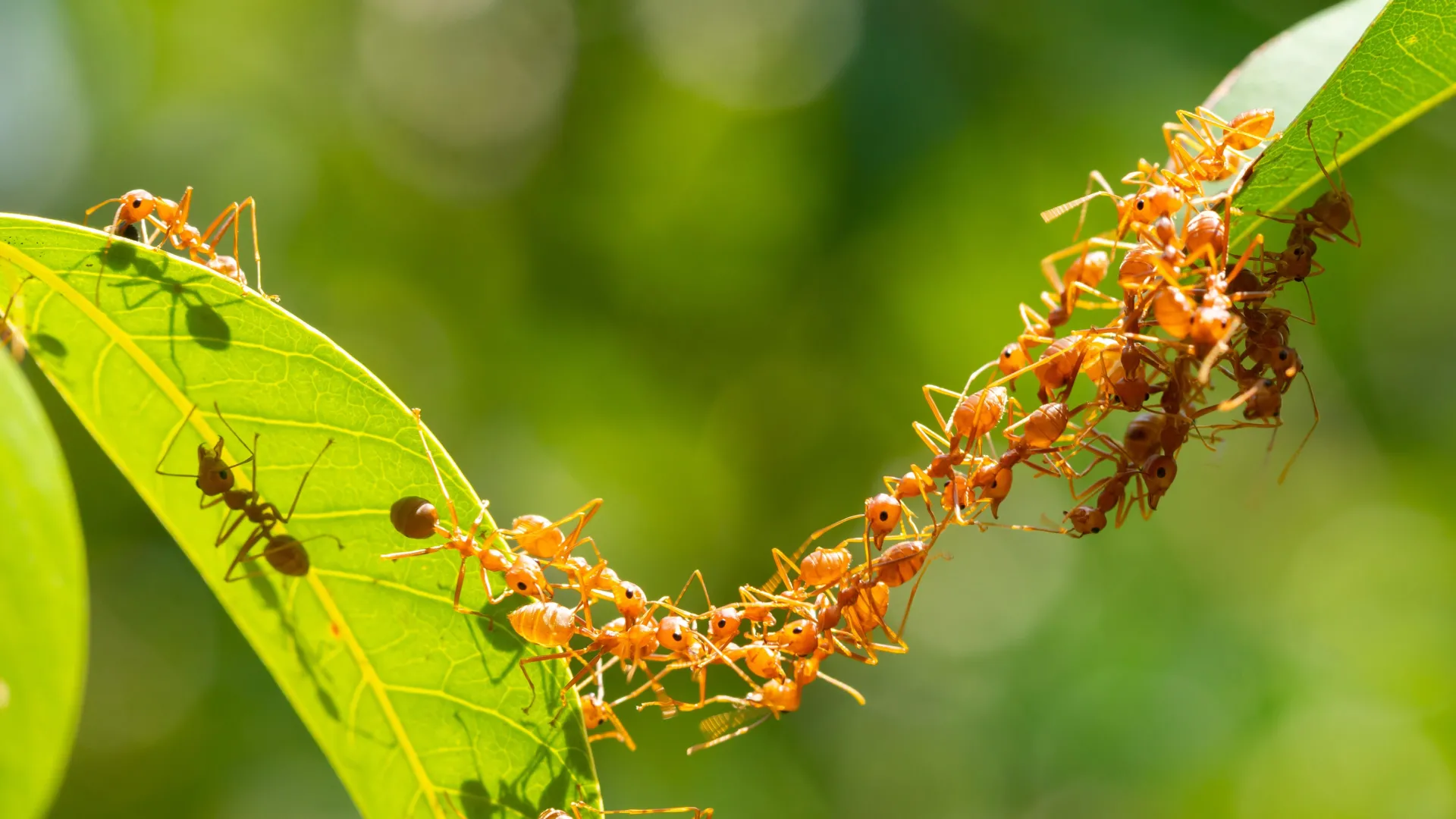
These arboreal insects are famous for their intricate nest-building, where they link together to form living chains that manipulate leaves, binding them with silk produced by their larvae. Researchers from Macquarie University, led by Madelyne Stewartson, alongside Dr. Chris Reid and an international team, conducted experiments measuring the force exerted by weaver ant groups of varying sizes. By encouraging the ants to pull on artificial leaves connected to force meters, they quantified how group size influenced individual and collective strength.
The “Force Ratchet” Model
Dr. Daniele Carllesso from the University of Konstanz introduced the “force ratchet” theory to explain this phenomenon. According to this model, ants positioned at the rear of the chain stretch their bodies to absorb and store tension, effectively acting as force reservoirs, while those at the front maintain active pulling. This division of labor allows the team to amplify the force generated per ant as the group expands.
Implications for Robotics and Autonomous Systems
Dr. David Labonte of Imperial College London, a co-author of the study, emphasized that this mechanism is crucial for enhancing individual contributions within a team. Currently, robotic systems often face limitations where adding more units does not increase the force output per robot. Dr. Reid suggests that integrating ant-inspired cooperative strategies into robotic programming could enable swarms of autonomous robots to collaborate more effectively, optimizing their collective performance.
With the global robotics market projected to surpass $210 billion by 2025, innovations inspired by natural systems like weaver ants could accelerate the development of more adaptive, efficient robotic teams capable of complex tasks in manufacturing, disaster response, and beyond.