Tom Burick has always embraced the role of a creator. His journey spans designing advanced robots, restoring a classic teardrop trailer, and most recently, guiding students through the construction of a full-scale model of the groundbreaking 1940s computer, ENIAC.
Currently a technology educator at PS Academy in Gilbert, Arizona-a school dedicated to supporting students with autism and other unique learning profiles-Burick launched an ambitious project at the start of the 2025-26 academic year. Together with his students, he embarked on recreating the Electronic Numerical Integrator and Computer (ENIAC) to commemorate its 80th anniversary. ENIAC, recognized as one of the earliest programmable electronic computers, was revolutionary in its era, operating approximately a thousand times faster than its contemporaries.
Early Inspirations and the Path to Robotics
Growing up in Latrobe, Pennsylvania, Burick’s fascination with robotics was sparked by the television series Lost in Space, featuring a protective robot companion. “That robot was the boy’s closest ally, and I was instantly drawn to it. I wanted something like that in my life,” he recalls. This fascination ignited a lifelong passion for robotics and technology.
Starting with makeshift toy robots crafted from everyday materials, Burick integrated electronics by junior high. By high school, he was engineering sophisticated autonomous machines controlled by microprocessors. At just 15, he built a 150-pound steel firefighting robot, earning accolades from IEEE and other prestigious organizations.
His drive led him to seek mentorship from local universities. A pivotal moment came when a Carnegie Mellon University student invited him to tour their robotics lab, providing textbooks and components that fueled his self-education. Additionally, a robotics professor at Saint Vincent College allowed him to audit classes, further shaping his expertise. These experiences, Burick notes, “altered the course of my life.”
Despite his enthusiasm, Burick found traditional college settings limiting, especially given his diagnosis of dyscalculia, which made conventional math challenging. This condition encouraged him to develop innovative engineering approaches outside standard academic frameworks.
Entrepreneurship and Innovation in Robotics
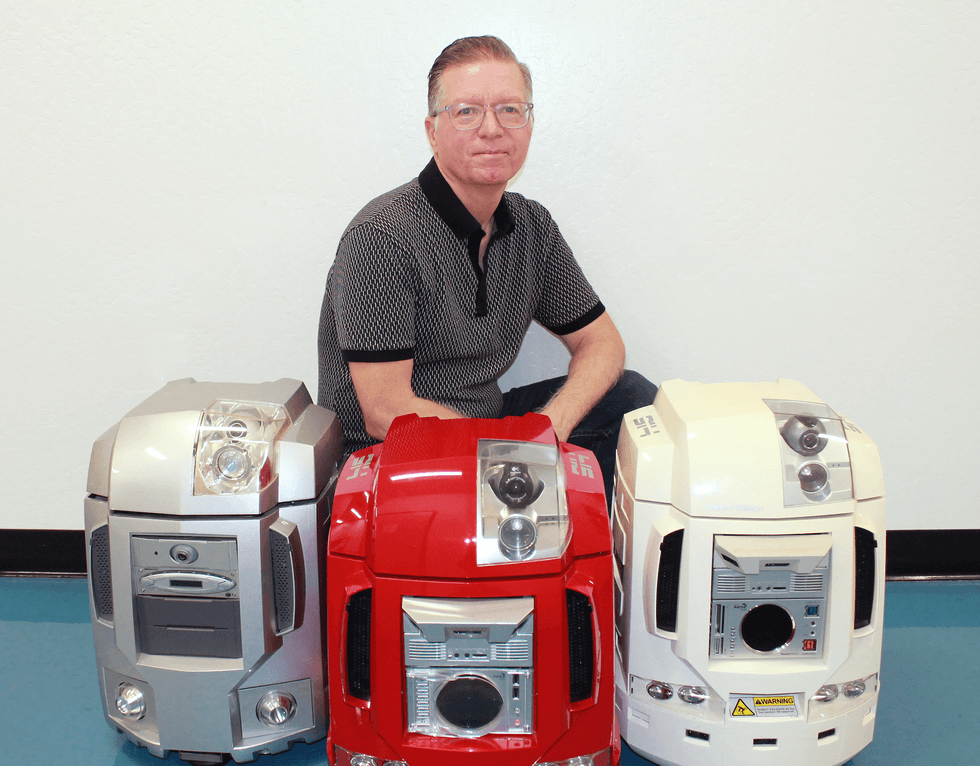
After high school, Burick gained experience in various technology roles before launching his own venture. In 2000, he founded White Box Robotics, inspired by the concept of “white box” PCs-customizable computers built from standard parts. He envisioned applying this modular philosophy to robotics, creating a versatile platform where components like chassis, drive systems, and sensors could be easily interchanged.
The result was the 914 PC-Bot, a robot platform likened to a “box of Legos” for its adaptability. Burick secured multiple patents for the design, and after merging with Canadian defense firm Frontline Robotics, the company sold around 200 units across 17 countries.
However, the 2008 economic downturn forced White Box Robotics to close in 2010. Reflecting on his journey, Burick says, “I lived my dream for a decade.” Following the closure, he sought a new direction, inspired by the mentors who had once supported him, leading him to a career in education.
Championing Neurodiversity in Education
In 2013, Burick began working with a vocational program for young adults on the autism spectrum, establishing its technical division. By 2019, he joined PS Academy Arizona as a technology instructor, where he connects deeply with his students, many of whom share neurodivergent traits.
Burick openly discusses his own experiences with dyscalculia, emphasizing the unique strengths it has fostered, such as exceptional 3D spatial reasoning. “I have a CAD program running in my mind constantly,” he explains. “My success in robotics is largely due to this condition-it’s been my superpower.”
He encourages students to view their neurodiversity as an asset rather than a limitation. “It requires persistence, but it also brings remarkable gifts,” he tells them. His teaching philosophy centers on leveraging these strengths, designing projects that harness students’ abilities to hyperfocus and execute precise, repetitive tasks.
Constructing the ENIAC Replica: A Collaborative Endeavor
Burick has incorporated lessons about ENIAC into his curriculum for years. Learning that the original 27-ton computer was dismantled and partially destroyed after its 1955 retirement, with only fragments displayed in museums, he and his students aimed to recreate the full machine to offer a tangible historical experience.
They began with a one-twelfth scale model to grasp the computer’s complexity. Encouraged by the students’ enthusiasm, Burick proceeded to source materials for the life-size build. ENIAC’s design featured 40 large metal panels arranged in a U-shape, housing vacuum tubes, resistors, capacitors, and switches. The students tackled the 20 identical accumulator panels first, a process demanding meticulous precision to avoid compounding errors.
The project culminated in assembling three function tables-each containing banks of switches for numerical constants-two punch-card machines, and installing 18,000 simulated vacuum tubes. The construction consumed nearly 300 square meters of heavy cardboard, 1,600 hot-glue sticks, and seven gallons of black paint.
Reflecting on the scale and detail, Burick shares, “When we finished, it felt like being surrounded by a team of scientists.”
Continuing the Legacy of Hands-On Learning
Prior to the ENIAC project, Burick’s students built an 8-foot drivable Tesla Cybertruck replica, complete with a 400-watt stereo and subwoofer. Looking ahead, he plans to undertake another ambitious build, possibly recreating a spacecraft from the Apollo moon missions.
“Every day, I get to share my passion for robotics and technology with students,” Burick says. “It’s fulfilling to be in the role of mentor, just as others were for me. It completes a meaningful cycle.”