Vbot’s Vision: Redefining Robotics as Human Companions
In late 2023, following a strategic session at Horizon Robotics, Yu Yinan, then head of the company’s smart driving division, joined CEO Yu Kai, CTO Huang Chang, VP Su Jing, and other leaders for dinner. The conversation naturally shifted toward the future trajectory of robotics technology.
While Horizon Robotics is widely recognized for its AI chip innovations, the company’s ambitions have always extended beyond semiconductors, envisioning a future where robots play a pivotal role in everyday life.
During that evening, opinions diverged sharply. Some participants, dubbed “arrivalists,” anticipated a future where robots might dominate humanity, akin to science fiction’s Trisolarans. Others, the “control theorists,” foresaw humans managing fleets of robotic laborers. Yu Yinan offered a third perspective: robots as companions-entities that coexist with humans on equal footing rather than as mere tools or overlords.
Inspired by this philosophy, Yu departed Horizon Robotics a year later to establish Vbot, a startup dedicated to embodied intelligence and consumer-focused robotics.
Introducing BoBo: The Quadruped Companion Robot
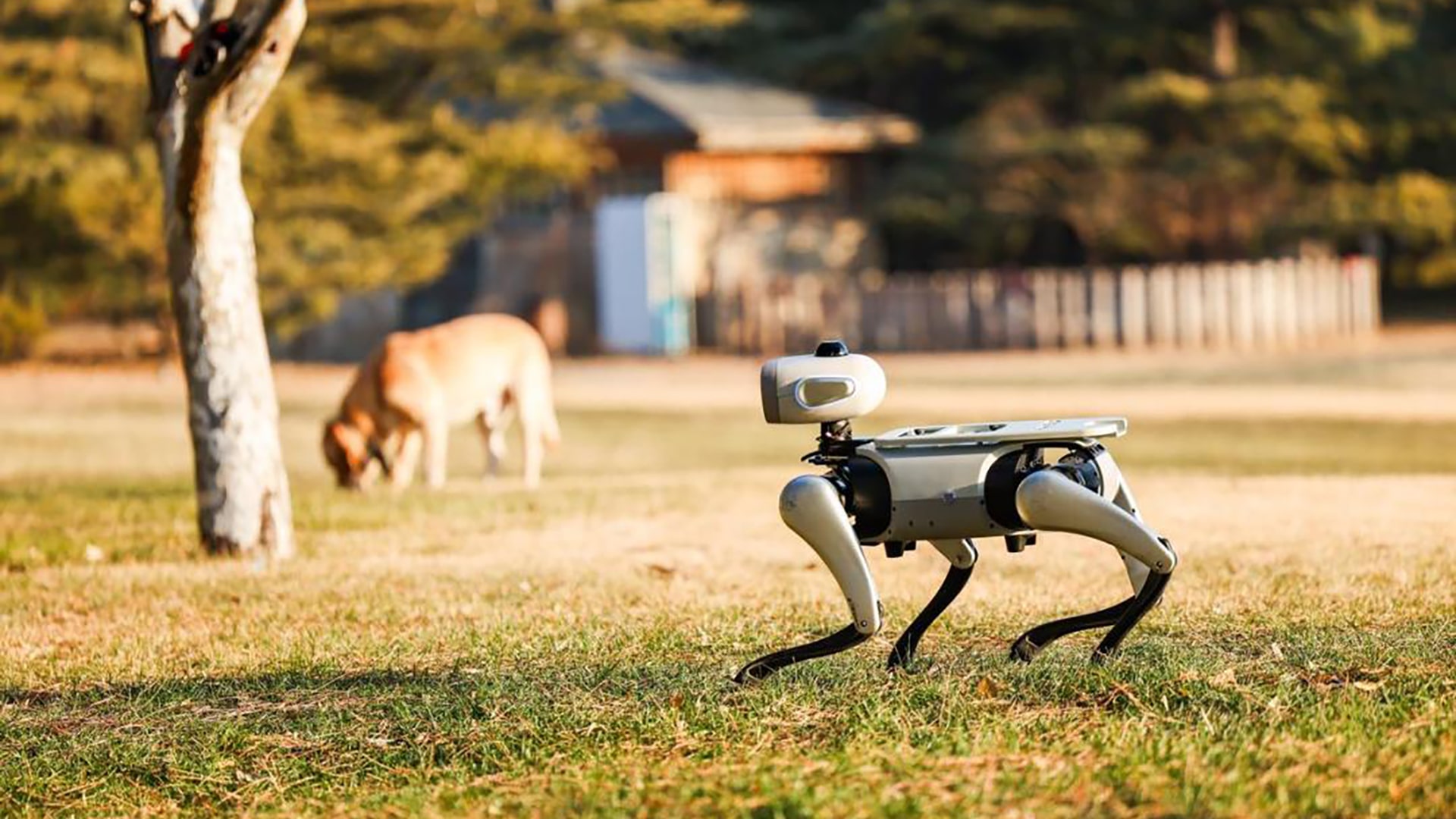
On December 23, Vbot launched preorders for BoBo, a quadruped robot priced at RMB 9,988 (approximately USD 1,398). Named for its distinctive oversized head, BoBo is tailored to three primary user groups:
- Children: BoBo serves as a playful companion, capable of chatting, engaging in outdoor activities, and capturing daily moments.
- Seniors: It assists with carrying groceries, provides illumination during nighttime walks, accompanies users on strolls, and autonomously patrols the home environment.
- Tech Enthusiasts: Its modular backplate supports add-ons like cargo baskets for camping, remote parcel retrieval, or exploration of challenging terrains.


Engineering BoBo for Domestic Life
BoBo is engineered primarily for home use, where safety and stability are paramount. It can navigate diverse surfaces and walk alongside its owner without requiring a remote control. Its smooth, rounded exterior minimizes injury risks, a critical feature for households with children and elderly members.
Unlike many hardware startups that frequently pivot, Vbot has maintained remarkable consistency. Observers who reviewed the company’s initial design drafts in early 2025 would recognize the final product’s close adherence to those original plans.
Within just over a year, Vbot transitioned from concept to prototype, mold creation, and mass production with impressive precision. When asked if this discipline stemmed from his B2B experience, Yu acknowledged the influence, citing Horizon Robotics’ decade-long strategic stability as a model.
From B2B Foundations to Consumer-Centric Innovation
Yu’s nine-year tenure at Horizon Robotics included co-developing the Journey series of AI chips and collaborating with automakers like Changan Automobile and Li Auto. However, he views B2B and B2C markets as fundamentally distinct. In consumer robotics, success hinges on a sharply focused product vision tailored to specific user needs.
Yu highlights companies such as DJI and Insta360 as exemplars of brands that have thrived by identifying and addressing personalized consumer demands.
“Understanding precisely who your customer is forms the cornerstone of any consumer product design,” Yu emphasizes.
BoBo’s Role as a Family Companion
BoBo’s identity as a “companion robotic dog” is deeply personal to Yu, inspired by his experiences as a father. He envisioned a robotic partner for his ten-year-old daughter to explore the outdoors with and a playful friend for his three-year-old son.
In user trials at a Beijing elementary school, 40% of children described BoBo as a “big brother,” perceiving it not merely as a toy but as a reliable peer offering companionship.
This sense of connection relies heavily on advanced AI capabilities, particularly in natural language understanding and cognitive functions.
Hybrid AI Architecture: Balancing Cloud and Edge Intelligence
BoBo leverages cloud-based large language models like Qwen and MiniMax for complex language comprehension and reasoning tasks. Meanwhile, perception, decision-making, and motion control are managed locally through proprietary models. This hybrid approach reduces training expenses while ensuring responsiveness and reliability, even in low-connectivity environments. Additionally, it enables the collection of valuable motion data to inform future product enhancements.

Insights from Yu Yinan: The Journey Behind BoBo
Why Hands-On Demos Matter
Yu Yinan: “Watching a video or attending a live demo can’t compare to users trying the product themselves. Videos can be edited, and demos are controlled environments. Real-world use is unpredictable, so we wanted people to experience BoBo’s reliability firsthand.”
Maintaining Design Consistency
Yu Yinan: “We designed BoBo for our own families. While the surface goal was to create a playmate for children, the deeper purpose was to encourage outdoor exploration. This ‘demand behind the demand’ kept our vision steady despite external feedback.”
Choosing the Quadruped Form
Yu Yinan: “We evaluated three consumer robot categories: public service, household labor, and companionship. Humanoid robots suit the first two but remain long-term projects. Quadrupeds are currently the most mature and commercially viable form for home companionship.”
Consumer Readiness of Four-Legged Robots
Yu Yinan: “BoBo meets key criteria: smooth mobility, safe remote operation, and practical battery life-lasting about five hours. For kids, it’s like owning a personal computer in the mid-1990s-a gateway to robotics. For seniors, it offers practical assistance. For adults, it serves as a remote avatar exploring inaccessible areas.”
Natural Walking Without a Remote
Yu Yinan: “BoBo perceives its environment rather than merely reacting. Unlike robots relying on LiDAR for simple obstacle detection, BoBo’s algorithms interpret what it sees-distinguishing a wall from a curtain or leaves. This semantic understanding underpins its autonomy.”
Moments of Realization
Yu Yinan: “One memorable moment was when BoBo played with its shadow. Most AI hardware today is reactive, but we want BoBo to exhibit self-driven behavior-loops of curiosity and exploration that hint at self-awareness. Our company name, Vbot, and flower-shaped logo symbolize this vitality.”
Core Traits of Vbot’s Intelligence
- Curiosity: exploring interesting stimuli.
- Survival instinct: seeking recharge when battery is low.
- Safety: avoiding hazards.
These traits mirror qualities parents nurture in children, enabling robots to act autonomously rather than simply obey commands.
Hybrid Intelligence Strategy
Yu Yinan: “We employ a hybrid AI model: cloud-based systems handle large-scale reasoning, while on-device modules manage perception, decision-making, and control, all developed in-house.”
Focus on Locomotion Over Manipulation
Yu Yinan: “While some firms emphasize hand manipulation data, we prioritize movement and environmental interaction. Like human development, mastering crawling and walking lays the foundation for complex skills. Our motion data builds essential physical intuition for future advancements.”
Contrasting B2B and B2C Demand Approaches
Yu Yinan: “B2B focuses on broad, predictable needs, like computing power or automotive chips. B2C demands attention to subtle, personalized signals. Companies like DJI and Insta360 succeeded by creating new categories that addressed unmet desires. Startups should target passionate niches before scaling.”
Personal Touch in Product Development
Yu Yinan: “The fun aspect of Vbot reflects my own taste. We’re crafting companions, not mere tools. Passion and love for the product are irreplaceable, even as tastes evolve.”
Balancing Present and Future Market Needs
Yu Yinan: “Robotics advances through a ‘double helix’ of supply and demand, but today it remains supply-driven. Mobility is the foundation-once perfected, new applications naturally arise. Just as electricity found countless uses after its discovery, mobility will unlock embodied intelligence’s potential.”
Production and Market Strategy
Yu Yinan: “Mass production requires upfront investment, but we’re confident in selling tens of thousands of units. Our priorities are user satisfaction, shipment volume, revenue, and profit, in that order. We accept minimal or negative margins initially to build trust.”
In-House Motor Development
Yu Yinan: “We develop components internally only when suppliers can’t meet our specifications for cost and reliability. While manufacturing partners handle production, we retain control over process design. I plan to oversee production personally, embracing a hands-on approach.”
Overcoming Supply Chain Challenges
Yu Yinan: “Finding ‘angel suppliers’ who invest early in vision and execution is crucial. It’s akin to fundraising-building trust and commitment from partners.”
Lean AI Team Structure
Yu Yinan: “The AI era enables rapid learning and lean operations. We function like a special forces unit-small, efficient teams with clear ownership of domains, eliminating finger-pointing and ensuring accountability.”