
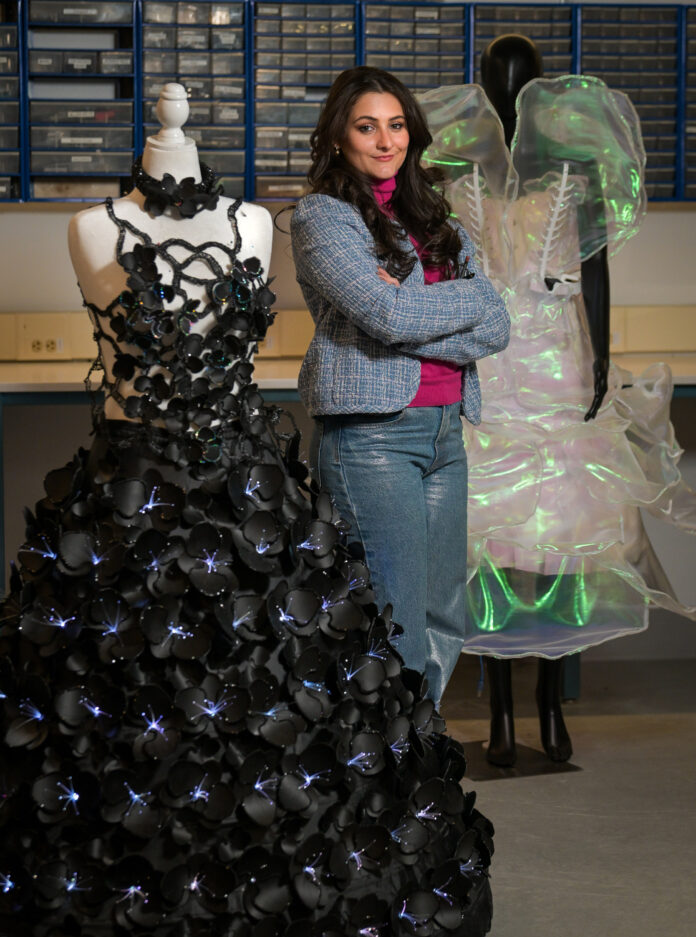
From Engineering to Elegance: Maia Hirsch’s Fusion of Technology and Fashion
A Unique Journey Beyond Luxury Brands
Maia Hirsch’s passion for fashion design did not originate from a lifelong admiration of luxury houses like Chanel, Hermès, or Dior. Although she appreciates high-end fashion, Hirsch, a 24-year-old mechanical engineer from Ithaca, New York, has always been more captivated by the intricacies of robotics and scientific innovation than by imported silks or fine leather.
Her unexpected foray into fashion began during the upheaval of the 2020 pandemic. Stranded while studying in Florida, Hirsch enrolled in a fashion design course at the Istituto Marangoni Miami as a creative escape and therapeutic outlet amid global uncertainty.
Blending Robotics with Runway Glamour
What started as a hobby has now propelled Hirsch onto the prestigious stage of New York Fashion Week 2026. She will debut her cutting-edge, technology-infused garments at the Times Square venue Dramma, showcasing a new vision where engineering meets haute couture.
“It’s a privilege to challenge the conventional image of engineers and roboticists by breaking stereotypes,” Hirsch shared. Currently pursuing her PhD in robotics at Cornell University, she emphasizes how fashion’s broad cultural reach offers a platform to introduce science into public spaces where it rarely ventures.
Innovative Creations: The “Blooming Dress” and “Gazing Dress”
At the upcoming SFWRunway “Future of Fashion” event, Hirsch will present her “Blooming Dress,” an interactive piece powered by batteries that unfolds into a radiant white flower with a simple handshake. Constructed from cotton and delicate organza petals, the dress incorporates touch sensors and actuators-mechanisms that translate electrical signals into physical movement, enabling the petals to bloom dynamically.
“Small touch sensors embedded in the model’s palm activate the motors within the dress upon contact, triggering the blooming effect,” Hirsch explained.
Additionally, Hirsch will unveil the “Gazing Dress,” a mesmerizing ensemble woven with optical fibers and stretch sensors. This design responds to the wearer’s movements by illuminating in real time, creating a captivating interplay of light and motion.
Crafting High-Tech Couture: The Process and Challenges
Hirsch’s creations are the result of months of meticulous work, involving extensive sketching, prototyping, and troubleshooting-sometimes even causing accidental short circuits. Utilizing Cornell’s advanced Maker Club facilities, she has access to 3D printers, laser cutters, and embedded systems that enable her to refine her visionary designs.
Each garment represents over four months of dedication and thousands of dollars in grant funding. Yet, for Hirsch, the investment is worthwhile if it helps dismantle barriers in male-dominated STEM fields and inspires other women to pursue their passions without compromise.
Empowering Women in STEM Through Fashion
“I live by the motto, ‘You cannot be what you cannot see,'” Hirsch said. “I want women to realize they can excel in engineering and robotics while embracing their love for fashion and femininity. You don’t have to sacrifice one for the other to belong.”
Despite progress since the 1970s-when women comprised just 7% of STEM professionals-recent statistics reveal that women currently hold only about 30% of STEM jobs in North America, with less than 20% occupying technical roles in computer science and engineering. Hirsch’s work aims to expand this representation by merging creativity with technology.
Inspiration from Visionary Designers
Hirsch draws inspiration from trailblazers like Dutch designer Iris Van Herpen, renowned for integrating nature, architecture, and mechanics into her avant-garde creations. Van Herpen’s groundbreaking 3D-printed bridal gown and collaborations with celebrities such as Beyoncé, Lady Gaga, and Gigi Hadid have redefined fashion’s boundaries.
Notably, Van Herpen designed the robotic ensemble worn by entrepreneur Mona Patel at the 2024 Met Gala, featuring kinetic butterflies crafted by artist Casey Curran-a spectacle that earned Patel acclaim as the event’s standout.
Looking Ahead: The Future of Wearable Technology
While Hirsch aspires to generate similar excitement at New York Fashion Week, she acknowledges the current limitations of her pieces. “These garments are delicate and not suited for everyday wear,” she noted. “They aren’t weatherproof, so exposure to rain or extreme cold could damage the batteries. Storage and maintenance also present challenges for the average wearer.”
Nevertheless, Hirsch embraces her role as a pioneer in fashion’s evolving landscape. “Fashion should be more than something you wear-it should be an experience,” she said. “Mechanical engineering empowers me to create unprecedented designs and layer fashion on top of them.”