
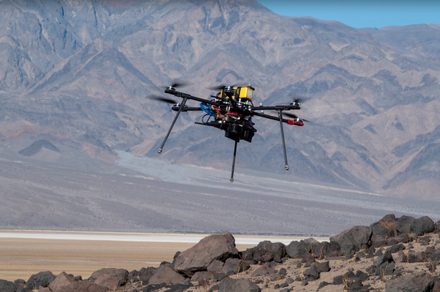
A team tests new flight software after the success of their Ingenuity aircraft.
NASA/JPL-Caltech
NASA drone flying over Death Valley’s Mars Hill.
NASA/JPL-Caltech After reaching Mars in early 2021 with the Perseverance Rover, NASA’s Ingenuity heli proved to be a huge success. It exceeded expectations by flying an amazing 72 times across the Martian surface. Ingenuity, the first aircraft ever to fly powered and controlled on another planet, was unable to fly again in 2024 after sustaining damage to one of its blades. The aircraft’s successful mission to map parts of the Martian terrain and assist Perseverance inspired NASA’s Jet Propulsion Laboratory engineers to work on the next-generation models to be used for future missions to Mars, and possibly beyond. Testing the new helicopter’s software and hardware requires going to locations that are similar to Mars, minus its thin atmosphere. A JPL team has recently been working in California’s Death Valley National Park. The landscape is barren and dusty, similar to the fourth planet away from the sun. The engineers tested new software while flying a drone above Death Valley’s Mars Hill Sand Dunes and Mesquite Flats Sand Dunes. Roland Brockers, a JPL drone pilot and researcher, said that Ingenuity, the drone, was originally designed to fly over terrain with a lot of texture. However, it eventually had to cross blander areas, where this became difficult. “We want future vehicles that are more versatile, and don’t have to worry about flying in challenging areas like these dunes,” said Roland Brockersa JPL researcher and drone pilot. Nathan Williams, JPL’s geologist who worked on Ingenuity before, said that field tests provide a more comprehensive perspective than computer models or limited satellite images. “Scientifically important features aren’t located in the most benign of places, so we need to be prepared to explore more challenging terrains than Ingenuity.” This is not the first time that a NASA team has gone to Death Valley to test gear for other worlds. The area has been used by NASA engineers since the 1970s when they were preparing for the first Mars landers with the twin Viking spacecraft. In recent years, the space agency has used this area to test a precision landing system for the Perseverance Rover by flying a component in a piloted chopper. The rover’s arrival at Mars was captured on video in detail, showing its final moments just before landing. This ISS flyover is stunning.
The ISS orbits Earth at a distance of 250 miles and a speed of 17,000 mph. This allows astronauts to see 16 sunrises and sunsets per day. In certain conditions, the aurora light show can be spectacular. This is caused by particles from Earth’s magnetic fields interacting with particles from the Sun.
Read More
Blue Origin’s rocket booster returns home to a hero’s welcome. Here’s why
the booster’s success represents a giant step for the spaceflight firm.
Oh, wait.
Yesterday, we welcomed Jacklyn and our fully reusable New Glenn first stage back to the Space Coast. Thank you, Team Blue. pic.twitter.com/WQyvFqn5Cd
— Blue Origin (@blueorigin) November 19, 2025
Read more