
Exploring a double-explosion “superkilonova,” ancient Roman gypsum burials, kangaroo locomotion biomechanics, and other captivating scientific discoveries.
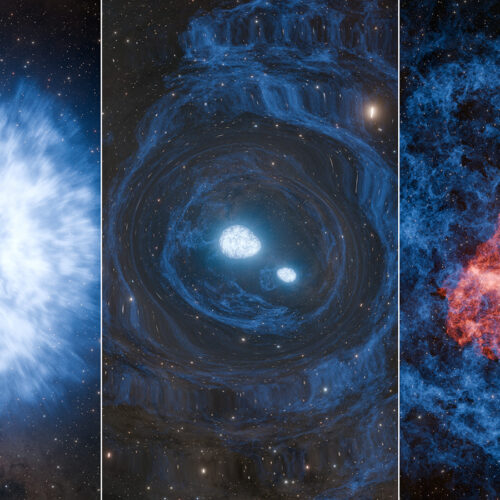
The three phases of a superkilonova: an initial supernova explosion, the collision of neutron stars, and the resulting kilonova ejecting heavy elements.
Image Credit: Caltech/K. Miller and R. Hurt (IPAC)
The vast array of fascinating scientific breakthroughs emerging each month often exceeds the time available to cover them all. Previously, we compiled annual summaries of notable science stories that nearly escaped attention. This year, we’ve shifted to a monthly digest format. December’s highlights include a fossilized bird that tragically died from ingesting stones, the discovery of a rare double-explosion “superkilonova,” the unearthing of an ancient mariner’s fingerprint, insights into kangaroo hopping mechanics, and a breakthrough in a dark matter mystery once featured on The Big Bang Theory, among other intriguing findings.
Unraveling the Mechanics Behind Kangaroo Hopping
Kangaroos and their relatives, wallabies, belong to the macropod family, characterized by their distinctive movement patterns. At slow speeds, these animals use all four limbs and their tail to support themselves, but at faster paces, they switch to a hopping gait. Interestingly, unlike most animals where rapid movement demands more energy, kangaroos exhibit a decoupling of speed and energy expenditure during hopping. A recent study published in eLife suggests that this phenomenon is linked to changes in their posture as hopping speed increases.
Researchers employed 3D motion capture technology combined with force plate data to build a detailed musculoskeletal model of red and grey kangaroos. They analyzed how body mass and velocity affect hindlimb posture, movement efficiency, tendon stress, and ankle joint function during hopping. The findings revealed that kangaroos adopt a more crouched hindlimb posture at higher speeds, with the ankle joint bearing the majority of the workload per hop. This crouched stance enhances energy absorption, thereby boosting locomotion efficiency.
DOI: eLife, 2025. 10.7554/eLife.96437.3
A 120-Million-Year-Old Bird Fossil Reveals a Fatal Mistake
Approximately 120 million years ago, a small bird met its demise after choking on a cluster of tiny stones lodged in its throat. This extraordinary fossil was recently identified among the extensive collection at the Shandong Tianyu Museum of Nature in China. The specimen represents a newly identified species named Chromeornis funkyi, inspired by the electronic music duo Chromeo. Remarkably, this is the first fossilized bird discovered with stones trapped in its throat, as detailed in a study published in Palaeontologica Electronica.
While some modern birds, such as chickens, intentionally swallow small stones to aid digestion by grinding food in their gizzards, CT scans of this fossil revealed over 800 tiny stones lodged in the throat, distinct from typical gizzard stones. The researchers propose that the bird was ill and ingested the stones accidentally, a behavior observed in sick birds today. Attempts to expel the stones likely caused them to become stuck in the esophagus, leading to the bird’s fatal choking.
DOI: Palaeontologica Electronica, 2025. 10.26879/1589
The Phenomenon of a Double-Explosion “Superkilonova”
In 2017, astronomers witnessed a groundbreaking cosmic event known as a “kilonova,” resulting from the merger of two neutron stars and accompanied by intense gamma-ray bursts. This observation inaugurated the era of “multi-messenger astronomy.” Recently, astrophysicists reported evidence of a second such event, but with an extraordinary twist: the kilonova may have been preceded by a supernova explosion just hours earlier, creating what is now termed a “superkilonova,” as described in a paper in The Astrophysical Journal Letters.
Supernovae are colossal explosions marking the death of massive stars, dispersing heavy elements like carbon and iron across the cosmos. Kilonovae occur when two neutron stars in a binary system spiral inward, emitting gravitational waves and ejecting neutron-rich material. Their collision produces a glowing cloud of debris, with a distinctive infrared brightness caused by heavy elements that absorb visible light but allow infrared to pass through.
The newly observed event, named AT2025ulz, initially resembled the 2017 kilonova but later exhibited characteristics akin to a supernova, puzzling astronomers. Further analysis combining data from multiple observatories suggested a multi-phase occurrence: a supernova explosion birthed two neutron stars, which then merged to create the kilonova. While compelling, more observations of similar superkilonovae are needed to confirm this phenomenon.
DOI: Astrophysical Journal Letters, 2025. 10.3847/2041-8213/ae2000
Fingerprint from an Ancient Seafarer Discovered in Denmark
Around the 4th century BCE, a small fleet of four boats launched an unsuccessful raid on an island near Denmark. The victorious islanders commemorated their defense by sinking one of the enemy vessels, laden with weapons, into a nearby bog. This vessel, known as the Hjortspring boat, was excavated in the 1880s. Recently, archaeologists uncovered a remarkably preserved human fingerprint embedded in the pine pitch tar used to waterproof the boat, as reported in PLoS ONE.
This fingerprint provides valuable clues about the origins of the raiders. Earlier theories suggested they hailed from the region around modern-day Hamburg, Germany. However, the presence of pine pitch, abundant in Baltic coastal forests, indicates the attackers may have come from the Baltic Sea area, implying they navigated hundreds of kilometers across open water. Researchers hope to extract ancient DNA from the tar to further illuminate the identities of these early seafarers.
DOI: PLoS ONE, 2025. 10.1371/journal.pone.0336965
Roman Funerary Practices: Preserved Fingerprints in Gypsum Burials
Archaeologists at the University of York have uncovered fingerprints and handprints preserved in hardened gypsum used by Romans in Britain during the 3rd and 4th centuries CE for burial rituals. The Seeing the Dead project studies bodies encased in liquid gypsum (plaster of Paris) poured into coffins, which solidifies around decomposing remains, preserving detailed impressions of body shapes, clothing, and wrappings-similar to the casts of Pompeii victims.
To date, around 70 gypsum burials have been found in Yorkshire. While examining a stone sarcophagus excavated in the 1870s, researchers discovered a clear handprint and several fingerprints in the gypsum lining. Previously, it was believed the gypsum was heated to over 150°C before application, but the presence of these prints suggests the material was smoothed by hand at much cooler temperatures. The team is hopeful that DNA extraction from the sarcophagus might reveal the genetic sex of the interred individual.
Playing Super Mario Games as a Remedy for Burnout
The pressures facing young adults today-rising living costs, student debt, academic demands, and constant digital connectivity-contribute to widespread burnout. Interestingly, playing certain video games like Super Mario Bros. and Yoshi may alleviate stress and anxiety, fostering resilience. A study published in JMIR Serious Games found that these games help players reconnect with a sense of childlike wonder, which correlates with increased happiness and reduced burnout risk.
The researchers used a mixed-methods approach, conducting in-depth interviews with 41 college-aged players and a survey of 336 participants. Results showed that those experiencing greater childlike wonder during gameplay reported higher overall well-being and lower burnout symptoms. The study highlights how thoughtfully designed, globally recognized games can serve as accessible digital spaces for mental health support.
DOI: JMIR Serious Games, 2025. 10.2196/84219
Solving a Dark Matter Puzzle from The Big Bang Theory
While The Big Bang Theory sitcom received mixed reviews from physicists regarding its portrayal of scientists, it consistently featured accurate scientific equations, thanks to advisor David Saltzberg. One episode involved Sheldon and Leonard attempting to calculate axion production from the sun, a problem they couldn’t solve. Now, physicists have made progress on this challenge, as detailed in a recent paper in the Journal of High Energy Physics.
Axions are theoretical particles proposed as candidates for dark matter, which constitutes about 27% of the universe’s mass-energy content. Unlike WIMPs, which have evaded detection, axions behave more like waves, with their wave packet size inversely related to mass. Their extremely weak interaction with normal matter makes them difficult to detect in large particle colliders.
To overcome this, researchers led by Jure Zupan from the University of Cincinnati proposed that axions could be generated in fusion reactors fueled by deuterium and tritium within lithium-lined vessels. Neutrons produced in such reactors interact with the vessel materials, potentially producing axions or axion-like particles. This approach opens new avenues for experimental detection of these elusive particles.
DOI: Journal of High Energy Physics, 2025. 10.1007/JHEP10(2025)215