
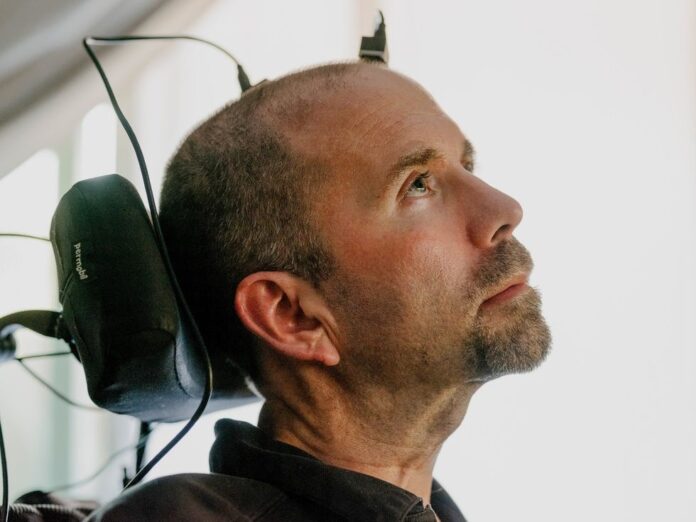
Casey Harrell, diagnosed with amyotrophic lateral sclerosis (ALS), experienced a progressive loss of speech. In 2023, surgeons implanted four electrode arrays into the brain areas responsible for controlling speech muscles, restoring his ability to communicate effectively.
Experiencing the Future: Controlling Technology with the Mind
Scott Imbrie recalls with awe the first time he used a brain implant to operate a robotic arm and felt it respond as if it were part of his own body. “That initial handshake still gives me chills,” he shares. This breakthrough was made possible by an array of electrodes implanted in his brain, enabling him to both command the robotic limb and receive tactile feedback directly to his nervous system.
Imbrie’s journey began decades earlier. After a severe car accident in 1985 left him with a broken neck and doctors predicting permanent paralysis, he defied expectations through sheer determination. Over time, he regained limited mobility and sought to contribute to spinal cord injury research. His persistence paid off when, in 2020, he joined a pioneering clinical trial at the University of Chicago focused on brain-computer interfaces (BCIs).
Imbrie belongs to an exclusive group-fewer people have undergone advanced BCI implantation than have traveled to space. However, the landscape is rapidly evolving as numerous companies strive to transition BCIs from experimental setups to practical medical solutions that could assist millions suffering from paralysis and neurological disorders. Some envision BCIs eventually becoming consumer products.
Advocacy and Support: The Role of BCI Pioneers
Integral to this progress are individuals like Imbrie, who participate in the BCI Pioneers Coalition. Founded in 2018 by Ian Burkhart-the first quadriplegic to regain hand movement via a brain implant-the coalition ensures that the voices of users shape the development of these technologies. Their feedback guides companies, clinicians, and regulators to better understand real-world needs and challenges.
Beyond advocacy, the coalition provides vital peer support. Despite promising outcomes, brain implants carry risks such as surgical complications and psychological impacts if the device underperforms or ceases to function. John Downey, assistant professor of neurological surgery at the University of Chicago and lead investigator of Imbrie’s trial, notes that many potential participants are deterred by these risks, with only a fraction ultimately proceeding with implantation.
Inside a Brain-Computer Interface Trial
BCI participants come from diverse backgrounds, including spinal cord injuries, stroke-related paralysis, and ALS. Devices from companies like Blackrock Neurotech, Neuralink, and Synchron are tested for restoring motor functions, enabling computer and robotic arm control, and even reestablishing speech.
Most implants capture neural signals from the motor cortex, which governs voluntary movement, to operate external devices. Others target the somatosensory cortex to recreate sensations like touch and limb position. Early training involves participants imagining or attempting movements while observing virtual limbs, allowing researchers to calibrate decoders that translate brain activity into commands.
Ian Burkhart, paralyzed from a 2010 swimming accident, participated in a trial where his motor cortex signals were decoded to stimulate his paralyzed hand muscles. Over several years, he progressed from intense concentration on individual finger movements to fluidly performing tasks such as swiping credit cards, pouring liquids, and even playing video games like Guitar Hero.
Decoder training is ongoing due to “neural drift,” where brain signal patterns shift over time. For complex tasks, recalibration can take up to an hour before each session. Austin Beggin, paralyzed since 2015, describes the mental effort required to perform simple actions with a BCI as exponentially greater than for able-bodied individuals. His commitment involves traveling long distances monthly and dedicating hours daily to experiments focused on refining the technology.
Emotional Rewards Beyond Functionality
While BCIs offer practical benefits, many users emphasize the profound emotional impact. Beggin cherishes moments like shaking his parents’ hands or petting his dog-experiences that transcend mere utility. Similarly, Neuralink participant Alex Conley, who regained control over robotic limbs and computers after a 2021 accident, finds joy in using design software to create 3D-printable parts, rekindling his problem-solving spirit.
Nathan Copeland, who holds the record for the longest functional brain implant, highlights the importance of seemingly trivial activities. After sharing a video of himself playing Final Fantasy XIV using his implant, he responded to criticism by underscoring that leisure and self-expression are vital for quality of life and personal agency.
Transformative Outcomes: From Independence to New Possibilities
Noland Arbaugh, the first Neuralink recipient, paralyzed since 2016, quickly mastered cursor control and spent hours playing Civilization VI shortly after implantation. This newfound independence contrasts sharply with his previous reliance on mouth-operated devices, which demanded constant caregiver assistance.
Casey Harrell’s experience with a speech-restoring BCI is equally remarkable. After rapid speech loss due to ALS, an implant placed in 2023 enabled him to communicate within 30 minutes of activation. The device translates neural signals from speech-related brain regions into synthesized voice output, allowing Harrell to engage in conversations and resume part-time work.
Challenges Slowing BCI Adoption
Despite advances, current BCIs face limitations. Most systems require wired connections and bulky external hardware, restricting use to laboratory or home settings. Users like Harrell express a strong desire for portable solutions that enable mobility.
Academic research pressures often prioritize demonstrating peak performance on narrow tasks over developing versatile, user-friendly systems. This focus, combined with funding constraints, limits long-term access for participants once trials conclude. Scar tissue formation around implants can degrade signal quality over time, further complicating sustained use.
Burkhart’s implant was eventually removed due to infection, underscoring the fragility of current technology. The temporary nature of trials and rapid shifts in experimental protocols can frustrate users eager to build proficiency and independence.
Advancing Toward Practical and Portable BCIs
Efforts to commercialize BCIs are underway, with newer devices designed to be less invasive and more user-friendly. Neuralink’s implant features flexible electrode threads inserted via a robotic system, housed in a compact unit embedded in the skull that wirelessly transmits data and charges. Synchron’s “stentrode” is implanted through blood vessels and connects wirelessly to a chest-mounted unit, enabling at-home and mobile use.
These companies employ adaptive machine learning decoders to compensate for neural drift, reducing the need for frequent recalibration. Synchron has demonstrated integration with devices like the Apple Vision Pro headset, allowing users to control smart home appliances through gaze and thought commands.
Future improvements aim to interpret higher-level intentions rather than low-level motor commands, simplifying user interaction. For example, thinking about sending an email could automatically open and populate the message, streamlining communication.
Durability remains a significant hurdle, with current implants lasting approximately ten years-far from a lifelong solution. Replacement surgeries are limited due to the brain’s delicate environment. Users and their families often face difficult decisions about whether to undergo implantation now or wait for more advanced technology.
The Prospect of Consumer Brain-Computer Interfaces
Some industry leaders, including Neuralink’s Elon Musk, envision BCIs evolving into consumer products capable of replacing smartphones, enabling memory storage and playback, or facilitating AI symbiosis. While this vision attracts investment and public interest, it also raises concerns among users about insurance coverage, surgical access, and data privacy.
Trial participants like Arbaugh emphasize the need for robust legal protections regarding neural data ownership and usage. Blackrock Neurotech focuses primarily on medical applications but acknowledges the potential for broader interfaces that serve both disabled and able-bodied users, advocating for equitable access to advanced technology.
Imbrie believes that consumer adoption could drive affordability and feature enhancements, ultimately benefiting medical users. He urges a shift in public discourse to highlight the empowering aspects of BCIs rather than focusing solely on risks, emphasizing the human desire for independence and agency.
“Lying immobile and dependent was dehumanizing,” Imbrie reflects. “As humans, we crave autonomy, and BCIs offer a path back to that.”