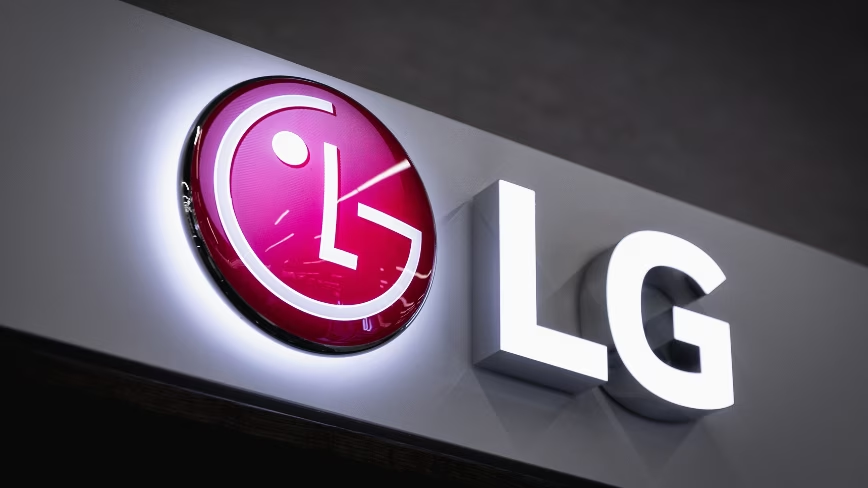
Following a visit from Nvidia’s Madison Huang, LG Electronics is exploring deeper collaboration in physical AI, signaling a significant step as AI-powered robotics transition from experimental phases to real-world applications.
LG Electronics announced on Wednesday that it is engaged in preliminary talks with Nvidia to explore joint ventures across three key domains: robotics, AI-driven data centers, and automotive mobility solutions.
This development follows a visit by Madison Huang, Nvidia’s senior director of physical AI platforms and daughter of CEO Jensen Huang, to LG’s headquarters in Yeouido, Seoul. The meeting also included representatives from other leading South Korean tech firms and was attended personally by LG CEO Ryu Jae-cheol.
While no formal partnership or contract has been finalized, and details such as product plans, investment figures, or timelines remain undisclosed, the focus areas align closely with both companies’ strategic priorities, indicating a substantive dialogue rather than a routine engagement.
Synergies and Strategic Advantages
LG’s pivot towards AI-enhanced physical systems is a natural evolution for a global leader in home appliances. At CES 2026, LG introduced CLOiD, an advanced home robot featuring dual articulated arms with seven degrees of freedom each and dexterous hands with five independently controlled fingers. This robot embodies LG’s “Zero Labor Home” initiative, aiming to automate both physical chores and cognitive tasks within households.
LG’s AI vision is structured around three pillars: superior device performance, a seamlessly integrated smart home ecosystem, and expansion into AI-powered vehicles and data center cooling solutions.
CLOiD operates on LG’s proprietary ‘Affectionate Intelligence’ platform, which enables contextual understanding, natural user interaction, and adaptive learning within the home environment.
However, LG currently lacks Nvidia’s Isaac robotics framework, which includes a sophisticated simulation environment, pre-trained manipulation models, Omniverse-based digital twin technology, and GPU-optimized real-time AI inference capabilities. Incorporating Nvidia’s physical AI stack could significantly accelerate LG’s robotics development cycle, bridging the gap from prototype to market-ready product.
From Nvidia’s perspective, partnering with LG offers access to a vast consumer market. Nvidia’s existing robotics collaborations, such as the Siemens factory trial where a Humanoid HMND 01 Alpha robot operated continuously for eight hours using Nvidia’s AI platform, have primarily targeted industrial and enterprise sectors.
LG’s extensive global footprint in connected home appliances through its ThinQ ecosystem and its ambition to deploy robots in residential settings represent a unique opportunity for Nvidia to gather rich, real-world data from diverse home environments, enhancing AI training and refinement.
Beyond Robotics: Data Centers and Automotive AI
While robotics is the most visible aspect of the discussions, the potential collaboration on AI data centers and automotive mobility could have more immediate commercial impact.
LG has positioned itself as a key player in high-efficiency HVAC and thermal management solutions tailored for AI data centers, a sector experiencing rapid growth due to the increasing power density of GPU clusters that traditional cooling systems cannot efficiently handle.
Nvidia’s data center segment, which has driven the majority of its record-breaking revenues in recent years, represents the leading edge of AI infrastructure worldwide. A partnership in thermal management would integrate LG’s hardware expertise into Nvidia’s ecosystem, complementing the AI compute layer rather than competing with it.
In the automotive arena, both companies maintain robust AI initiatives. Nvidia’s DRIVE platform is widely adopted in autonomous and semi-autonomous vehicles, providing critical AI computing capabilities.
LG’s automotive division, which manufactures infotainment systems, cameras, electric vehicle components, and AI-driven in-cabin technologies such as gaze tracking, adaptive displays, and multimodal generative AI, is among its fastest-growing business units.
A formal collaboration could merge LG’s advanced in-cabin AI solutions with Nvidia’s DRIVE compute platform, creating a more integrated and intelligent vehicle experience.
The Growing Momentum of Physical AI
This announcement underscores the accelerating momentum in physical AI-the deployment of AI in robots and autonomous systems functioning in real-world environments, distinct from cloud-based AI models.
Recent investments, such as Sereact’s $110 million funding round to develop adaptable AI for robotics, highlight the influx of capital into the intelligence layer of robotics technology. Nvidia’s successful factory deployment with Siemens demonstrated the viability of physical AI in live industrial settings, and the ongoing talks with LG suggest this technology is now poised to enter consumer homes.
For Nvidia, expanding physical AI partnerships beyond industrial applications into consumer electronics is a strategic milestone. Its Omniverse and Isaac platforms aim to become the universal development infrastructure for physical AI, much like Nvidia’s GPUs have become foundational for cloud AI workloads.
Each major robotics company adopting Nvidia’s stack strengthens its ecosystem. LG, with its scale in home appliances and commitment to residential robotics, represents a distinct and potentially larger partner compared to industrial clients, opening new avenues for AI integration in everyday life.