Introducing the Humanoid Robotics Challenge: Pushing the Boundaries of Manipulation
Robotics continues to captivate the imagination, especially as humanoid robots edge closer to performing everyday human tasks. Inspired by the growing interest in robotic dexterity, I propose a series of competitive events-The Humanoid Robotics Olympics-that aim to accelerate advancements in robotic manipulation. These challenges are designed to stretch current capabilities and inspire breakthroughs in autonomous, general-purpose robots.
Understanding Today’s Robotic Manipulation Landscape
Before diving into the proposed events, it’s essential to grasp the current state of robotic manipulation. Most progress has been made through learning-from-demonstration techniques, where robots mimic human actions recorded via teleoperation. Commonly, this involves either dual-robot setups-where one robot is manually guided and the other replicates the movements-or virtual reality systems that track hand motions. Neural networks then train on hundreds of short demonstrations to replicate complex tasks such as smoothing out a towel or folding laundry.
Despite these advances, several limitations persist:
- Absence of tactile feedback: Robots lack high-resolution force sensing at the wrist, limiting the operator’s ability to feel and adjust grip forces in real time.
- Restricted finger articulation: Current teleoperation and AI models struggle to control individual fingers beyond simple open/close motions, hindering fine manipulation.
- Limited tactile sensing: Human hands are equipped with dense sensory arrays, a complexity not yet replicated in robotic hands, reducing sensitivity to object texture and slippage.
- Moderate positional accuracy: Robots typically achieve precision within 1 to 3 centimeters, which is insufficient for many delicate tasks.
Humanoid Robotics Olympics: Five Core Events
Each event targets a unique manipulation challenge, encouraging innovation in dexterity, force control, and adaptability.
Event 1: Mastering Door Operation
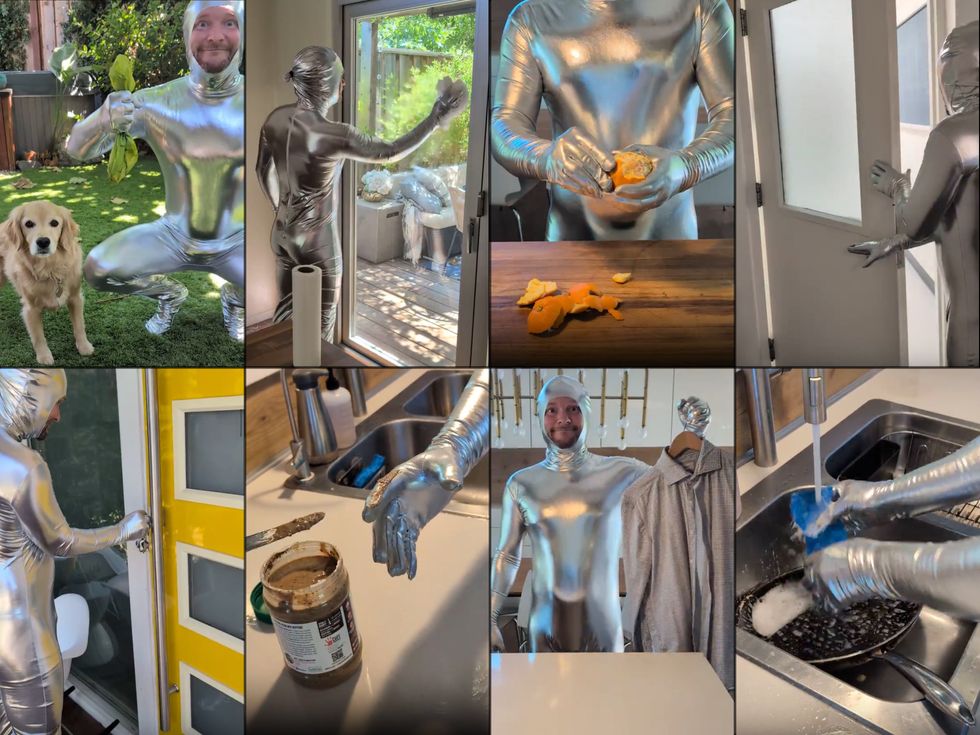
Opening doors involves complex force dynamics and whole-body coordination. Robots must grip and twist handles with sufficient torque while maintaining grip stability, especially on self-closing or lever-handle doors.
- Bronze Level: Navigate a round knob push door.
- Silver Level: Open a self-closing lever-handle door requiring additional force control.
- Gold Level: Successfully enter through a self-closing lever-handle door using dynamic motion or dual-arm coordination to prevent reclosing.
Event 2: Laundry Handling and Folding
Laundry tasks demand nuanced manipulation of flexible, deformable objects. Robots must handle garments with care and precision.
- Bronze Level: Fold a T-shirt starting inside-out into a neat, right-side-out fold.
- Silver Level: Turn a sock inside-out, requiring delicate finger insertion and pinching.
- Gold Level: Hang a men’s dress shirt on a hanger, including buttoning and sleeve positioning-an intricate task expected to take several years to master.
Event 3: Tool Utilization and Manipulation
Humans excel at using tools to extend their capabilities. Robots must develop the strength and dexterity to wield everyday tools effectively.
- Bronze Level: Clean a window using a spray bottle and paper towels, managing flexible materials and liquid application.
- Silver Level: Prepare a peanut butter sandwich, involving precise knife handling and spreading motions.
- Gold Level: Insert the correct key from a keyring into a lock without dropping any keys, demonstrating advanced in-hand manipulation and force control.
Event 4: Fingertip Dexterity Challenges
Fine motor skills are critical for manipulating small objects with precision and subtle force.
- Bronze Level: Roll matched socks into pairs, requiring coordinated finger movements.
- Silver Level: Use a dog waste bag dispenser, involving sliding and tearing actions that demand delicate force application.
- Gold Level: Peel an orange by hand, a task combining high precision and controlled force without external tools.
Event 5: Wet Environment Manipulation
Robots must adapt to wet and slippery conditions to perform household chores effectively.
- Bronze Level: Wipe a countertop with a damp sponge, managing moisture without compromising grip.
- Silver Level: Clean peanut butter residue from manipulators, simulating messy real-world conditions.
- Gold Level: Use a sponge in a sink to remove grease from a pan, combining wet handling with forceful scrubbing motions.
Participation Guidelines and Rewards
To qualify for medals, robots must autonomously complete tasks in real-time, with video evidence showing unedited performance. Completion times can be up to ten times longer than human benchmarks. The first robot to achieve each task will receive a medal, with future challenges rewarding improvements of at least 25% in speed.
Participants can claim their medals by contacting the organizer with shipping details. Sharing images of robots proudly displaying their medals is highly encouraged.
Looking Ahead: The Future of Humanoid Robotics
These challenges are designed not only to benchmark progress but also to inspire the robotics community to develop more capable, versatile humanoid robots. As technology evolves, overcoming these manipulation hurdles will bring us closer to robots that seamlessly integrate into daily life, assisting with household chores and beyond.