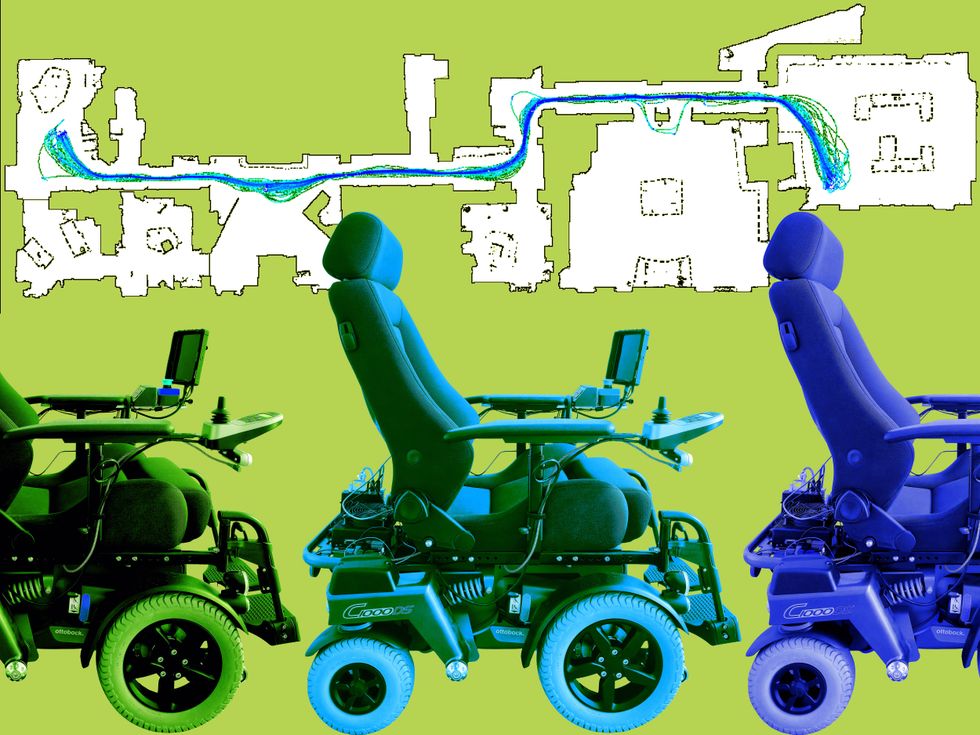
Bridging the Gap: AI-Driven Wheelchair Mobility
Individuals with significant mobility impairments often demonstrate remarkable skill maneuvering through confined spaces-outperforming many current robotic systems. Recent innovations in intelligent wheelchair technology, highlighted at a conference in Anaheim, California, are exploring whether artificial intelligence can fully replicate or even enhance this human capability.
Innovative Sensor-Integrated Wheelchairs: A German Research Initiative
Christian Mandel, a senior scientist at the German Research Center for Artificial Intelligence (DFKI) in Bremen, alongside colleague Serge Autexier, spearheaded the development of prototype electric wheelchairs equipped with advanced sensors. These wheelchairs are engineered to autonomously navigate environments cluttered with obstacles, utilizing data not only from onboard sensors but also from external devices such as drone-mounted color and depth cameras.
Mandel explains that their smart wheelchairs operate in two modes: semi-autonomous and fully autonomous. In semi-autonomous mode, users steer the wheelchair via a joystick, sharing control with the system. Conversely, the fully autonomous mode allows users to issue natural language commands-for example, “Take me to the coffee machine”-enabling the wheelchair to navigate independently.
This close-up image showcases the wheelchair’s joystick alongside its integrated camera system.
Image credit: DFKI
Technical Framework and Experimental Validation
The research, part of the broader REXASI-PRO project (Reliable and Explainable Swarm Intelligence for People With Reduced Mobility), involved two identical smart wheelchairs outfitted with dual lidars, 3D cameras, odometers, user interfaces, and embedded computing units. Unlike semi-autonomous operation, the autonomous mode leverages the open-source ROS2 Nav2 navigation framework, combined with simultaneous localization and mapping (SLAM) techniques and local obstacle avoidance algorithms.
In practical tests, users interacted with the wheelchair via a human-machine interface, issuing voice commands that were then confirmed or declined through the same interface. Upon confirmation, the wheelchair autonomously charted a safe path to the destination, dynamically adjusting its route to circumvent detected obstacles.
Challenges in Smart Wheelchair Adoption and Practicality
Pooja Viswanathan, CEO and founder of Braze Mobility in Toronto, emphasizes that affordability and accessibility remain critical hurdles for widespread adoption of intelligent mobility aids. “The cost factor is significant,” she notes. “Funding mechanisms rarely cover advanced AI enhancements unless there is compelling proof of safety and tangible benefits. Moreover, reliability must extend beyond controlled environments to the unpredictable conditions users face daily.”
Viswanathan also highlights the diversity of user needs, stating, “Cognitive, motor, sensory, and environmental differences mean that a one-size-fits-all solution is unrealistic.” Braze Mobility addresses this by producing blind-spot sensors that can be retrofitted to existing electric wheelchairs, providing multimodal alerts to enhance user awareness without supplanting their control.
Louise Devinge, a biomedical engineer at IRISA in Rennes, France, adds that increasing the complexity of smart wheelchairs through additional sensors and autonomy demands sophisticated communication and synchronization within the system. “As sensing and computational capabilities grow, ensuring consistent, robust performance across varied real-world scenarios becomes increasingly challenging,” she explains.
Thus, the immediate priority in this field is not to replace users with AI but to foster seamless collaboration between human operators and intelligent systems.
Visualization of sensor data used by the 3D Driving Assistant, including laser scans, point clouds, virtual laser scans, grid maps, and the wheelchair’s physical boundaries at multiple heights.
Image credit: DFKI
Future Outlook: Mainstreaming Smart Wheelchairs
Mandel projects that within the next decade, smart wheelchairs with advanced autonomous capabilities will become commercially available. Viswanathan regards the REXASI-PRO system as a visionary example of the field’s potential, noting its emphasis on intelligent navigation, sophisticated sensing, and the integration of trustworthy, explainable AI-critical factors for user safety and confidence.
Reflecting on his journey, Mandel recalls his early work developing head joystick-controlled smart wheelchairs. He acknowledges the impressive adaptability of users with severe disabilities, stating, “Even navigating narrow passages, many users perform exceptionally well without assistance.” This insight underscores the importance of designing technologies that complement, rather than underestimate, user abilities.
Conclusion
As smart wheelchair technology evolves, the focus remains on enhancing user autonomy through intelligent assistance that respects individual capabilities and environmental complexities. The ongoing research and development efforts promise a future where AI-powered mobility aids are both reliable and accessible, empowering users to navigate their world with greater independence.