Advancing Earthmoving with Autonomous Excavation Technology

Image courtesy of Bedrock Robotics.
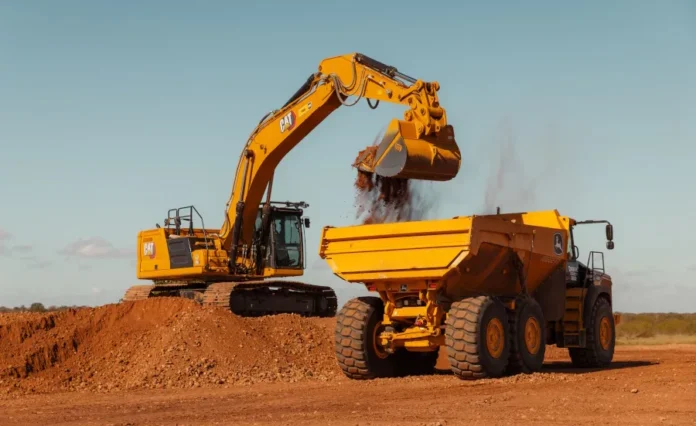
An autonomous Caterpillar excavator equipped with Bedrock Robotics technology operates on a confidential project in the Southwest U.S., loading a John Deere rock truck.
Revolutionizing Site Preparation at a Major Manufacturing Facility
Bedrock Robotics, in collaboration with Sundt Construction, is deploying cutting-edge autonomous excavation systems to streamline mass earthmoving at a sprawling 130-acre manufacturing site in the Southwestern United States. This facility supports the domestic energy sector, emphasizing the critical role of automation in large-scale infrastructure projects.
Proven Efficiency and Scalability in Autonomous Earthmoving
To date, Bedrock’s autonomous excavators have relocated over 65,000 cubic yards of material by mimicking traditional workflows-loading human-operated articulated rock trucks with precision and consistency. The technology has been integrated across a range of excavators, from compact 20-ton units to heavy-duty 80-ton machines, enabling a flexible and scalable approach to earthmoving operations. Sundt Construction’s senior project manager, Dan Green, highlighted the project’s magnitude, noting that approximately 700,000 cubic yards of rock and soil will be moved, with autonomous excavators accounting for about 10% of the total workload.
Industry Partnerships Driving Autonomous Innovation
Based in San Francisco, Bedrock Robotics is a startup specializing in retrofitting existing heavy machinery with autonomous capabilities. Alongside Sundt, companies such as Austin Bridge & Road, Maverick Constructors, Haydon Companies, Champion Site Prep, Zachry Construction, and Capitol Aggregates are actively piloting Bedrock’s add-on kits. Eric Cylwik, Sundt’s director of innovation, emphasized the value of automation in handling repetitive, labor-intensive tasks that require continuous operation-tasks that traditionally demand a dedicated team working long hours. By automating these routine activities, operators are freed to focus on more complex and critical aspects of the project.
Autonomy Meets Real-World Challenges on Remote Construction Sites
Remote and expansive job sites often face challenges in securing skilled operators, leading to increased costs and operational delays. Autonomous equipment is proving to be a game-changer in these environments. For example, Bechtel has utilized Built Robotics’ autonomous excavators for trenching solar farms in Texas, while Moog’s autonomous skidsteers have efficiently delivered solar panels for projects in Western New York. Sundt’s integration of artificial intelligence and machine learning has accelerated the learning curve for their operators, enabling a smoother collaboration between human and autonomous machinery.
Harnessing Operator Expertise to Enhance Autonomous Performance
Dan Green explained that experienced operators play a crucial role in training autonomous systems by demonstrating task execution nuances. “Each operator has a unique approach to their work,” Green said. “By consolidating the knowledge of multiple operators into a single autonomous system, we create a powerful, unified operator.” This human-in-the-loop methodology ensures that autonomous machines adapt to real-world variability and operator preferences, enhancing overall efficiency and safety.
Founders’ Vision and Industry Impact
Founded by former Waymo engineers and executives, Bedrock Robotics leverages expertise from the autonomous vehicle sector to tackle construction-specific challenges such as terrain navigation and dynamic site conditions. CEO Boris Sofman highlighted the company’s strategy of deploying technology on active job sites, which accelerates development and scalability. He noted the industry’s growing acceptance of autonomous solutions, driven by workforce shortages and the need to maintain project timelines without disruption.
Enhancing Safety and Addressing Workforce Gaps
One of the standout benefits of Bedrock’s autonomous systems is the implementation of geofencing technology, which restricts human access to operating zones, significantly reducing the risk of accidents. Sofman pointed out that as experienced operators retire, the construction industry faces a looming skills gap, making safety a paramount concern. Autonomous machinery not only mitigates these risks but also compresses project schedules, delivering faster completion times and cost savings.