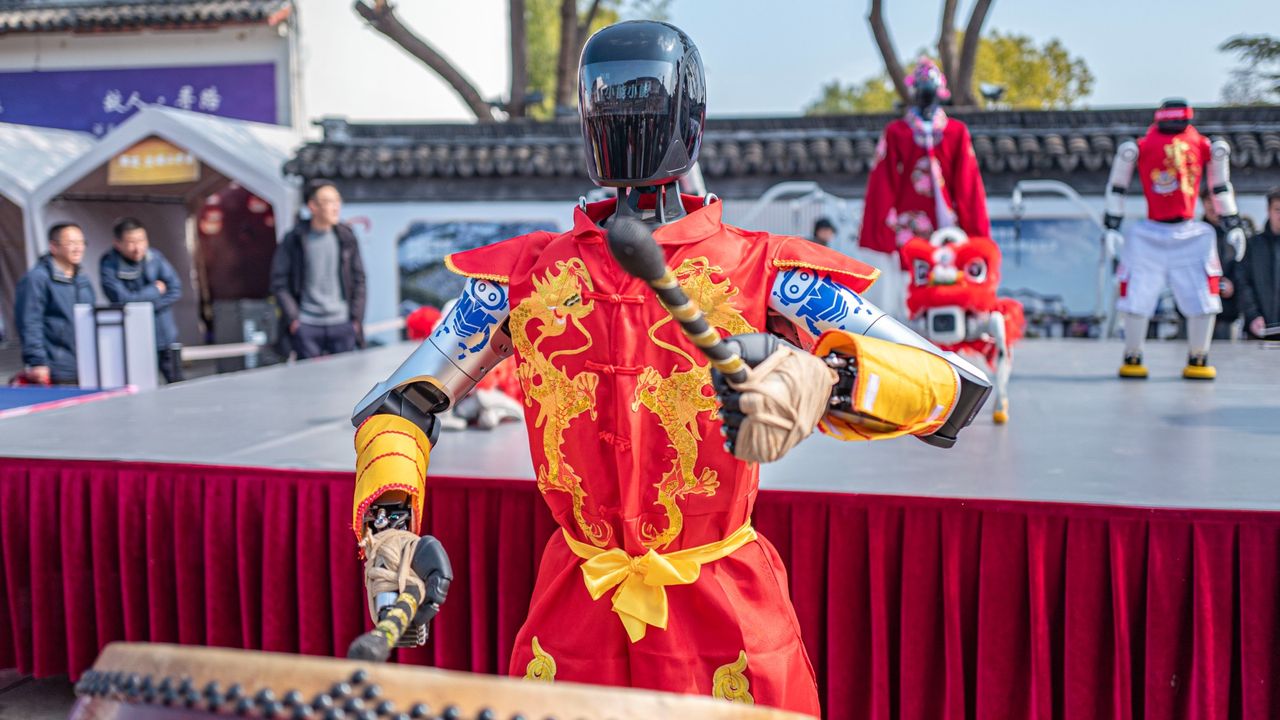
China’s Humanoid Robots: From Novelty to Global Contenders
Once dismissed as mere curiosities, China’s humanoid robots have rapidly evolved into sophisticated machines poised to become a global presence. Their increasing realism and capabilities raise important questions: should society embrace these robotic companions, or approach them with caution?
Showcasing Technological Progress on a Grand Stage
During China’s recent Spring Festival Gala, state television featured humanoid robots performing an impressive array of feats-from agile backflips to intricate choreographed routines, including playful sparring with children wielding nunchucks. This display marked a stark improvement from the clumsy, mechanical movements seen in previous years, highlighting the rapid advancements in China’s robotics sector.
Balancing Enthusiasm with Realistic Concerns
Despite the excitement surrounding these developments, experts warn of potential pitfalls. Issues such as data privacy, mass data collection, and the impact on employment loom large. The surge in interest and investment could also lead to an overheated market, risking a speculative bubble in advanced robotics technology.
Humanoids: A Tangible Reality or Distant Dream?
The concept of human-like machines has fascinated humanity for centuries, appearing in myths and legends worldwide. Today, turning these ideas into practical consumer products is no longer science fiction. Eduardo B. Sandoval notes that breakthroughs in related industries-such as electric vehicles-have accelerated progress by improving battery life, motor efficiency, and sensor technology. Meanwhile, artificial intelligence systems have become increasingly sophisticated, enabling more autonomous and responsive robots.
For instance, Unitree Robotics, a prominent Chinese manufacturer, offers its G1 humanoid robot starting at approximately $13,500 (£10,000), signaling a move toward more accessible pricing for advanced robotics.
Investment and Market Dynamics Driving Growth
In 2025, the global humanoid robot market reached an estimated value of 17 billion yuan ($2.5 billion), with China contributing about half of this figure. The country boasts the world’s most comprehensive supply chain for humanoid robotics, supported by a vibrant ecosystem of manufacturers, suppliers, and research institutions.
According to Omdia, over 14,500 humanoid robots were shipped worldwide last year-a nearly 400% increase compared to the previous year. Chinese companies Agibot and Unitree dominate this surge, accounting for roughly 75% of global deliveries.
The Chinese government plays a pivotal role, not only through subsidies but primarily as a major purchaser of humanoid robots, fueling demand and encouraging innovation. Local governments further bolster the industry by establishing specialized centers where robots can be tested and trained for specific tasks, providing valuable data to refine their capabilities. Investors often weigh the availability of such local resources when deciding where to allocate funding.
While China leads the pack, international players like Tesla are entering the arena. Tesla has recently shifted focus from electric vehicles toward developing an AI-driven robotics platform. Although Chinese robots currently excel in physical agility, Tesla’s competitive edge may lie in its advanced AI systems, which aim to provide more intelligent and adaptable robotic behavior.
Evaluating the Risks and Future Implications
Beyond the spectacle of public performances, experts question the true sophistication of these humanoid robots. Hans Liwång from the Swedish Defence University suggests that in the near future, robots resembling humans and animals could find applications in military and security sectors, raising strategic and ethical considerations.
Western observers express concern over China’s rapid advancements, anticipating that humanoid robotics could become one of the largest global industries. Morgan Stanley projects that by 2050, up to one billion humanoid robots might be in operation worldwide, with annual expenditures surpassing $7.5 trillion.
Nevertheless, it is crucial to interpret China’s public demonstrations with a critical eye. Analysts caution that such performances, while impressive, are often carefully choreographed and do not necessarily reflect industrial-grade reliability or autonomous functionality. Georg Stieler of Stieler Technology and Marketing emphasizes that these robots typically execute pre-programmed routines repeatedly, with minimal real-time environmental awareness-an essential feature for practical deployment in factories or service roles.
Conclusion: Navigating the Rise of Humanoid Robotics
China’s humanoid robots symbolize a remarkable leap forward in robotics technology, blending mechanical prowess with emerging AI capabilities. As the industry expands, balancing innovation with ethical, economic, and security concerns will be vital. Whether these robots become everyday helpers or strategic assets, their integration into society demands thoughtful regulation and ongoing scrutiny.