
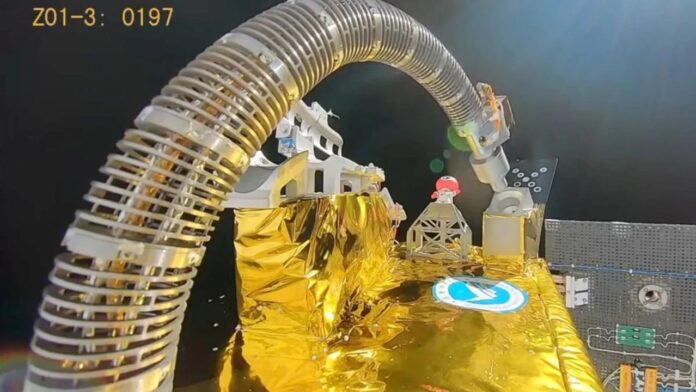
China’s Hukeda-2 satellite has successfully demonstrated a groundbreaking refueling operation using its innovative robotic arm, marking a significant advancement in in-orbit servicing technology.
(Image credit: CCTV handout)
China Advances Satellite Refueling with Robotic Arm Technology in Low Earth Orbit
The Chinese satellite Hukeda-2 has achieved a pivotal milestone by completing a successful refueling test in low Earth orbit (LEO) using a sophisticated robotic arm designed to maneuver with exceptional dexterity. This accomplishment underscores China’s growing dominance in satellite servicing technologies, an area where NASA and other Western agencies are still developing capabilities.
Innovative Robotic Arm Enables Precise Docking in Orbit
Hukeda-2 is a technology demonstration satellite equipped with a flexible, octopus-inspired robotic arm capable of curling, twisting, and grasping objects in confined spaces. The arm’s tip features a nozzle-like mechanism engineered to align precisely with a refueling port, enabling it to connect securely while both the servicing satellite and target move at orbital velocities exceeding 27,000 kilometers per hour (approximately 16,800 mph).
Constructed from a series of spring-like segments threaded with cables and powered by motors, the arm can perform fine adjustments necessary for docking maneuvers in the challenging environment of space. This design allows it to operate effectively despite the high-speed relative motion and limited spatial margins.
Recent Test Confirms In-Situ Refueling Capability
On March 24, 2024, Chinese state media announced that Hukeda-2’s robotic arm had completed its inaugural refueling test. While initial reports left ambiguity about whether the operation involved another spacecraft, subsequent images revealed that the arm docked with a dedicated refueling port on the satellite itself. This self-docking test is a critical step toward future satellite servicing missions.
This achievement builds upon China’s earlier success in June 2023, when the Shijian-25 satellite refueled the Shijian-21 satellite in geosynchronous orbit approximately 35,800 kilometers (22,000 miles) above Earth. That event marked the first confirmed satellite-to-satellite refueling in space, demonstrating China’s leadership in this emerging field.
Extending Satellite Lifespans to Enhance Sustainability
Satellites that exhaust their fuel reserves lose the ability to maintain their orbits and eventually re-enter Earth’s atmosphere, where they burn up. Refueling in orbit can significantly extend the operational life of satellites, reducing the frequency and cost of launching replacements. This approach aligns with global efforts to promote sustainable space operations and mitigate orbital debris.
While NASA and Western aerospace companies have pursued in-orbit refueling concepts for years, practical implementation has remained elusive. China’s progress with Hukeda-2 and Shijian satellites signals a shift toward operational satellite servicing capabilities.
Supporting China’s Expanding Satellite Constellations
China plans to utilize refueling technology to maintain its rapidly growing Qianfan (“Thousand Sails”) satellite constellation, which aims to rival SpaceX’s Starlink network. As of mid-2024, over 100 Qianfan satellites are active in orbit, with ambitions to deploy up to 15,000 satellites by 2030 to provide global broadband coverage.
In contrast, SpaceX currently prioritizes frequent launches of new satellites using its reusable Falcon 9 rockets rather than extending the lifespan of existing spacecraft through refueling.
Addressing Orbital Debris with Innovative Deorbiting Solutions
Beyond refueling, Hukeda-2 will test an 8-foot-wide (2.5-meter) balloon designed to increase atmospheric drag and accelerate the satellite’s descent at the end of its mission. This passive deorbiting method aims to reduce the accumulation of defunct satellites in LEO, a growing concern as megaconstellations expand.
If successful, this technology could be integrated into future Chinese satellites to facilitate controlled re-entry without relying on active propulsion systems. However, the timeline for deploying this balloon remains undisclosed.
Challenges of Orbital Congestion and Environmental Impact
Despite advances in deorbiting technologies, the exponential growth of satellite constellations poses significant risks of overcrowding in LEO. SpaceX’s proposal to launch up to one million satellites for global internet coverage could exacerbate congestion and increase collision hazards.
Additionally, recent studies have highlighted that satellite reentries release substantial amounts of metallic particles into the upper atmosphere, potentially affecting atmospheric chemistry and climate in ways not yet fully understood.
As University of Regina astronomer Samantha Lawler emphasizes, “What goes up must come down,” underscoring the importance of responsible satellite lifecycle management to preserve the space environment.