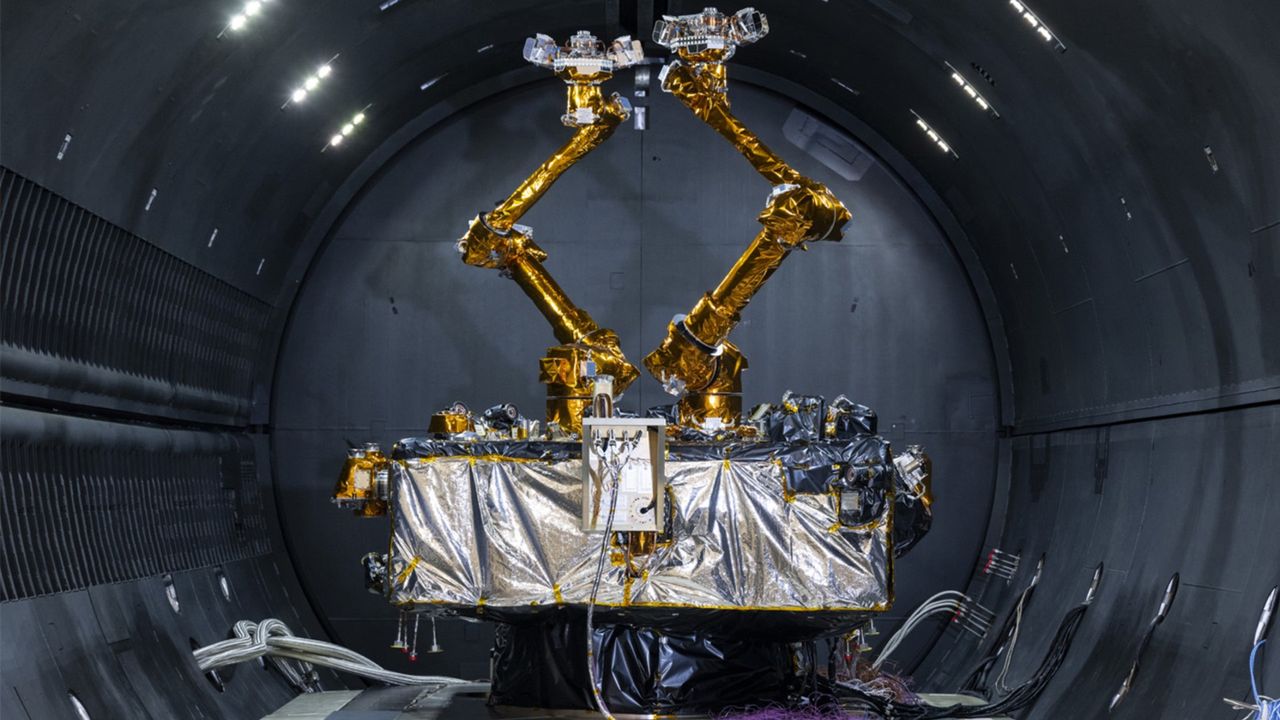
(Image credit: U.S. Navy | Sarah Peterson)
Revolutionizing Satellite Longevity: DARPA’s Upcoming GEO Servicing Mission
The Defense Advanced Research Projects Agency (DARPA) is preparing to launch a groundbreaking mission aimed at extending the operational lifespan of satellites orbiting far above Earth. This summer, DARPA’s Robotic Servicing of Geosynchronous Satellites (RSGS) demonstrator is scheduled for deployment, marking a significant milestone in on-orbit satellite maintenance.
Robotic Precision in Space Maintenance
Central to the RSGS mission is an advanced robotic servicing system designed to perform a variety of essential tasks. This dexterous robotic suite will enable in-orbit satellite refueling, upgrades, detailed inspections, anomaly troubleshooting, and even repositioning of satellites. By automating these complex operations, DARPA aims to reduce the need for costly satellite replacements and mitigate the growing problem of space debris.
Targeting the Challenging Geosynchronous Orbit
Unlike many satellite servicing initiatives focused on low Earth orbit (LEO), DARPA’s program targets satellites in geosynchronous orbit (GEO), approximately 22,236 miles (35,786 kilometers) above Earth. At this altitude, satellites orbit in sync with Earth’s rotation, maintaining a fixed position relative to the surface. This unique vantage point is critical for telecommunications, weather monitoring, and defense applications, providing continuous coverage over specific regions.
However, servicing satellites at GEO presents formidable challenges due to the vast distance and harsh environment. Traditionally, when GEO satellites exhaust their fuel, they are moved to “graveyard” orbits to clear the way for replacements, contributing to the increasing accumulation of orbital debris. DARPA’s RSGS mission seeks to change this paradigm by enabling in-situ servicing that prolongs satellite functionality and reduces space congestion.
Overcoming Developmental Hurdles
Initially announced in 2017, the RSGS program faced multiple setbacks, including contractor transitions and pandemic-related supply chain disruptions. The original contractor, Maxar Technologies, withdrew in 2019, and integration challenges further delayed progress. Currently, SpaceLogistics, a Northrop Grumman subsidiary, leads the spacecraft development, successfully integrating DARPA’s robotic payload.
With these obstacles addressed, the RSGS spacecraft is on track for launch in 2026. Following a 10-month transit to GEO using efficient electric propulsion, the mission will commence operations in 2027. Collaborative efforts with NASA and the U.S. Naval Research Laboratory ensure the robotic servicer is adaptable to diverse mission requirements while prioritizing safety and operational efficiency.
Beyond Refueling: Comprehensive Satellite Upgrades
DARPA envisions a future where servicing spacecraft operate continuously in orbit, potentially assisting multiple satellites over several years. The agency emphasizes that maintenance will extend beyond simple refueling. Many GEO satellites, despite being fully functional, face premature retirement due to outdated payloads. Currently, satellites are built with redundant systems and maximum fuel reserves to compensate for the lack of in-orbit servicing, increasing their complexity and launch costs.
The RSGS mission aims to revolutionize this approach by enabling payload upgrades, preventive maintenance, orbit corrections, and mechanical repairs. This holistic servicing strategy promises to enhance satellite resilience and adaptability, ultimately reducing the financial and environmental costs associated with satellite replacement.
Contextualizing Satellite Lifespans and Market Dynamics
Typically, geostationary satellites have operational lifespans of around 15 years, significantly longer than many low Earth orbit constellations like SpaceX’s Starlink, which average about five years. While LEO satellites benefit from rapid replacement cycles and technological refreshes, GEO satellites represent high-value assets with substantial launch and manufacturing costs, making their extended serviceability crucial.
DARPA’s RSGS program enters a competitive and rapidly evolving market, with private companies such as Astroscale and Thales Alenia Space also developing satellite servicing technologies. However, DARPA’s approach emphasizes creating a sustainable and resilient space infrastructure that could transform satellite operations across both governmental and commercial sectors.
Shaping the Future of Space Operations
By shifting from disposable satellite models to upgradable and maintainable assets, the RSGS initiative aims to establish a new standard for space sustainability. This mission not only promises to extend satellite lifetimes but also to reduce space debris and operational costs, fostering a more robust orbital environment.
As the launch window approaches, DARPA’s robotic servicing technology stands poised to pioneer a transformative era in space asset management, ensuring that critical satellites remain functional and adaptable for years to come.