(
) Visitors to
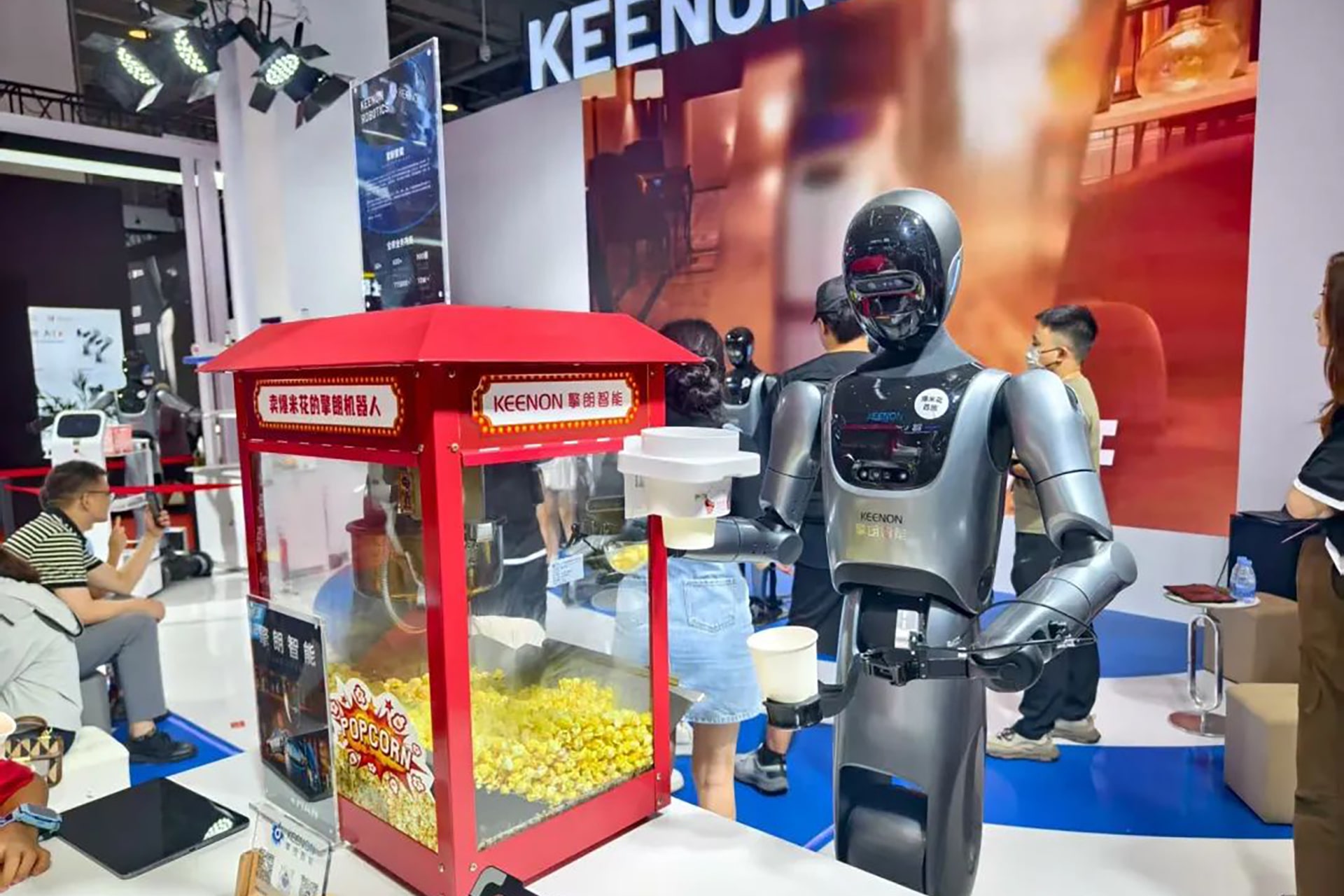
Keenon Robotics ‘sstand during the exhibition season of July and August would likely have seen mockups for bars, lounges, or theaters. XMAN-F1, the bipedal robot service of the company, was seen there serving drinks, popping popcorn and mixing cocktails. Some might say that the robot is taking on the role as a human employee.
Robots doing real work in this setting is not just a show trick. It reflects Li Tong’s commercial mindset as the CEO of Keenon Robotics. Li Tong, in an interview with 36Krrepeatedly referred to “commercialization”.
Li believes that this focus has helped Keenon navigate through the volatility that has challenged so many commercial robotics companies. It was one of a few companies that survived the last major shakeup in the industry and is still standing today.
Yet, bringing robots to real-world commercial applications is easier said than accomplished. Li says that success is more than just brainstorming in a office. It requires close, on-the ground observation of business operations in order to find the elusive overlap between what robots are capable of and what businesses need.
He said that there is always a gap between what the client expects and what you imagine.
Li remembered Keenon’s first deployment at a chain of hotpot restaurants. The company sent not only its R&D team but also product managers and project managers to observe and take part. When the robots failed to deliver food, staff took over.
Keenon’s staff had to know every operational detail in order to fine-tune their service model: how workflows are structured, what each task entailed, the training of new staff, and internal performance standards.
Li noted that at this hotpot restaurant there were over 20 different job functions. These included both part-time workers and full-time workers. Each runner wore an RFID wristband and earned RMB 0.5 per trip (USD 0.07), by swiping the band after each delivery.
How can one determine if a robot is commercially feasible? Li proposed a concept called “positionalization.” Robots are ready for large-scale deployment when they can replace a human’s role and outperform them in efficiency. He argued that anything less is just a flashy demonstration.
Keenon estimates that its robots could replace a full time human position for one-third to half the cost. “Robots do the work.” Li joked that we are essentially a labour company. “Commercialization is whether robots can really become labor.”
The company has sold over 100,000 commercial robots. According to IDC’s 2024 report on the global commercial service robotic market, Keenon has a 23% share.
Keenon is likely the manufacturer of the robots seen in Burger King and Hilton hotels delivering food. Its product line also includes cleaning robots. It has a presence across more than 60 countries, including Japan and South Korea.
Keenon, with a stable business of dedicated-function robotics, began its shift in 2023 to embodied intelligence. The company’s strategy is shifting from task-specific machines towards general-purpose humanoid robotics.
Li outlined a long-term plan: first, deploying robots on fragmented markets; then, gathering large volumes and operational data; and finally, using improved models to develop a more generalized robotic intelligent.
During a conversation with 36Kr at the World Robot Conference in San Francisco, Li discussed Keenon’s success in commercialization, their transition from purpose-built robots to general-purpose ones, and their playbook for international growth. His insights could be useful for the next generation robotics entrepreneurs. The following transcript was edited and consolidated to ensure clarity and brevity.
Robotics companies are essentially labor companies
How do you feel about this new wave as embodied robotics gain traction? What is Keenon’s edge over the many newcomers?
Li Tong, (LT): The surge of embodied Intelligence has only been happening for two or three years. Everyone is starting at the same point. What gives us an advantage is our deep understanding of the industry and the seriousness we take to the product. We can bring new robots quickly to market, while others are still demonstrating tech demos.
We also know how to globalize and how to understand local cultures to design products that match them.
You’ve worked in robotics for over a decade. How does the last couple of years compare to earlier stages in the industry?
This reminds me of a mass innovation and entrepreneurial wave that occurred years ago. In the last decade, we have seen cycles of excitement followed by disappointment every two to three years. We’re used it.
Our company has been through multiple cycles. Four or five years ago service robots barely existed in our daily lives. Then, 80-100 companies tried to break into this field.
It looks like history is repeating itself. Companies that focus on real commercialization will survive. It was the same last time. Those who didn’t commercialize failed. Only a few players have achieved real scale.
36Kr: Everyone agrees that commercialization is crucial, but many still struggle with it. Why?
There’s a gap in the deployment between what you imagine and what you actually do. Do you really understand your customers or are you just assuming that you do?
Robot companies should be embedded into their clients’ operations to learn about their workflows, painpoints, and willingness-to-pay. This is how you can find the overlap between customer value and product capability.
Robots can replace human employees and cost only one-third to half as much. This is what allows commercialization to be done at scale.
It’s called “positionalization”. Only when a robot is able to perform a task more efficiently than a person can it be deployed on a large scale. Otherwise, it is just a gimmick.
The robots are labor. We joke that our company is essentially a labour company. Commercialization is a question of whether robots are truly capable of becoming labor.
36Kr: Your approach to commercialization seems scenario-focused. Can you give an example?
Let’s take the hotpot chain as an example. There are 20 job roles, and two types of deliveryers: full-time and part-time. Each delivery earns RMB 0, and is tracked by a wristband.
Labor costs are transparent. Even the delivery process has been divided into three roles: One person plates the food, one delivers it, and the third serves the client.
Keenon is one of the few names that remain from the previous robot boom. Is your edge granular control over commercialization?
We wouldn’t be so bold, but I don’t think you can commercialize behind a desk. You need to be on the ground, observing how customers work and their real pain points.
For years, we’ve studied client environments in detail, including workflows, roles, training processes, and standards.
How does this approach manifest itself in Keenon’s organizational structure?
36Kr: How does that approach show up in Keenon’s organizational structure? If there is a problem, they will deliver the order themselves.
Switching after selling 100,000 units.
36Kr: Keenon focused on hotel service robots before 2023. Why the shift now to humanoid robotics?
We have always debated whether to save for a big reveal with a general purpose robot or go the incremental route. We chose the latter.
Our focus is on vertical deployments, where we collect data as we go. Currently, data is the bottleneck for robotics. Vertical markets generate repeatable and shareable data. With enough iteration this leads to general-purpose capabilities. This is our commercialization logic.
36Kr – How do general-purpose and specialized robots compare when used in the real world?
The majority of our early robots were dedicated to a single task. The advantage is that they are highly effective at a single task. The downside is that they are not reusable. You have to create a new design each time you change jobs.
General purpose robots are the exact opposite. They can be reassigned for different tasks with data and software iterations. They can also be less efficient. For example, a robot that carries four trays could be specialized. A humanoid robot? Two hands and two trays.
Some roles are better suited to general-purpose robots like multitasking waitstaff. Other roles, such as pure delivery, are better handled with specialized robots. You don’t always need a humanoid robotic arm.
Hybrid deployments are the future. Use each type where it is most effective to solve labor shortages efficiently.
General-purpose robots require major structural and technical changes. How will you use your experience from the past decade?
The core technology is the same: mechanics and motors, control systems and algorithms. All of these products are developed in-house. The main difference is in the AI models. Everyone starts from the same point.
The industry has not yet reached a consensus on the best model structure. Some, like [Unitree Robotics CEO] Wang Xingxing, are skeptical of visual-language-action (VLA) models. We still believe they are true. Maybe he is right, maybe we’re wrong. It’s hard for us to know until mass deployment occurs.
Do not operate in a vacuum.
You are not stuck manually collecting the data with joystick controls as many others.
LT: That’s right. Even then, operational data is still needed, as spatial awareness is a part of VLA architecture. Even if you have 100 robots collecting eight hours of data a day, it’s not enough. You can only get data when you deploy in mass. It’s a classic chicken-and-egg situation: without scale, there are no data.
There is still a noticeable difference between what customers expect and how robots perform. What’s your opinion? Take our hotel delivery robotics. In China, elevator retrofitting can be done. Overseas, elevators are regarded as special-purpose equipment and their modification is prohibitively costly.
We thought, why don’t we give robots arms so they can push the buttons? It turns out that it’s not as simple as you might think.
Many hotel have six elevators. The robot does not know which door to open after pressing the button. The indicator lights are different: some are red and some have a different shape. Once inside, the robot must verify that the elevator is heading to the correct floor. It must avoid collisions while still making it out of the elevator before it closes.
The robots don’t yet understand the real world. Even something as simple as pressing the elevator button can be surprisingly difficult, and requires high generalization.
36Kr: Can embodied AI help solve this?
LT: Definitely. Last year we launched the world’s first dual-arm embodied service robot, XMAN-W3, with both a “brain” and a “little brain.”
Its “brain” is cloud-based and powered by a multimodal large model that handles long-term task planning and complex scene understanding. Our internal testing showed decent generalization. Of course, real-world deployment is messier. But as training continues, its capabilities will improve.
36Kr: When did you start developing embodied intelligence models?
LT: In 2023.
36Kr: Since you’re strong in hardware, why not partner with a third party to build the robot’s “brain?”
LT: History shows that it rarely works. In a vacuum, without scenarios or data, a “brain” just can’t be built properly.
We once tried buying a navigation module—a relatively basic “brain” for sensing, decision-making, and execution. It never worked because the vendor didn’t understand the business context. That’s why we build our own.
Developing a robot “brain” isn’t about publishing a few papers. We create real-life scenarios, then reverse-engineer the model structure based on what’s needed. Only then do we train and tune it.
Going global is non-negotiable
36Kr: According to IDC, you’re now the global market leader in commercial service robots. What’s your take on going overseas?
LT: For robots, international expansion is inevitable. Robots are labor. Overseas, labor is expensive, so robots are worth more. Our prices abroad are several times higher than in China.
Our primary markets are Japan, South Korea, Europe, and North America. These are places where labor is costly and scarce.
We’re the official robotics partner for the Canadian senior care association. When I asked what kinds of robots they needed, the answer was: “All of them.”
36Kr: How accepting are international consumers of robots?
LT: Japan and South Korea are more receptive. Maybe it’s because people there grew up watching Doraemon, so they naturally see robots as human allies.
The robots we sell in Japan are designed to be cute, making them feel like companions. In the West, though, people grew up with The Terminator. They want robots to look tough.
36Kr: Do you work with local partners to expand abroad?
LT: Yes, local partners are key. In Japan, we work with SoftBank. In South Korea, with KT Corporation. In the Middle East, we’ve partnered with Saudi Aramco. Local backing is crucial for breaking into overseas markets.
KrASIA Connection features translated and adapted content that was originally published by 36Kr. This article was written by Qiu Xiaofen for 36Kr.