
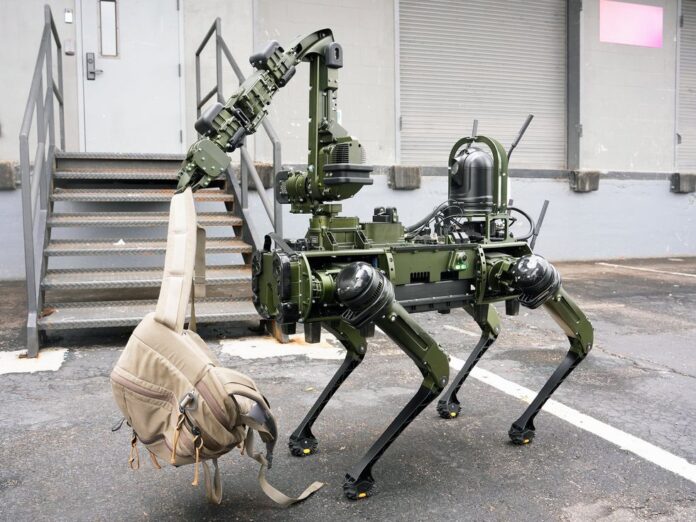
Ghost Robotics Introduces a Manipulator Arm to Its Vision 60 Quadruped
Ghost Robotics, a pioneering company that emerged from the University of Pennsylvania’s GRASP Lab-renowned for developing highly durable quadruped robots-has unveiled a significant enhancement to its Vision 60 platform: a versatile robotic arm. This addition expands the robot’s capabilities beyond mobility, enabling it to interact with its environment in more complex ways.
Military Applications and Ethical Considerations of Robotic Quadrupeds
While Ghost Robotics’ quadrupeds are widely utilized in public safety, disaster response, and inspection roles, their potential military applications have sparked considerable discussion. The U.S. military’s stringent safety standards for personnel have driven interest in robotic systems that can perform hazardous tasks remotely. However, the prospect of legged robots equipped with weapons raises ethical and operational concerns.
Despite the widespread use of robotic systems in recent conflicts, such as in Ukraine, the idea of armed quadrupeds remains controversial. Ghost Robotics’ CEO, Gavin Kenneally, emphasizes that their robots primarily serve to protect human operators by undertaking dangerous missions, rather than replacing soldiers. The company acknowledges that some military customers may equip these robots with weapons, but stresses that all deployments adhere to strict ethical guidelines and legal frameworks.
Notably, many robotics firms have pledged not to weaponize their general-purpose robots, yet accept that military-grade robots exist and must comply with established rules of engagement. Ghost Robotics aligns with this stance, ensuring that decisions regarding weaponization are governed by government policies and oversight. The U.S. Department of Defense Directive 3000.09 outlines clear responsibilities for autonomous weapon systems, mandating human judgment in the use of force and accountability measures.
Capabilities of the Vision 60’s New Manipulator Arm
The newly integrated arm on the Vision 60 offers six degrees of freedom, significantly enhancing the robot’s functional versatility. Designed as a modular sensor and manipulation platform, the arm allows the robot to navigate complex environments by moving obstacles, collecting samples, or performing other interactive tasks that were previously impossible for legged robots.
Interestingly, users have found innovative uses for the arm beyond manipulation. For example, it serves as an elevated sensor boom, providing a vantage point akin to a human’s eye level. This capability enables the robot to peer around corners or over barriers without exposing itself to danger, a critical advantage in reconnaissance and surveillance operations.
Ghost Robotics initially experimented with off-the-shelf robotic arms but found them insufficiently rugged for field conditions. Consequently, they engineered a custom arm designed to endure the same harsh environments as the Vision 60 itself. The arm is treated as a “fifth leg,” integrating seamlessly into the robot’s whole-body control system to maintain balance and stability during complex maneuvers.
Robust Design Tailored for Extreme Environments
The Vision 60 is engineered for demanding operational contexts, appealing to specialized users such as special forces. It boasts a battery life capable of three hours of continuous movement or up to 20 hours on standby. The robot is sealed against dust and sand ingress, can withstand shallow water immersion, and operates reliably in temperatures ranging from -40°C to 55°C. Its modular design allows rapid field repairs, including leg replacements within minutes, ensuring mission continuity.
Operators can remotely command the Vision 60 to perform complex tasks such as opening doors or manipulating objects at height, expanding its utility across diverse scenarios.
Global Competition and the Future of Legged Robotics
Although Ghost Robotics has quietly delivered over 1,000 quadrupeds worldwide, CEO Gavin Kenneally remains vigilant about the competitive landscape, particularly regarding China’s strategic investments in legged robotics technology. Chinese companies like Unitree have captured approximately 70% of the global quadruped market, despite recent security concerns related to data transmission vulnerabilities.
Kenneally warns that the technological advantage currently held by U.S. companies could diminish rapidly, mirroring the trajectory seen in the drone industry. The U.S. government’s recent restrictions on Chinese drone manufacturer DJI underscore the geopolitical stakes involved in robotics technology leadership.
To maintain a competitive edge, Kenneally advocates for sustained and broad-based government support for the American robotics sector rather than selective funding. He stresses that quadruped robotics has matured beyond experimental stages and is poised to become indispensable for both commercial and defense applications. Continuous innovation will be essential to staying ahead in this rapidly evolving field.