Hungary Advances in Humanoid Robotics with New Research Initiative
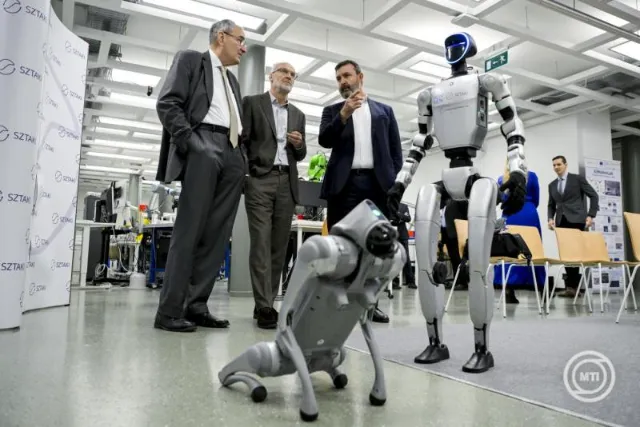
At the forefront of humanoid robotics innovation, a dedicated research team has been established at the HUN-REN Institute of Computer Science and Automation SZTAKI, leveraging Hungary’s strong background in automotive manufacturing, artificial intelligence, and autonomous systems. This development was announced by Laszlo Palkovics, the government commissioner for artificial intelligence, during a press conference in Budapest.
Hungary’s Strategic Position in the Global Robotics Market
During the event, Palkovics highlighted Hungary’s preparedness to engage actively in the rapidly expanding global robotics sector. Market analyses predict a significant surge in demand for humanoid robots, and Hungary aims to be a key contributor to this growth. The government has committed to fostering an ecosystem conducive to the research, development, and production of humanoid and quadruped robots designed for seamless human interaction. This includes establishing state-of-the-art testing facilities to ensure these robots meet real-world operational standards. Palkovics described HUN-REN SZTAKI as “Hungary’s leading and most vital research institution” in this domain.
Leveraging Automotive Expertise for Robotics Innovation
Hungary’s investment in automotive research and development, measured as a percentage of GDP, rivals that of neighboring countries like the Czech Republic and Austria. Palkovics emphasized that the country’s globally recognized automotive sector provides a solid foundation of expertise and infrastructure that can be redirected to support the government’s ambitious robotics initiatives.
Cutting-Edge Research in Robotics and Autonomous Systems
The Engineering and Business Intelligence Research Laboratory at SZTAKI has long specialized in collaborative robotics. Laszlo Monostori, director general of HUN-REN SZTAKI, explained that the creation of the new humanoid robotics group represents a natural evolution of their work. This team aims to expand the frontiers of current robotic technologies, building upon platforms such as the Unitree and Boston Dynamics quadruped robots.
Monostori also noted that HUN-REN SZTAKI oversees the National Laboratories for Autonomous Systems and Artificial Intelligence, where pioneering research in robotics, sensing technologies, and autonomous control has been conducted for years. He stressed that humanoid robotics uniquely integrates disciplines including industrial robotics, autonomous systems, and control theory.
Interdisciplinary Excellence in Humanoid Robotics
Humanoid robotics stands at the intersection of mechanical engineering, computer science, and advanced control theories. Jozsef Borkor, scientific director at SZTAKI, highlighted that the Autonomous Systems National Laboratory’s accumulated expertise enables world-class research into robot locomotion, environmental perception, and autonomous decision-making. The overarching objective is to develop robots capable of operating safely and effectively alongside humans in everyday environments.
Looking Ahead: The Future of Human-Robot Collaboration
As humanoid robots become increasingly sophisticated, their potential applications span from industrial assistance to healthcare and domestic support. Hungary’s investment in this field positions it to contribute significantly to the next generation of intelligent machines designed for collaborative work with people.
Additional Insights
- Hungary’s pioneering efforts in robotics date back to 1957, when the country developed its first learning robot, which resembled a ladybug.
- Explore emerging discussions on the societal impact of robotics, including debates on automation and human roles in the future workforce.