
Massive Layoffs at The Washington Post Shake Global News Coverage
In a sweeping and devastating move, The Washington Post recently terminated over 300 employees, accounting for nearly one-third of its workforce. This drastic reduction has led to the complete dissolution of key departments, including sports, local news, and notably, its international reporting teams. Among those affected are all correspondents and editors covering the Middle East, a region of critical geopolitical importance.
Lizzie Johnson, the paper’s Ukraine correspondent, poignantly shared on social media, “I was just laid off by The Washington Post in the middle of a war zone,” highlighting the precarious timing and impact of these cuts.
Voices from the Frontline: Fired Journalists Speak Out
On the day following the layoffs, dismissed staff gathered outside The Washington Post’s headquarters to protest the decision. Ben Brasch, a recently let-go reporter, condemned the layoffs as “shameful,” criticizing the paper’s ownership. He pointed to Jeff Bezos, the fourth-richest individual globally and owner of the publication, accusing him of prioritizing personal projects over journalistic integrity. Brasch highlighted Bezos’s controversial expenditure on a documentary about Melania Trump, suggesting it was an attempt to curry favor with the former president, rather than investing in the newsroom’s future.
Ownership and Editorial Shifts: The Bezos Era at The Washington Post
Since acquiring The Washington Post in 2013, Jeff Bezos has overseen significant changes. In 2024 alone, the paper lost more than 250,000 digital subscribers after choosing not to endorse a candidate in the presidential race between Kamala Harris and Donald Trump. Additionally, Bezos’s Amazon contributed $1 million to Trump’s inaugural fund, raising questions about the intersection of business interests and editorial independence.
Impact on International Reporting: A Critical Loss
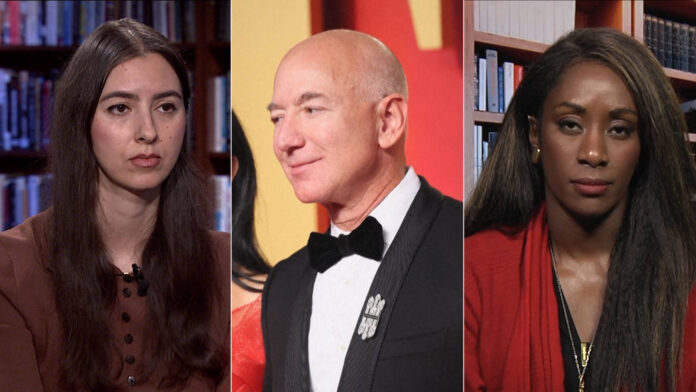
Nilo Tabrizy, an investigative journalist specializing in Iran who was among those laid off, described the layoffs as a “bloodbath” that dismantled the entire Middle East bureau and much of the international desk. She recounted how Peter Finn, head of the international desk, expressed a preference for being laid off rather than overseeing the painful restructuring. The cuts have left a void in coverage of vital global issues, including escalating tensions in the Persian Gulf, where U.S. military presence is intensifying amid fears of potential conflict.
Tabrizy emphasized the collaboration between international and national security reporters, noting that the reduction in foreign correspondents undermines the paper’s ability to provide comprehensive national security coverage. She also highlighted the vulnerability of local staff such as translators and drivers, who lack union protections and face uncertain futures.
The Broader Media Landscape: Consequences for U.S. Audiences
With many U.S. media outlets scaling back foreign bureaus, The Washington Post’s cuts represent a significant setback for American audiences seeking reliable international news. Tabrizy warned that this erosion of global reporting capacity is a disservice to readers who rely on in-depth coverage to understand complex world affairs.
Reflections from a Former Editor: Karen Attiah’s Perspective
Karen Attiah, former global opinion editor at The Washington Post, shared her dismay over the layoffs and the paper’s direction under Bezos. Joining the Post shortly after Bezos’s acquisition, Attiah recalled a period of creative freedom and a clear mandate to establish the paper as a leading global news source. She was instrumental in amplifying voices like Jamal Khashoggi, the Saudi journalist murdered in 2018, whose death exposed the dangers faced by reporters worldwide.
Attiah criticized Bezos for seemingly abandoning these values, noting his absence from the newsroom during the layoffs and his focus on personal leisure activities abroad. She lamented the loss of diversity within the newsroom, pointing out that fewer than 30 Black journalists remain on staff, and she was the last full-time Black opinion columnist. Attiah described the layoffs as a “shameless” attack on journalism’s role as a defender against oppression.
Changing Editorial Priorities and Corporate Influence
Juan González questioned the stark reversal in Bezos’s approach-from championing free press to muzzling dissenting opinions and financially supporting political figures like Donald Trump. Tabrizy echoed this sentiment, describing the current state of The Washington Post as a “complete departure” from its founding mission encapsulated in the motto “Democracy dies in darkness.”
She expressed sorrow for colleagues who must now operate within a diminished institution, noting the once collaborative newsroom culture has been shattered. The layoffs were executed with minimal transparency and respect, with employees receiving brief, impersonal notifications and being barred from returning to work immediately.
Looking Ahead: The Future of Independent Journalism
As The Washington Post undergoes this transformation, the implications for journalism and democracy are profound. The dismantling of international reporting teams and the erosion of editorial independence raise urgent questions about the media’s capacity to hold power accountable and inform the public.
Independent outlets like Democracy Now! continue to emphasize the importance of fearless journalism in an era of corporate consolidation and political influence. The voices of journalists like Nilo Tabrizy and Karen Attiah underscore the need to protect and support newsrooms committed to truth and diversity.
Upcoming Coverage: Iran Talks and Gaza Developments
Stay tuned for our forthcoming reports on the ongoing diplomatic discussions in Oman between the United States and Iran, as well as the latest updates from Gaza. These stories remain critical to understanding the shifting dynamics in global politics and conflict.