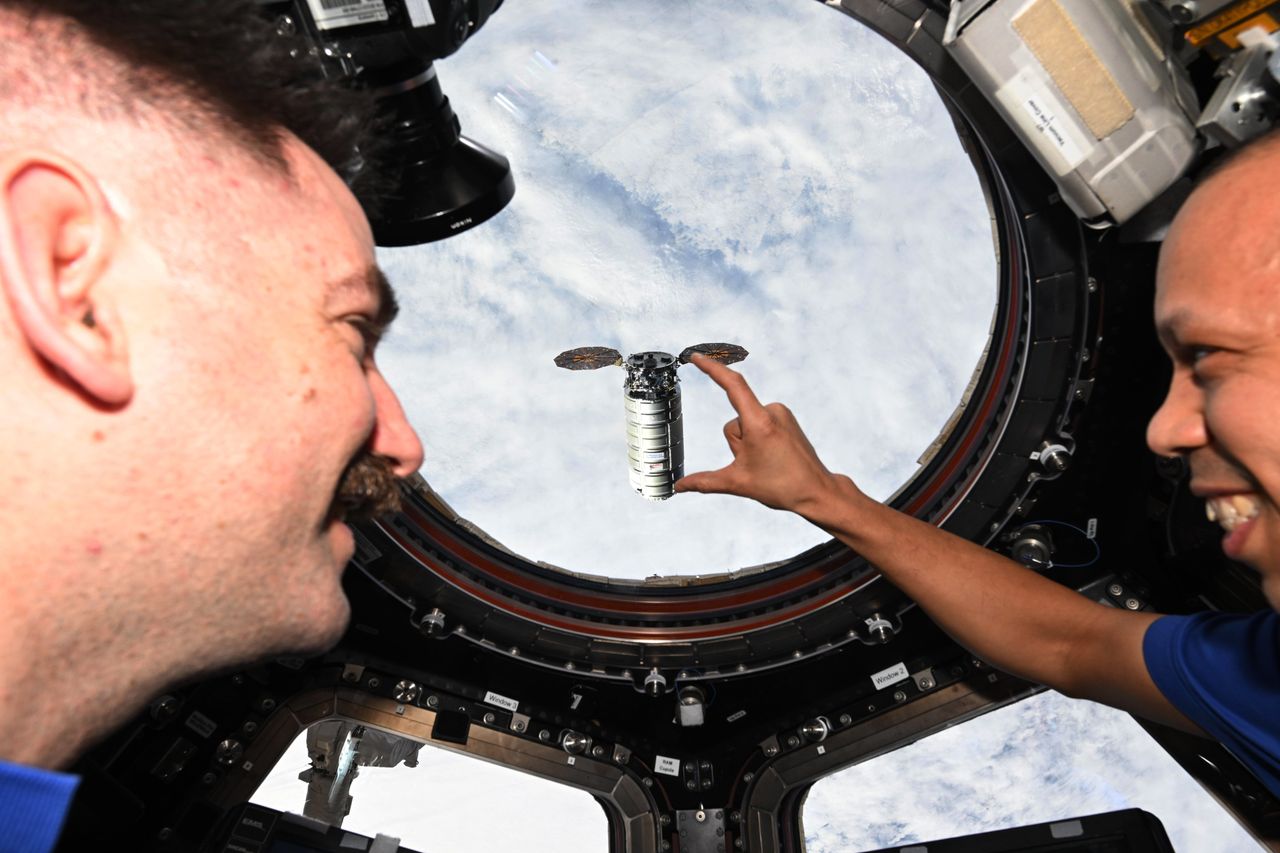


Even beyond Earth’s atmosphere, astronauts find moments to share laughter and camaraderie.
In a lighthearted moment aboard the International Space Station (ISS), astronauts Chris Williams and Jack Hathaway used a clever perspective trick to make it seem as though Williams was grasping the Cygnus XL cargo spacecraft through the station’s cupola window. Their smiles and laughter highlight the human side of space exploration.
Mission Overview: Delivering Vital Supplies to the ISS
On April 11, 2026, NASA’s Northrop Grumman Commercial Resupply Services 24 (CRS-24) mission launched successfully atop a SpaceX Falcon 9 rocket. This mission transported over 11,000 pounds (approximately 5,000 kilograms) of essential cargo, including scientific experiments and provisions, to the ISS aboard the Cygnus XL spacecraft, which is distinguished by its two circular solar arrays.
Two days later, on April 13, astronauts Williams and Hathaway skillfully operated the Canadarm2 robotic arm to capture the Cygnus vehicle. They then maneuvered it to the Earth-facing port of the station for secure attachment, enabling the transfer of supplies and research materials.
The Complexity and Triumph of Space Cargo Operations
Handling spacecraft docking in orbit is an intricate and demanding task. The successful capture and installation of the Cygnus XL by Williams and Hathaway represent a significant achievement, ensuring the continuous flow of critical resources to the orbiting laboratory.
Despite the technical challenges and the harsh environment of space, astronauts maintain a spirit of joy and teamwork. Their ability to balance precision work with moments of levity is essential for long-duration missions.
Community and Collaboration in Space
NASA astronaut Jessica Meir celebrated the accomplishment on social media, congratulating her colleagues and acknowledging the collaborative efforts of NASA, Northrop Grumman, SpaceX, and the Canadian Space Agency teams. She highlighted the upcoming hatch opening and the commencement of cargo operations, which include numerous scientific investigations and fresh food deliveries.
Looking Ahead: The Importance of Resupply Missions
Resupply missions like CRS-24 are vital for sustaining the ISS and advancing scientific research in microgravity. With over 25 years of continuous human presence in orbit, the ISS relies on these deliveries to support experiments that contribute to advancements in medicine, materials science, and Earth observation.
As commercial partnerships expand, the efficiency and frequency of cargo missions continue to improve, paving the way for future deep space exploration endeavors.