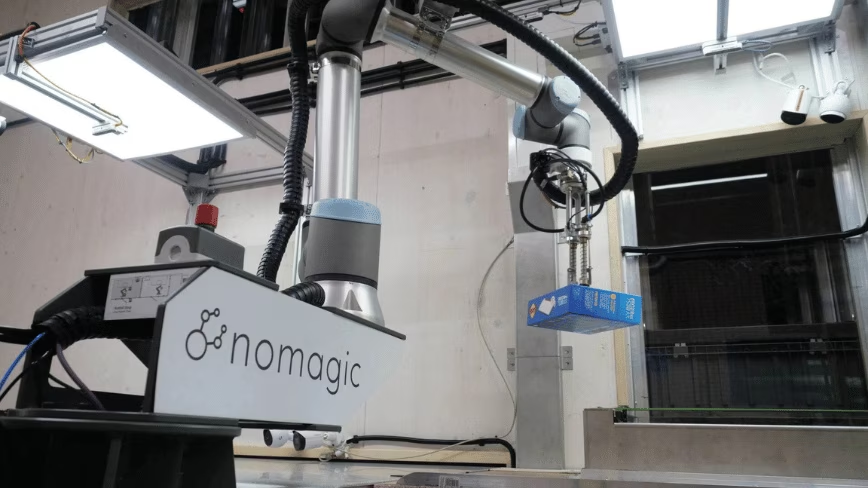
Nomagic, a robotics company headquartered in Warsaw, has successfully integrated a vision-language-action (VLA) model into operational warehouse environments. This advancement reportedly reduced the frequency of robot stoppages requiring human intervention by approximately 50%. Their newly established AI research lab, led by a former Google DeepMind expert, emphasizes achieving task-specific excellence before pursuing broader generalization.
Real-World Application of Vision-Language-Action Models
While many robotics teams continue to showcase vision-language-action models in controlled demonstrations, Nomagic has taken a significant step by deploying their VLA system in active warehouses with commercial clients. This practical implementation has led to a substantial decrease in the need for human assistance during robotic operations. The company positions itself as one of the pioneers in applying VLAs beyond experimental settings into genuine production environments.
Strategic Focus: Specialization Over Generalization
Nomagic’s approach diverges from the prevalent trend of developing a universal robotic intelligence capable of functioning across diverse machines and tasks. Instead, they prioritize perfecting a model tailored to excel at a specific function from the outset, gradually expanding towards more generalized capabilities. Markus Wulfmeier, their chief scientist and former DeepMind researcher involved with the Gemini Robotics project, explains that true mastery must be demonstrated through real-world deployments before attempting broader generalization.
This philosophy addresses the challenge posed by the “long tail” of rare and unpredictable scenarios encountered in physical environments. Similar to the hurdles faced by autonomous vehicle developers, training models solely through simulations or remote control typically achieves around 80% accuracy. However, in warehouse settings, such a success rate is insufficient, as frequent human interventions would undermine operational efficiency and cost-effectiveness.
Ensuring Reliability with a Hybrid System
Nomagic acknowledges that their VLA models have yet to reach near-perfect autonomous performance, with success rates below 99.9%. To bridge this gap, they integrate their AI with established classical software systems that monitor for errors and enforce safety protocols. This hybrid “harness” ensures that the overall system meets the stringent reliability standards required for deployment in commercial warehouses.
Co-founder and CEO Kacper Nowicki highlights the importance of this approach: “In physical environments, a 99.9% success rate isn’t just a marketing claim-it’s the minimum threshold for operational approval. Our harness guarantees this from day one, while the AI continues to improve.”
Leveraging Extensive Real-World Data
A key advantage for Nomagic lies in the volume and quality of data generated by their active robot fleet. Their systems process millions of successful item picks monthly, with over two million originating from the fashion e-commerce giant Zalando alone. This continuous stream of real-world data enables the company to train and refine their VLA models more effectively than relying on simulated environments.
Impact on Warehouse Automation and Industry Implications
The initial commercial deployment of Nomagic’s VLA technology is at Brack.Alltron, Switzerland’s second-largest e-commerce platform. Founder Roland Brack attests to the transformative effect: “We now operate robots that genuinely comprehend their surroundings, allowing us to run fully autonomous shifts overnight and on weekends.”
Although VLAs have yet to achieve flawless independent operation, Nomagic’s pragmatic deployment-first strategy contrasts sharply with labs focused on developing general-purpose humanoid robots. This approach underscores the growing momentum in automating European warehouses, a critical sector in the continent’s robotics landscape. As co-founder Tristan d’Orgeval states, “Our process starts with solving a real problem, not building a lab and then searching for applications. This sequence distinguishes a viable business from a mere demonstration.”