(Image credit: NASA)
Advancing Human Space Exploration: Leveraging Current Missions for Lunar and Martian Frontiers
As ambitions to establish a sustained human presence on the Moon and Mars intensify, researchers are capitalizing on data and tools from ongoing space missions to tackle the practical challenges of off-world living and exploration.
Transforming Earth-Based Tools for Interplanetary Use
Scientists are repurposing instruments and datasets originally designed for Earth observation to support future crewed missions beyond our planet. Gina DiBraccio, heliophysicist and acting director of NASA’s Solar System Exploration Division at Goddard Space Flight Center, highlighted a space weather decision-support system initially created to monitor near-Earth conditions. This platform now integrates data from Mars orbiters and rovers, including NASA’s MAVEN, Curiosity, and Perseverance, enabling astronauts on Mars to evaluate radiation exposure risks in near real-time.
This comprehensive dashboard, accessible via tablet, consolidates multiple data streams to alert crews about solar flares and other space weather phenomena, guiding timely protective actions. DiBraccio emphasized, “This represents one of the pioneering tools that will empower astronauts to interpret and respond to space weather directly from the Martian surface.”
Decoding Martian Space Weather Over a Solar Cycle
Long-duration missions at Mars continue to enrich our understanding of radiation hazards. Shannon Curry, principal investigator for MAVEN at the University of Colorado Boulder, unveiled a newly compiled catalog documenting Martian space weather events over a full solar cycle from 2014 to 2025. This extensive dataset quantifies radiation levels in Mars’ orbit, some of which penetrate the planet’s thin atmosphere to reach the surface, providing critical insights into the timing and intensity of radiation exposure astronauts might face.
“This catalog offers a comprehensive forecast of radiation conditions across varying solar activity phases,” Curry explained, underscoring its value for mission planning and crew safety.
Pinpointing Lunar Water: A Key to Sustainable Moon Missions
Identifying precise locations of water ice on the Moon, especially near the south pole where NASA’s Artemis program aims to land astronauts, remains a significant challenge. Bethany Ehlmann, director of the Laboratory for Atmospheric and Space Physics at the University of Colorado Boulder, noted discrepancies among existing datasets regarding water distribution.
“While we know water exists broadly in the lunar south pole region, the exact sites remain uncertain-akin to saying there’s water somewhere in a large city without knowing the specific neighborhoods,” Ehlmann remarked.
To resolve this, NASA recently selected a cutting-edge imaging spectrometer designed for lunar orbit. This instrument will serve as “enhanced eyes” for explorers, mapping water and mineral deposits with high precision and identifying scientifically valuable sampling sites. Such technology promises to refine resource maps critical for future crewed missions.
Confronting the Persistent Problem of Lunar Dust
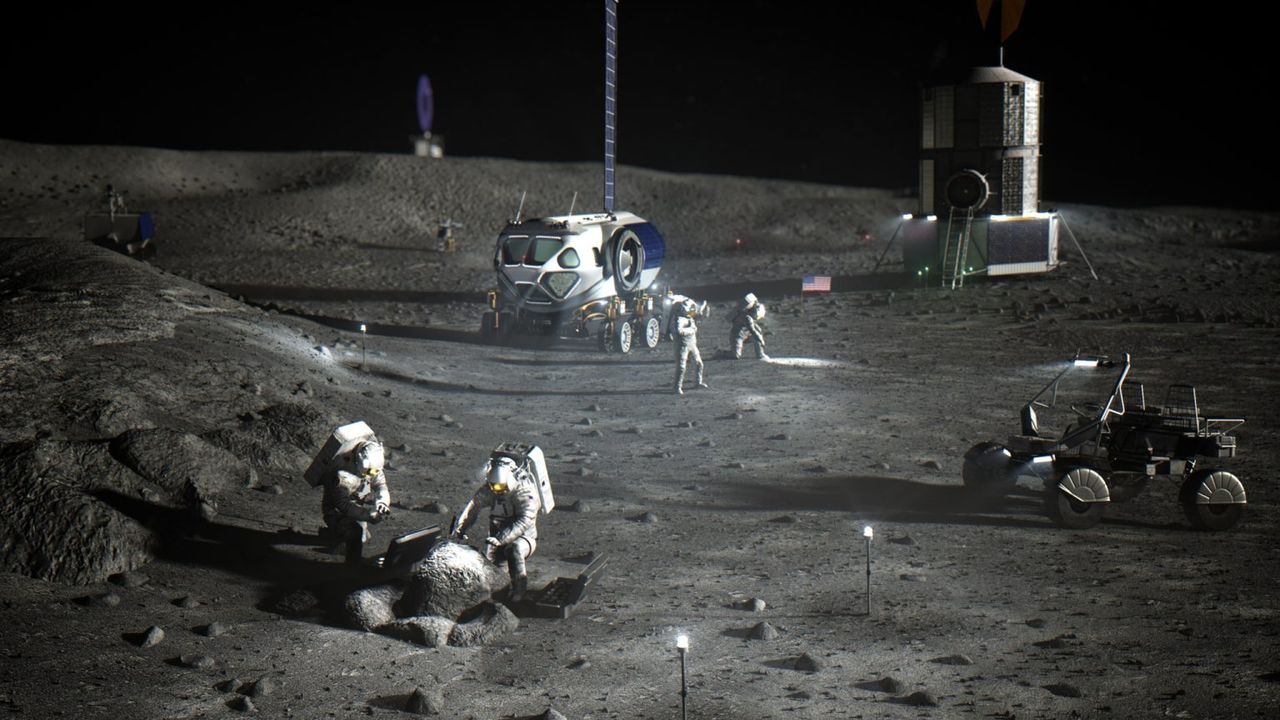
Lunar dust, notorious for its abrasive and pervasive nature, continues to pose operational challenges reminiscent of those encountered during the Apollo missions. Apollo 17 commander Gene Cernan once described dust as “one of the greatest obstacles to normal lunar operations,” highlighting its potential to degrade equipment and impact astronaut health.
To address this, NASA’s Artemis IV mission will deploy the Dust and Plasma Environment Surveyor (DUSTER), a $24.8 million initiative led by Xu Wang of the University of Colorado Boulder. Mounted on a rover, DUSTER will monitor dust and plasma dynamics near the lunar surface, particularly how these factors respond to human activity.
Complementing this effort, the Compact Electrostatic Dust Analyzer (CEDA) is being developed to characterize lunar dust properties. Designed to endure harsh landings and operate on the surface or in orbit, CEDA will provide vital data to inform dust mitigation strategies.
“Dust is omnipresent on the Moon; it’s unavoidable and must be managed effectively for successful exploration,” Wang emphasized.
Exploring Mars’ Magnetic Shields for Radiation Protection
Researchers are investigating whether localized magnetic fields on Mars could offer natural radiation shielding. Preliminary models based on orbital data suggest that crustal magnetic anomalies embedded in Martian rocks might protect areas spanning several miles.
To map these protective zones with greater detail, teams are miniaturizing magnetometers for deployment on aerial platforms such as drones, akin to NASA’s Ingenuity helicopter. These airborne surveys will achieve higher resolution measurements than orbital instruments, enhancing our understanding of Mars’ radiation environment.
Synergizing Robotic and Human Exploration for a Sustainable Future
Collectively, these advancements underscore the indispensable role of robotic missions in paving the way for human explorers. As Bethany Ehlmann succinctly put it, “The future of space exploration is not a choice between robots or humans-it’s about integrating both to maximize success.”