
Sharpa: The Enigmatic Robotics Startup Captivating the Embodied Intelligence Industry
A Glimpse into Sharpa’s Breakthrough Demonstrations
Among insiders in the embodied intelligence community, Singapore-based Sharpa has emerged as one of the most intriguing and talked-about startups of 2025. At the International Conference on Robotics and Automation (ICRA) in May 2024, Sharpa’s demonstration attracted significant attention. Their human-sized robotic hand showcased remarkable dexterity-peeling eggs, cutting with scissors, and performing intricate tasks with lifelike finesse. Each fingertip was embedded with approximately 1,000 tactile sensors, enabling an unprecedented level of sensitivity and control.
The Veil of Secrecy Surrounding Sharpa
Despite the buzz, Sharpa has maintained a notably low profile. Investors recount difficulties in establishing contact; one remarked, “I reached out months ago but was met with silence. To this day, the leadership remains unclear.” Another echoed this sentiment, noting that attempts to engage through Hesai Technology’s investment channels were unsuccessful. This aura of mystery extends to robotics entrepreneurs as well, many of whom have expressed eagerness to acquire Sharpa’s flagship product, the SharpaWave dexterous hand, priced near USD 50,000. However, the device has been largely unavailable, with potential buyers often invited to test it only at Sharpa’s Shanghai facility.
Sharpa’s Public Debut and Technological Showcase
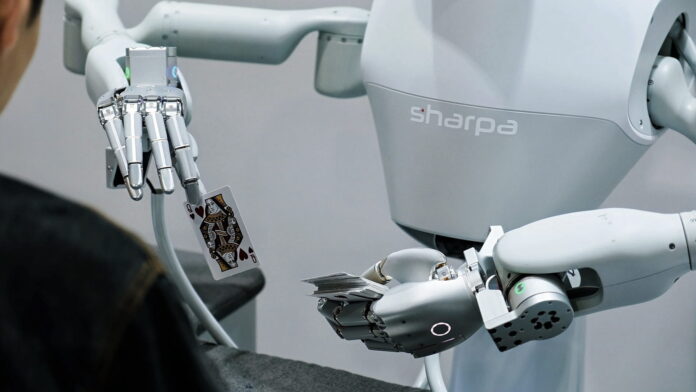
Sharpa officially unveiled itself to the public at CES 2026, less than two years after its inception. The company introduced Sharpa North, a humanoid robot equipped with its proprietary dexterous hands and an advanced self-learning control system. The robot demonstrated impressive capabilities on stage, including playing table tennis, folding paper pinwheels, and capturing photographs with precision using an integrated camera system.
Founders and Corporate Roots: The Hesai Connection
Speculation about Sharpa’s founders was confirmed recently: the company was established by David Li, Xiang Shaoqing, and Sun Kai, who serve as CEO, CTO, and chief scientist of Hesai Technology, respectively. Hesai is renowned as the world’s leading automotive LiDAR supplier, a technology critical for spatial awareness in autonomous vehicles and robotics. The company’s name is inspired by “San Jose,” reflecting the founders’ Silicon Valley roots where they began their entrepreneurial journeys.
Hesai’s Expanding Influence in Robotics and Autonomous Driving
Hesai’s LiDAR sensors have been integrated into various robotics platforms, including those from Unitree Robotics and Vbot, as well as Xiaomi’s inaugural automobile. The company’s 2020 IPO prospectus highlighted its growing footprint in robotics applications such as unmanned delivery and automated cleaning. Following its Hong Kong stock exchange debut in September 2025, Hesai experienced initial share price volatility but rebounded strongly after reporting a 1,300% year-over-year increase in LiDAR shipments for robotics, surpassing 60,000 units. CFO Andrew Fan attributed this surge to escalating demand from both assisted driving and robotics sectors.
“Over the next decade, we aim to pioneer a new era of perception and interaction between vehicles and robots,” stated David Li, outlining Hesai’s long-term vision.
From Component Supplier to Robotics Innovator
The establishment of Sharpa signals a strategic pivot by Li and his co-founders from being mere component suppliers to creators of integrated robotic systems. Their academic credentials are impressive: Li holds a PhD in motion control from the University of Illinois at Urbana-Champaign and studied robotics at Tsinghua University; Sun earned a PhD in mechanical engineering from Stanford University; and Xiang, also a Tsinghua alumnus, completed dual master’s degrees in electrical and mechanical engineering at Stanford and previously worked on iPhone systems integration.
This blend of deep research expertise and industrial experience has enabled the trio to bridge the gap between theoretical robotics and practical deployment effectively.
Industry Trends: Autonomous Driving Expertise Fuels Embodied Intelligence Startups
The crossover from autonomous driving to embodied intelligence is becoming increasingly common. For example, Tars, a startup founded by former Huawei scientist Chen Yilun, recently secured RMB 1.7 billion (approximately USD 238 million) in angel funding. A financial advisor specializing in this sector noted, “Spatial perception is the shared foundation between automotive LiDAR and embodied intelligence, which explains the strong investor interest in companies like Sharpa with ties to Hesai.”
Strategic Location and Corporate Structure
Sharpa’s headquarters in Singapore, coupled with an operational office in Shanghai, positions the company to leverage global partnerships while maintaining proximity to China’s robust manufacturing and supply chain networks. This dual presence supports both international collaboration and efficient production.
Geopolitical Challenges and Corporate Strategy
Sharpa’s incorporation in Singapore and its discreet operational approach may be influenced by geopolitical factors affecting Hesai. In early 2024, the U.S. Department of Defense designated Hesai as a “Chinese military company,” leading to a significant selloff in its shares. Although Hesai contested this classification in U.S. courts, the ruling against the company in mid-2025 left the issue unresolved, complicating its international expansion efforts. Prior to this, Hesai had emphasized its global footprint, with the U.S. market representing a substantial portion of its business, a narrative that resonated with overseas investors.