IEEE Spectrum ( ]robotics]has a weekly selection of amazing robotics videos. We also publish a weekly calendar with upcoming robotics events. Please submit your events to be included.
Enjoy today’s videos with IROS 2025 ()! 19-25 October 2025 in HANGZHOU.
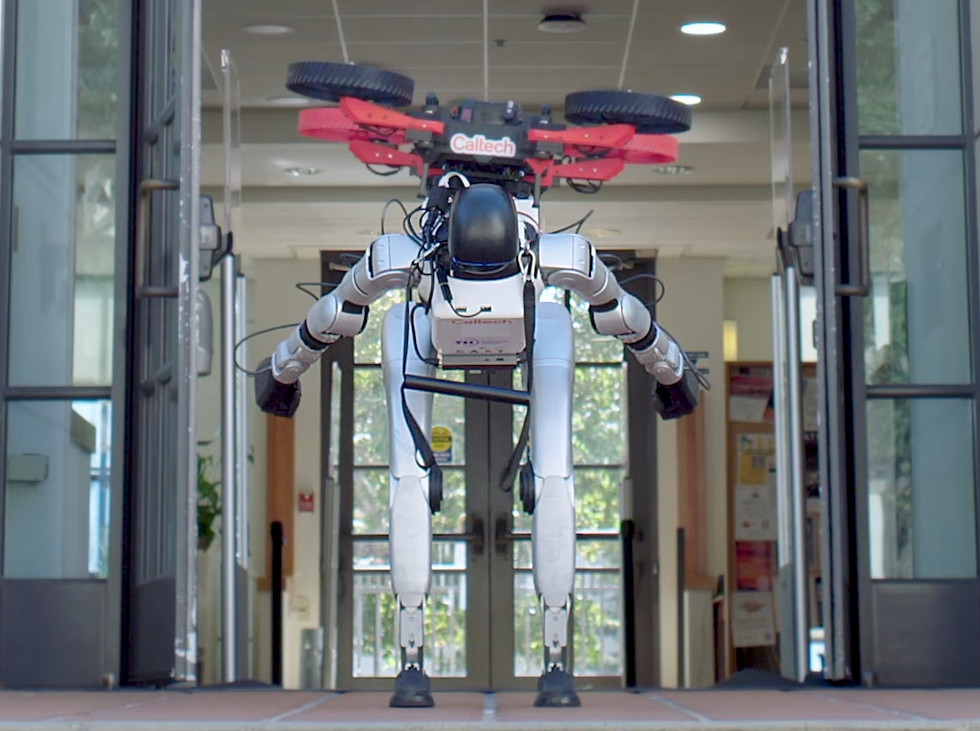
Caltech’s Center for Autonomous Systems and Technologies and the Technology Innovation Institute of Abu Dhabi, UAE recently conducted a demo of X1, a multiple robot system developed in a three-year collaborative effort between the two institutions. During the demonstration, M4, a CAST multimodal robot, launched in drone mode off the back of a humanoid. It can land, convert to driving mode, and then return again as needed. The demonstration showed what can be achieved when engineers from different institutions working on autonomous systems and technologies work together.
Caltech’s Center for Autonomous Systems and Technologies and the Technology Innovation Institute of Abu Dhabi, UAE recently conducted a demo of X1, a multiple robot system developed in a three-year collaborative effort between the two institutions. During the demonstration, M4, a CAST multimodal robot, launched in drone mode off the back of a humanoid. It can land, convert to driving mode, and then return again as needed. The demonstration showed what can be achieved when engineers from different institutions working on autonomous systems and technologies work together.
[
Caltech Center for Autonomous Systems and Technologies ( )
Spot performs a dynamic whole-body manipulating using a combination reinforcement learning and sampling based control. The behavior shown in the video was fully autonomous. This included the dynamic selection and placement of contacts on the arms, legs, and bodies, as well as coordination between the locomotion and manipulation processes. The tire is 15 kilograms (33 lbs), which makes its mass and inertial power significant when compared to the robot’s weight. A motion-capture system external was used to simplify perception and a computer external linked via Wi-Fi performed intensive computation operations.
[
Robotics and AI Institute ( )
The Figure 03 represents a breakthrough in transforming humanoid robotic prototypes into deployable and scalable products. Figure, by combining advanced perception and tactile Intelligence with home-safe design, mass-manufacturing ready, has created a platform that is capable of learning, adapting and working in both domestic and commercial environments. Figure 03, designed for Helix, home and the world, lays the foundation for a true general-purpose robot that can transform the way people live and work.
I am very, very nervous about the kid and dog in these clips.
[
Figure
Researchers have developed a new superagile robotic system that can change shape with ease thanks to its amorphous properties, similar to the Marvel antihero Venom. Researchers used a material called electromorphing gel (eMG) that allows robots to demonstrate shape-shifting abilities. They can bend, stretch and move in ways previously impossible or difficult, by manipulating electric fields from ultralightweight sensors.
This is a very preliminary idea, but I like the idea of quadrupedal robotics working together to overcome obstacles.
[
Robot Perception and Learning Lab ( )
Have we reached the peak of dynamic humanoids yet?
[
Unitree
Dynamic manipulating, such as robots throwing or tossing objects, has recently gained a lot of attention as a new paradigm to speed up logistics operations. The focus has been primarily on the landing location of the object, regardless of its final orientation. In this work, a robot can “throw-flip”, or accurately “land” objects in a desired position and orientation.
[
LASA
I’m not that interested in “industry-oriented quadrupeds”. I am very interested in “ridable” quadruples.
[
MagicLab
I’m not at the point yet where I trust any humanoid with priceless ancient relics. Any humanoid is acceptable, not only the robotic ones.
[
LimX
Matt Mason, professor emeritus of CMU, presents this Carnegie Mellon University RI Seminar entitled “A Manipulation journey”.
This talk will review my career in manipulation, focusing on some projects that could offer some useful lessons to others. We will begin with my early days at the MIT AI Lab, my MS thesis which is still one of my most cited works, then move on to my arrival at CMU and a discussion with Allen Newell. Then we will discuss an exercise to imagine a coherent research programme, and how this led to a third and second childhood. The talk will end with a discussion of the lessons learned.
[
Carnegie Mellon University Robotics Institute ( )
Christian Hubicki explains and highlights the news and research in humanoid robots from the past year.
ICRA@40 has more excellent robotics discussion.
[ICRA@40 ]